- Chinese coal stocks rally on energy substitution expectations amid Middle East tensions
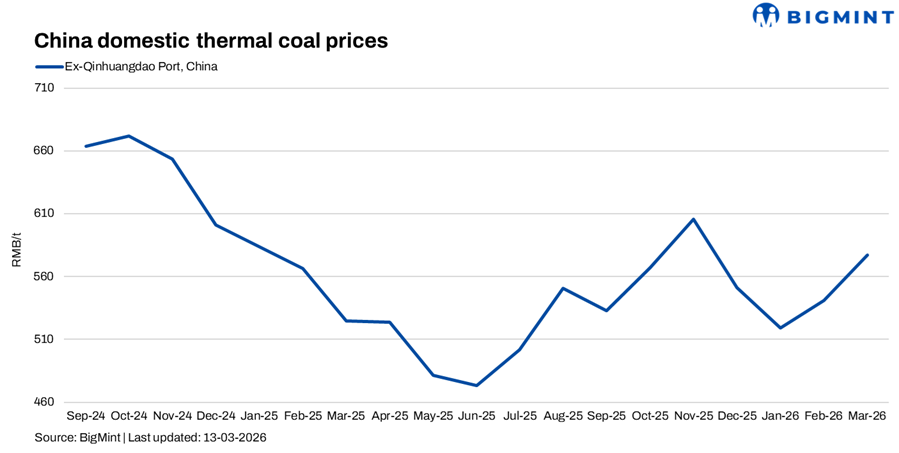
- Domestic thermal coal prices fall as weak demand outweighs global energy rally
Mysteel Global: China’s market for thermal coal and that for the shares of companies mining the coal showed a clear divergence on March 12.
While coal-related equities rallied sharply on expectations that coal could increasingly substitute oil and gas amid the escalating Middle East tensions, the spot market for thermal coal remained largely sluggish, Mysteel Global observes.
Coal stocks strengthened substantially in both the A-share market in Shanghai and on the Hong Kong bourse on Thursday. At the midday close of the A-share market on the Shanghai Stock Exchange, Zhengzhou Coal Industry & Electric Power and Yanzhou Coal Mining Company had hit their daily limit-up, while China Coal Energy had also touched its daily limit during the session, reaching its highest price since February 2008.
Meanwhile, the share prices of Lu’an Environmental Energy and Jinneng Holding Shanxi Coal Industry both rose by more than 6%, Mysteel Global noted.
Hong Kong-listed coal stocks also surged in tandem, with Yanzhou Coal Mining Company and Yancoal Australia both reaching record highs.
Analysts attributed the rallies to the latest developments in the Middle East. On Wednesday, two oil tankers were hit and caught fire in Iraqi waters, intensifying concerns over crude oil supply disruptions, even after the International Energy Agency agreed to release a record 400 million barrels of oil from global reserves.
Brent crude, the global oil benchmark, hovered around $100 per barrel late Wednesday, up 8.7% on the day.
At the same time, the benchmark Dutch TTF natural gas price rose to about €49.99/MWh on March 11, up 5.5% on day.
Typically, surging oil and gas prices affect the coal market through two main channels. First, higher gas prices prompt some countries and regions to switch to coal-fired power generation. Second, chemical producers may turn to the coal-to-chemicals production route due to its economic advantages.
Some institutions estimate that annual coal consumption globally could increase by more than 80 million tonnes this year if the Strait of Hormuz remains blocked for a prolonged period.
However, China’s domestic market for coal continued its downward trend on March 12, with prices falling even faster than in previous days. At northern transfer ports, the benchmark 5,500 kcal/kg NAR coal was offered Yuan 5/t lower at Yuan 735-745/t, Mysteel learned from traders on Thursday morning.
According to Mysteel’s assessment, the decline began on March 3, when the benchmark was priced at Yuan 751/t. As of March 11, it had already dropped to Yuan 741/t.
“The domestic market for thermal coal has not followed the rally in global energy commodities,” said an analyst based in Shanghai. “Instead, weak fundamentals are dictating its direction.”
Coal inventories continued to rise at northern ports, reflecting a combination of strong supply and weak demand. As of Wednesday, coal stocks at the eight northern ports tracked by Mysteel had risen by 1.3% on day and 4% on week to 24.78 million tonnes, with inflows of 1.35 million tonnes exceeding outflows of 1.03 million tonnes.
Analysts noted that geopolitical tensions often push global energy prices higher, while China’s domestic thermal coal market remains primarily driven by supply-demand fundamentals.
“In other words, the coal market is not currently concerned about potential energy supply shortages linked to the Middle East conflict.”
China’s key coal producers are expected to maintain or slightly increase production in 2026, as previously reported by Mysteel Global.
Note: This article has been written in accordance with a content exchange agreement between Mysteel Global and BigMint.
Leave a Reply