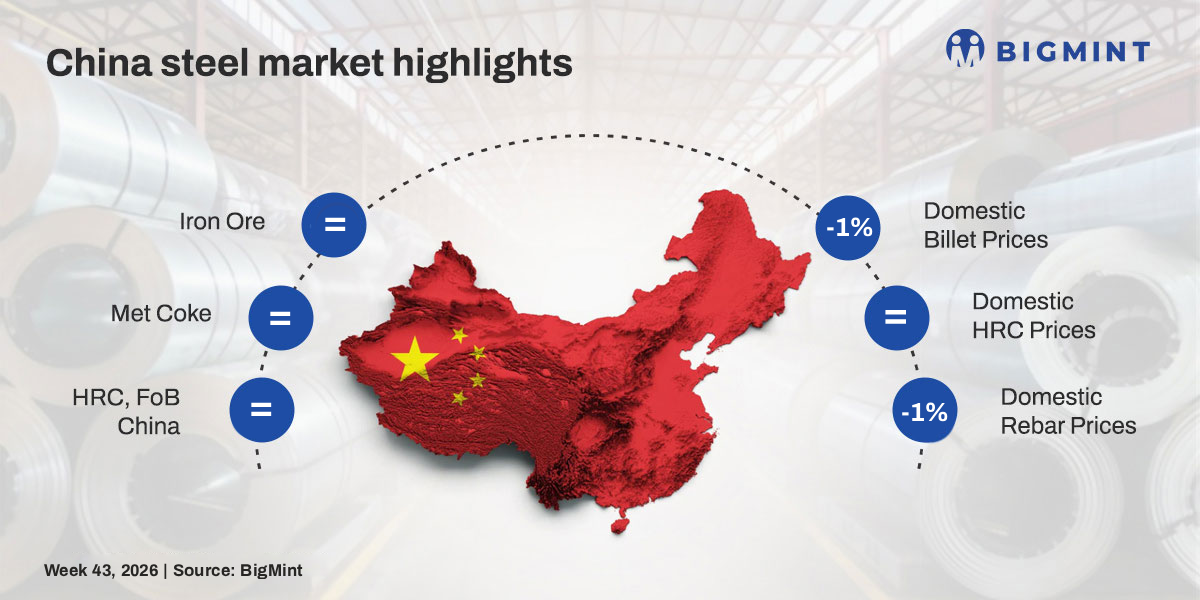
- Rebar and billet prices fall as construction demand weakens
- Coke price hikes face resistance amid weak mill profitability
China’s domestic steel market remained under pressure during the week, as subdued end-user demand and cautious buying limited price support. HRC prices edged down marginally, while rebar and billet prices declined w-o-w amid weak consumption and limited export support. Raw material prices showed mixed trends, with iron ore prices remaining stable, pellet premiums unchanged and lump premiums easing. Meanwhile, recovering coking coal supply and weak steel mill profitability continued to weigh on the coke market.
Domestic steel prices show mixed trends
HRC prices edge down w-o-w: China’s Domestic HRC prices remained largely stable w-o-w, with a marginal decrease of RMB 3/t ($1/t) to RMB 3,175/t ($475/t) as of 23 October from RMB 3,178/t ($472/t) in the previous week. However, SHFE HRC futures for the November 2026 contract declined by RMB 44/t ($7/t) w-o-w to RMB 3,201/t ($479/t) from RMB 3,245/t ($486/t) previously.
Although HRC prices initially rose during the week, weak downstream buying led to renewed declines. Some traders with low inventories attempted to raise prices mid-week, but limited purchasing interest prevented these increases from being sustained. SHFE HRC futures also retreated after an initial recovery. On the supply side, production rose w-o-w, while inventories declined, indicating some ongoing demand. However, the weak macroeconomic environment and continued supply-demand imbalance limited the scope for a sustained price recovery.
Additionally, Chinese HRC export offers remained stable w-o-w at around $505/t FOB Rizhao, following the previous week’s decline. Weak domestic price trends and subdued buying interest continued to weigh on market sentiment, while limited downstream demand constrained the scope for price increases.
Rebar prices decline w-o-w: China’s domestic rebar prices were marginally down by RMB 18/t ($3/t) w-o-w to around RMB 3,140/t ($470/t) on 23 October from RMB 3,158/t ($473/t) in the previous week. Meanwhile, SHFE rebar futures for the November 2026 contract declined by RMB 34/t ($5/t) w-o-w to RMB 3,042/t ($456/t), from RMB 3,076/t ($461/t) in the previous week.
Rebar prices declined amid weak construction demand, with most end-users purchasing only for immediate requirements rather than restocking. Although construction steel inventories continued to fall this week, subdued transactions limited the price support from destocking. On the supply side, previously maintained blast furnaces gradually resumed operations, while few new maintenance shutdowns were reported, keeping supply relatively high. Meanwhile, lower coking coal and coke prices eased production cost pressures, reducing the incentive for mills to cut output and adding to downward pressure on rebar prices.
Shagang Steel, one of China’s largest steel producers, has kept its long steel list prices stable for late-October 2026 sales (21-30 October), continuing to maintain the levels set earlier this month (1-10 October). The mill has kept rebar (16-25 mm) prices at RMB 3,450/t ($515/t), coiled rebar (8-10 mm) at RMB 3,580/t ($535/t), and wire rod (6-10 mm) at RMB 3,490/t ($521/t).
The decision comes amid subdued construction steel demand and limited improvement in domestic trading activity. Although some restocking has supported transactions, end-user consumption remains too weak to sustain price recovery. Lower raw material costs have eased input cost pressures, but the benefit to mill profitability remains limited.

Raw materials prices
Iron ore prices remain stable w-o-w: Iron ore fines benchmark prices (Fe 61%) remained steady w-o-w at $91/dmt CFR China on 23 October 2026, as market participants adopted a wait-and-watch approach amid concerns over weak steel margins and elevated port inventories. Buyers remained cautious, with fresh procurement decisions dependent on steel demand, mill profitability and restocking requirements.
Market participants are closely monitoring Chinese steelmakers’ buying activity, seaborne supply and port arrivals for clearer demand signals. Ample inventories and weak steel margins could limit fresh purchases and weigh on prices, while improved steel demand, better mill profitability or tighter supply may provide support.
a) Spot pellet premium remains steady: Spot pellet premium for Fe 65% grade pellet remain stable w-o-w to $26.25/t CFR China on 21 October.
b) Spot lump premium falls w-o-w: Spot lump premium fell by $0.013/t w-o-w to $0.2270/t CFR China on 23 October.
Coking coal market steady even as China’s supply recovers: China’s coking coal market remained broadly stable as mine production gradually recovered with the resumption of operations, although ongoing safety inspections continued to constrain supply growth. In the coke market, producers initiated the first round of price hikes of RMB 50-55/t ($7-8/t), but weak steel mill profitability and limited purchasing requirements restricted buying interest. The resulting standoff between coke producers seeking higher prices and steel mills resisting increases is likely to keep coke prices broadly stable with a weak undertone, while Chinese market developments continue to influence regional seaborne trade.
Meanwhile, Australian premium hard coking coal (PHCC) prices remained stable w-o-w at $268/t FOB, supported by relatively steady market conditions. In contrast, BigMint’s PHCC index eased $1/t w-o-w to $292/t CNF Paradip, India, as softer met coke and steel prices weighed on sentiment. However, improving procurement enquiries from Indian mills provided some support, limiting expectations of a sharp near-term correction.
Billet prices decline w-o-w on weak demand, lower export offers: Chinese billet prices fell by RMB 20/t ($4/t) w-o-w to RMB 2,920/t ($438/t) on 23 October from RMB 2,940/t ($440/t) on 16 October. SHFE rebar futures declined amid weak domestic demand, while billet export offers fell by $4/t to $462/t FOB China.
Domestic demand remained sluggish, with the Golden October peak season failing to deliver a meaningful recovery. Rebar consumption remained under pressure from weak real estate activity, reflected in a 12% y-o-y decline in volume. Although steel inventories declined by around 320,000 t, falling commodity prices and limited market momentum continued to weigh on sentiment. Declining steel output and additional mill maintenance in October and early November provided some support.
Raw material trends remained mixed, with iron ore prices falling sharply and coking coal struggling to support costs. Coke producers may attempt a price increase, although mills remain resistant. Overall, weak domestic consumption and lower export offers pressured billet prices, while declining inventories, reduced steel output and limited export availability offered some downside protection.
Outlook
With downstream demand expected to remain subdued, China’s steel market is likely to face continued price pressure in the coming week. HRC prices may remain weak and volatile, while rebar and billet prices could decline further if end-user consumption and buying interest fail to improve. Although production cuts and maintenance may ease supply pressure, their impact on prices will depend on the pace of demand recovery.
In the raw materials segment, cautious steel-mill procurement and weak profitability may limit price support for iron ore and coke, while recovering coking coal supply could keep availability relatively ample. A sustained recovery in steel prices will depend on stronger downstream demand and improved mill margins.
Leave a Reply