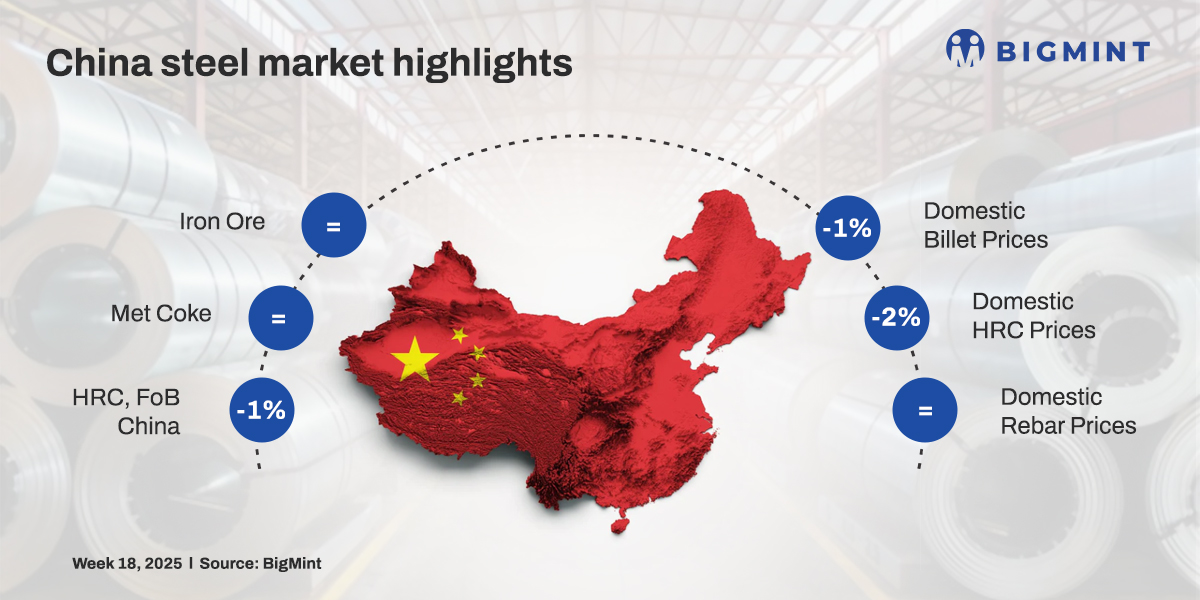
China’s steel market displayed a downtrend this week. Notably, domestic prices of hot-rolled coils (HRC) and rebar decreased w-o-w, with billets also witnessing a weekly drop. However, in the raw materials segment, spot iron ore prices stayed firm but coking coal went up over the week.
The China Iron and Steel Association (CISA) has announced that the total steel inventory at key Chinese enterprises stood at 15.29 million tonnes (mnt) in late-April 2025. Inventory levels decreased by 1.42 mnt or 8.5% from 16.71 mnt in mid-April.
China’s steel exports for April increased by 13.4% y-o-y to 10.462 million tonnes (mnt) compared to 9.22 mnt in April 2024, as per General Administration of Customs.
1. Iron ore spot prices largely stable :The benchmark price for iron ore fines (Fe 62%) was stable w-o-w at $98/t CFR China on 9 May compared to 5 May. The slight uptick was driven by recovering market momentum following the Labour Day holidays. Strong mill outputs, healthy margins, and firm portside demand supported the market, while medium-grade fines saw solid buying interest despite sustainability concerns.
a) Spot pellet premium stable w-o-w: The spot pellet premium for Fe 65% grade pellets held stable w-o-w at $12.60/t on 9 May.
b) Spot lump premium edges up: The spot lump premium increased by 0.004/t to $0.1575/dmtu on 9 May against 5 May.
2. Coking coal prices up w-o-w: Australian premium hard coking coal (PHCC) prices continued to increase this week. Prices stood at $192/t FOB Australia, up by $2/t w-o-w. This rise could be attributed to tightening supply conditions and stable demand, which helped support met coke prices despite broader market challenges. China’s coke prices remained stable, while mills limited purchases as inventories rose.
3. Chinese billet prices drop RMB 30/t ($4/t) w-o-w amid weak demand
Steel billet prices in Tangshan, China, declined by RMB 30/t ($4/t) w-o-w to RMB 2,910/t ($402/t), including 13% VAT, on 9 May compared to 30 April. The market saw a brief rebound after the Labour Day holidays but failed to sustain momentum as daily volumes fell below 100,000 mt. Despite the holiday break, demand remained sluggish, with high steel output contributing to rising inventories. Market sentiment weakened further following a new policy round, while SHFE rebar futures also dropped by RMB 74/t ($10/t) to RMB 3,022/t ($418/t).
4. Domestic HRC prices drop w-o-w: Chinese HRC offers dropped by RMB 50/t ($7/t) to RMB 3,160/t ($437/t) from RMB 3,210/t ($444/t) a week ago, following the downtrend in SHFE futures. SHFE HRC futures decreased by RMB 30/t ($5/t) to RMB 3,172/t ($438/t) on 9 May against RMB 3,202/t ($444/t) on 30 April. This decline was due to persisting bearish sentiment in China’s domestic steel market that led to cautious buying behaviour across regions. Moreover, China’s HRC export offers dropped by RMB 5/t ($1/t)w-o-w to RMB 450/t ($62/t) against RMB 455/t ($63/t) a week ago.
Baosteel has rolled over HRC prices for June sales, marking the third consecutive month of stability, according to BigMint’s sources. Additionally, hot-dip galvanised prices also remained unchanged. This stability was due to holidays and mixed trends in SHFE HRC futures.
5. Domestic rebar prices fall w-o-w: China’s rebar offers fell by RMB 10/t ($/t) w-o-w to RMB 3,250/t ($/t) from RMB 3,260/t ($/t) last week, mirroring the drop in SHFE rebar futures. Additionally, SHFE rebar futures (October 2025 contract) stood at RMB 3,036/t ($/t) on 9 May, down by RMB 60 /t ($3/t) from 3,096/t ($/t) as of 30 April. This decline is attributed to weak market sentiments post holidays.
China’s Shagang Steel has rolled over long steel product prices for early-May sales. Revised prices of rebars, coiled rebars, and wire rods are as follows:
- Rebars (16-25 mm):RMB 3,300/t ($453/t)
- Coiled rebars (8-10 mm):RMB 3,410/t ($468/t)
- Wire rods (6-10 mm):RMB 3,320/t ($455/t)

Outlook
In the near term, steel prices may remain relatively steady with minor changes. Moreover, geopolitical and trade-related developments and adjustments in China’s crude steel production could influence near-term trends.
Leave a Reply