- HRC prices steady; rebar rises on improved sentiment
- Post-holiday trends depend on inventory changes
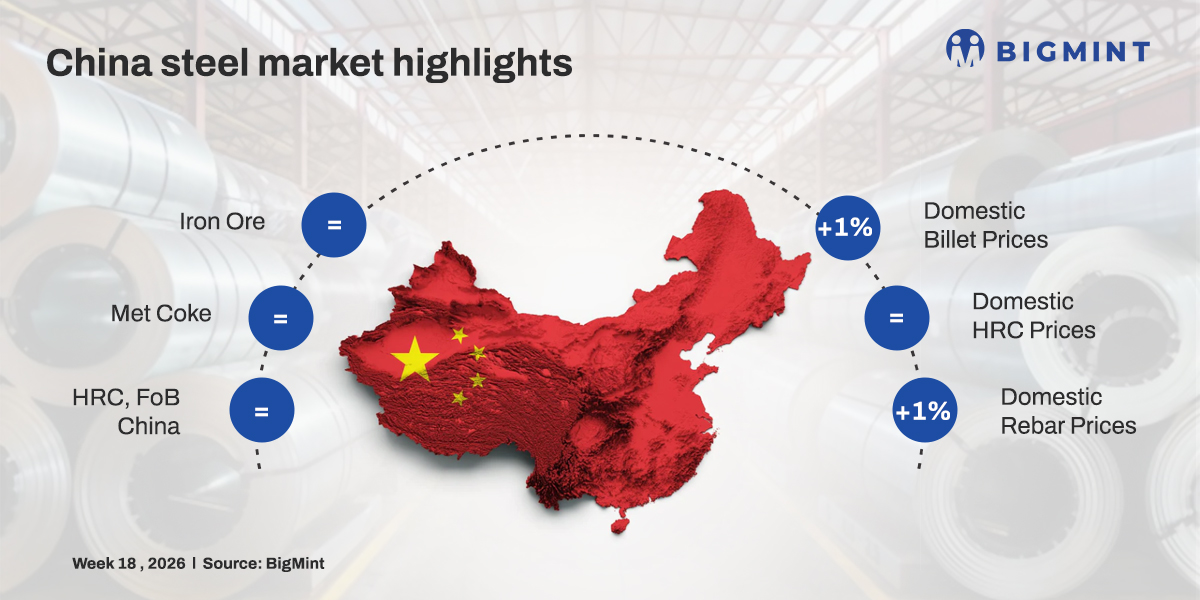
China’s steel prices showed mixed trends in the week ended 30 April 2026, with domestic hot-rolled coil (HRC) prices remaining stable w-o-w, while rebar prices rose marginally w-o-w. Raw materials prices, including iron ore, coking coal remained stable w-o-w, while billet prices increased w-o-w.
Ongoing May Day holidays in China have led to slower trade activity across the region. The holiday period is expected to continue from 1 to 5 May 2026, further keeping market participation relatively subdued during this time.
1.Iron ore spot prices remain steady w-o-w: Iron ore fines benchmark prices for Fe 61% held steady at $108/dmt CFR China on 30 April. Prices remain supported by limited trading, mainly in the medium-grade segment. Improved sentiment in steel exports is likely to support pig iron output and iron ore demand. However, the current shift toward fines demand may be temporary, with lump demand and prices expected to recover soon.
a) Spot pellet premium falls w-o-w: Spot pellet premium for Fe 65% grade pellet dropped to $16.70/t CFR China on 29 Apr.
b) Spot lump premium edges down w-o-w: Spot lump premium fell marginally w-o-w by $0.04 to $0.1780/dmtu on 30 Apr.
2. Coking coal market steady amid balanced supply-demand: China’s coking coal and coke markets remained stable, with no change in benchmark prices. Supply was steady despite safety checks, while strong steel demand and pre-holiday restocking supported consumption and kept inventories low. Spot prices rose slightly, with port prices and freight unchanged. The market is expected to stay range-bound in the near term.
In the seaborne market, Australian premium hard coking coal (PHCC) prices remained stable w-o-w at $231/t FOB as of 1 May, while BigMint’s PHCC index held steady at $253/t CNF Paradip. The stability in prices reflects a balanced market, with steady supply availability from Australia and cautious procurement by buyers, limiting any significant upward or downward movement.
3. Billet prices rise w-o-w on improved sentiment: Chinese billet prices increased by RMB 20/t ($3/t) w-o-w to RMB 3,040/t ($444/t) by 30 April, compared to RMB 3,020/t ($442/t) on 24 April. The rise was supported by improved sentiment, pre-holiday restocking, firmer raw material costs, and tightening availability at ports. Early-week stability gave way to gradual gains mid-week, aided by stronger futures and a positive PMI reading, though activity remained measured ahead of holidays. Export billet prices held steady around $480/t FOB, up from $465–475/t FOB last week, reflecting firmer domestic pricing.
4. Domestic HRC prices remain stable w-o-w: Chinese HRC prices remain unchanged w-o-w at around RMB 3,200/t ($468/t) as on 30 April 2026.However, SHFE HRC futures (October 2026 contract), rose marginally by RMB 13/t ($2/t) w-o-w to RMB 3,407/t ($499/t) from RMB 3,394/t ($497/t) a week earlier. Meanwhile, China’s HRC export offers remained stable w-o-w at around $505/t FOB, Rizhao.
5. Rebar prices increase w-o-w: Rebar prices in China stood at around RMB 3,350 ($450/t) as on 30 April, increasing by RMB 30/t ($4/t) w-o-w compared with RMB 3,320/t ($486/t) in the previous week. Moreover, SHFE rebar futures (October 2026 contract), also rose marginally by RMB 14/t ($2/t) w-o-w to RMB 3,204/t ($469/t) as on 30 April from RMB 3,190/t ($467/t) a week earlier.

Outlook
China’s steel market is expected to remain largely stable in the coming week, as muted activity may cap any significant upside, while relatively firm raw material costs are likely to provide downside support. Overall, clearer price direction will depend on the pace of demand recovery post holidays.
Leave a Reply