- Carbon quotas add pressure on steelmakers’ costs and competitiveness
- Seasonal demand expectations support prices despite weak consumption
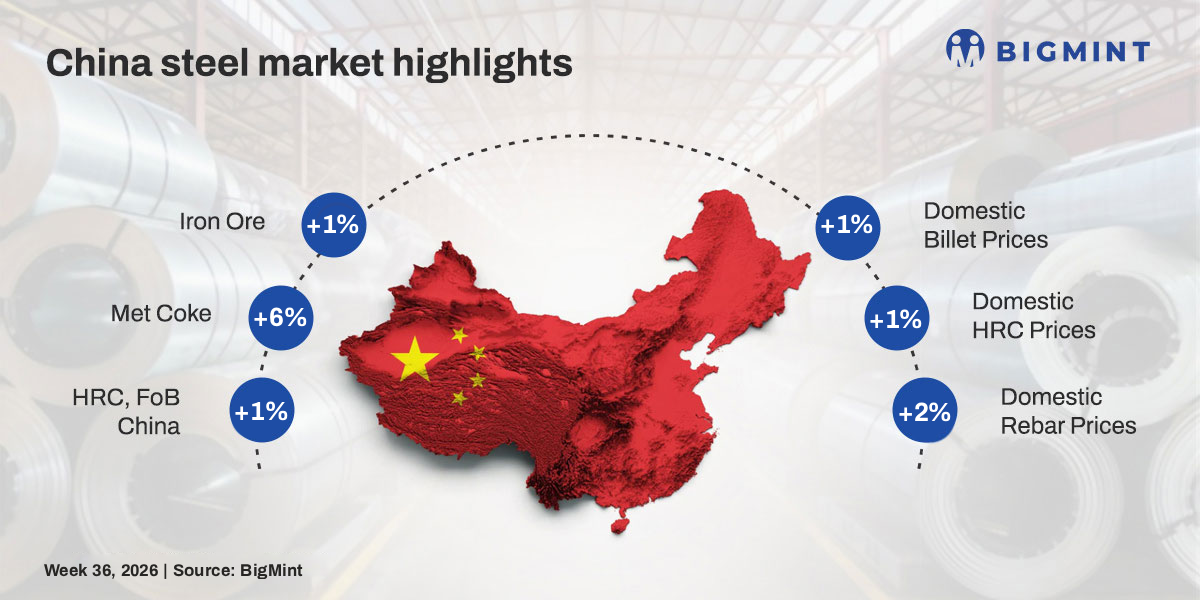
Looking at the market this week, firstly, there was increase in raw material prices, with iron ore and coking coal and coke prices continuing to strengthen resulting in an overall stronger raw material market and some support for finished steel costs.
China’s Ministry of Ecology and Environment has issued the 2026 carbon quota allocation scheme for steel, cement and aluminium. With 2026 marking the steel sector’s first substantive compliance year, market-based carbon constraints are expected to reshape steelmakers’ costs, technology investments and competitive landscape.
Inventory in mid-August
Additionally, the China Iron and Steel Association (CISA) reported that total steel inventories at key CISA-affiliated mills stood at around 18.33 million tonnes (mnt) during mid-August (11-20 August 2026), marking an increase of 1.15 mnt or 6.7% from 17.18 mnt in early-August.
In the mid- August elevated inventories indicate that demand remains insufficient to absorb supply, with construction steel and HRC stocks continuing to build. Downstream activity may gradually improve with the start of the traditional peak season.
Steel price trend
Domestic HRC prices rise: China’s domestic hot-rolled coil (HRC) prices increased by RMB 30/t ($4/t) w-o-w to around RMB 3,280/t ($489/t) on 4 September, compared with RMB 3,250/t ($485/t) a week earlier. Furthermore, SHFE HRC futures (October 2026 contract) were up by RMB 33/t ($5/t) to RMB 3,371/t ($502/t) from RMB 3,339/t ($497/t) in the previous week.
Domestic HRC prices strengthened as firm raw material costs and expectations of a seasonal demand recovery supported market sentiment. Tight coking coal supply, slow mine restarts in Shanxi amid safety inspections, and limited Mongolian imports kept steelmaking costs elevated. The latest coke price hike further squeezed mill margins, With many steel mills facing significant margin pressure or losses, producers showed stronger resistance to lowering HRC offers.
Meanwhile, optimism over stronger downstream demand during China’s September-October peak season provided additional support to the market.
Chinese HRC export offers increased by $5/t w-o-w to around $500/t FOB Rizhao, compared with $495/t FOB in the previous week.
The increase was driven by stronger cost support from higher iron ore and coking coal prices. Meanwhile, improving restocking demand in key overseas markets, including Vietnam, amid the seasonal recovery, encouraged Chinese mills to raise export offers further.
Rebar prices rise w-o-w: China’s domestic rebar prices increased by RMB 50/t ($7/t) w-o-w at around RMB 3,220 /t ($480/t) on 4 September from RMB 3,170/t ($472/t) in the previous week. Furthermore, SHFE rebar futures (October 2026 contract) up by RMB 22/t ($3/t) to RMB 3,102 /t ($462/t) from RMB 3,080/t ($459/t)
China’s steel market entered the week on a cautiously positive note, with the national blast furnace operating rate showing a slight recovery, easing concerns over production constraints. However, the improvement on the supply side failed to translate into stronger spot-market activity.
Spot steel prices initially moved higher, but the momentum quickly faded as transactions remained weak. On the cost side, rising raw material prices continued to put pressure on mills, with coking coal recording four rounds of price increases and pushing steelmaking costs higher. This kept mills firm on their pricing stance, with a strong willingness to defend or raise steel prices.
China’s Shagang Steel has kept its long steel prices unchanged for sales during 1-10 September 2026. The producer maintained its rebar (16-25 mm) price at RMB 3,250/t ($483/t), coiled rebar (8-10 mm) at RMB 3,380/t ($503/t), and wire rod (6-10 mm) at RMB 3,290/t ($489/t).
The decision reflects the mill’s cautious stance following the sharp rally in domestic long steel prices in late August, which was largely driven by surging metallurgical coke prices after three rounds of price increases. Although spot trading activity has improved, the increase was attributed mainly to speculative buying and restocking rather than a clear recovery in end-user consumption.
At the same time, limited downstream demand restricted the market’s ability to sustain the initial price gains. Although September-October marks the traditional peak season for steel consumption, subdued buying activity is likely to cap the upside. In the near term, rising production costs may provide a floor for steel prices, but a meaningful rally will depend on a stronger recovery in end-user demand.

Raw materials front
Iron ore spot prices gains upward momentum w-o-w: Iron ore fines benchmark prices for Fe 61% inched up by $1/t w-o-w to $100/dmt CFR China on 04 Sep’26. Prices surged amid strengthening sentiment in the ferrous market and better interest in medium-grade fines supported prices. The recovery has been more pronounced in blend fines than mainstream products, narrowing price differentials across brands.
Major coke producers proposed a fourth price increase on 1 September, further raising production costs and prompting mills to limit purchases of higher-priced iron ore. The combination of rising raw material costs and subdued steel margins weighed on procurement appetite.
a) Spot pellet premium stable w-o-w: Spot pellet premium for Fe 65% grade pellet remained firm w-o-w at $25.85/t CFR China on 26 August.
b) Spot lump premium rose w-o-w: Spot lump premium edged lower by $0.0385/t w-o-w to $0.2475/t CFR China on 4 September.
Coke rally gains momentum as tight supply fuels fresh price hike expectations: Coke and coking coal markets remained firm, supported by tight coal supply, strict mine-safety controls and widespread coke-plant production cuts. The fourth coke price hike of RMB 100-110/t ($15-16/t) was fully implemented, while active steel-mill procurement and low inventories have raised expectations of a fifth increase.
Seaborne coking coal prices also strengthened sharply, with Australian PHCC rising $15/t w-o-w to $276/t FOB and BigMint’s index increasing $19/t to $299/t CNF Paradip, driven by stronger Chinese buying. However, Indian buyers remain cautious and are largely in a wait-and-watch mode, anticipating a potential price correction before resuming bookings.
Billet prices rise w-o-w despite cautious demand: Chinese billet and rebar prices ended the week higher, supported by firm raw-material costs and expectations of seasonal demand improvement. However, cautious buying and subdued steel consumption limited the upside.
Standard billet prices at Tangshan Qian’an increased to RMB 3,040/t ($453/t) on 4 September from RMB 3,000/t ($446/t) on 28 August, gaining RMB 40/t ($7/t) w-o-w.
Raw-material costs remained an important support. Iron ore hovered around $99-100/t, while tight coking-coal supply supported costs. However, falling coke prices after recent increases reduced some of the support for steel prices.
Billet export offers ended at $466/t FOB, up $6/t w-o-w from $460/t on 28 August, although offers had reached $472/t earlier in the week. Export activity remained stable, with mills maintaining cautious pricing amid mixed overseas demand.
Outlook
With buyers waiting for clearer signs of stronger end-user demand, steel mills are likely to remain cautious. As production gradually resumes, weaker-than-expected demand could put pressure on prices. Despite the fourth round of coking coal hikes, subdued HRC prices may limit near-term gains, keeping the construction materials market volatile, with prices likely to remain range-bound in the short term.
Leave a Reply