- HRC, rebar prices fall w-o-w
- Raw material prices mostly down, coking coal rises
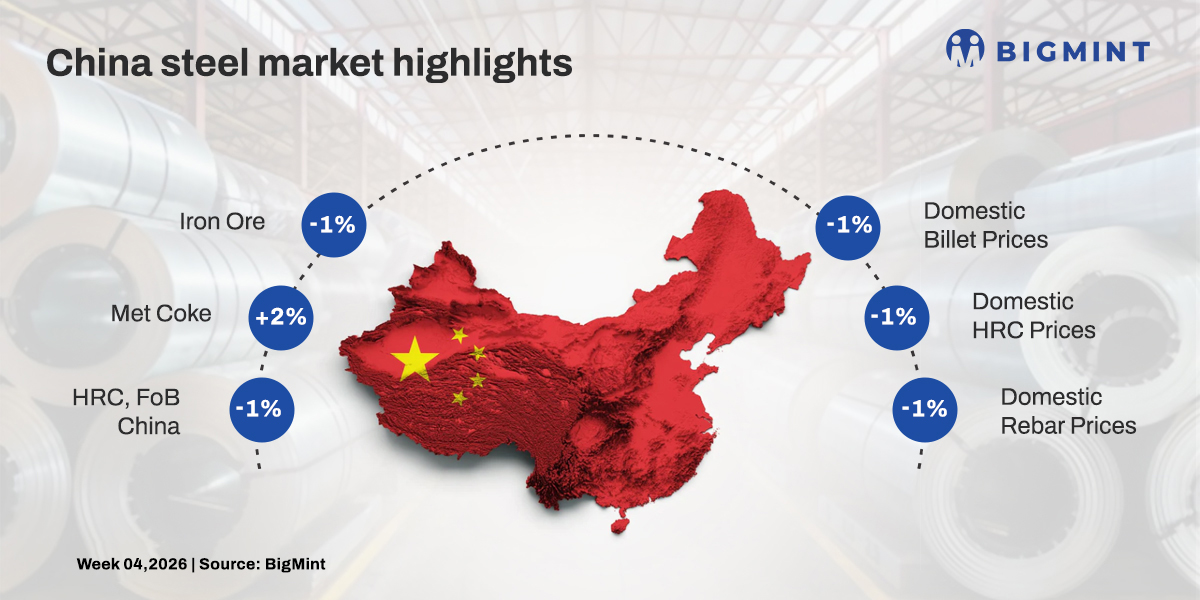
China’s steel prices fell in the week ended 23 January, with domestic hot-rolled coil (HRC) and rebar declining w-o-w. Raw materials, including iron ore and billet, also recorded marginal drops, while coking coal prices rose w-o-w.
China’s crude steel production reached 960.81 million tonnes (mnt) in 2025, marking a 4.4% y-o-y decline, from 1002.32 mnt in 2024, according to data from the National Bureau of Statistics (NBS). Moreover, crude steel output in December 2025 stood at 68.18 mnt, down by 10.3% y-o-y from 75.97 mnt in December 2024. This decline in crude steel production is mainly due to weaker domestic demand in China, particularly from the property sector, with softer consumption prompting mills to scale back output.
1. Iron ore spot prices edge down w-o-w: Iron ore fines benchmark prices for Fe 61% fell by $1/t w-o-w to $105/dmt CFR China on 23 Jan as weak downstream steel fundamentals continued to weigh on sentiment. Softer prices drew buyers, lifting trading activity in mainstream medium-grade fines as participants took advantage of the dip. However, some positive notion was observed lately in the week driven by positive macroeconomic outlook.
a) Spot pellet premium rise up w-o-w: Spot pellet premium for Fe 65% grade pellet rose by $0.5/t to $18.3/t CFR China on 21 January.
b) Spot lump premium steady w-o-w: Spot lump premium edge remained firm w-o-w at $0.045/dmtu on 23 January.
2. China’s domestic coke market remained weak w-o-w: China’s domestic coke market remained soft as steel mills maintained cautious procurement amid weak downstream demand. While coking producers adjusted output to manage margin pressures, supply reductions lagged demand declines, sustaining market weakness. Concurrently, Australian PHCC prices rose sharply by $18/t to $250/t FOB, with BigMint’s PHCC index for Paradip, India, up $17/t to $264/t on 23 January 2026.
3. China: Billet prices down w-o-w as demand stays weak ahead of holidays: Chinese billet prices fell by RMB 30/t ($4/t) w-o-w to RMB 2,940/t ($422/t) on 23 January, compared with RMB 2,970/t on 16 January. Prices came under pressure from soft downstream demand, winter-related disruptions, easing raw material prices earlier in the week, and high pre-Lunar New Year inventories. However, losses were partly capped toward the end of the week by disciplined mill supply and expectations of spring construction demand, which helped billet prices stabilise and edge up d-o-d throughout the week.
SHFE rebar futures also declined on a weekly basis, down RMB 49/t ($7/t) w-o-w to RMB 3,092/t ($444/t). Futures were weighed down by sluggish spot activity, reduced blast furnace operations, and elevated inventories, despite intermittent support from policy expectations and export sentiment. Overall sentiment remained cautious to neutral, with mills prioritising margin protection and inventory control ahead of the Lunar New Year.
4. Domestic HRC prices decline w-o-w: Domestic HRC prices in China dropped by RMB 30/t ($4/t) w-o-w to RMB 3,070/t ($441/t) on 23 January from RMB 3,100/t ($445/t) on 16 January 2026. However, SHFE HRC futures (May 2026 contract) increased by RMB 26/t ($4/t) w-o-w to RMB 3,298/t ($473/t) on 23 January from RMB 3,324/t ($477/t) on 16 January. The seasonal slowdown in HRC demand is intensifying, as weak domestic and export consumption continues to keep market momentum subdued. Moreover, China’s HRC export offers fell marginally by $3/t w-o-w to $470/t FOB on 23 January, from $473/t FOB a week earlier.
5. Rebar prices fall w-o-w: China’s rebar prices edged down by RMB 30/t ($4/t) w-o-w to RMB 3,160/t ($454/t) on 23 January from RMB 3,190 ($458/t) a week earlier, tracking decline in SHFE futures. The SHFE futures (May 2026 contract) dropped by RMB 39/t ($6/t) w-o-w to RMB 3,134/t ($450/t) on 23 January from RMB 3,173/t ($456/t) on 16 January 2026. Overall end-user demand remains weak ahead of the Lunar New Year holiday in China.

Outlook
China’s steel market is likely to remain volatile in the coming week ahead of the Lunar New Year holidays, with trading activity expected to remain slow. Weak demand fundamentals persist, and any price recovery will hinge on stronger downstream buying, with clearer market direction emerging as demand trends become more apparent.
Leave a Reply