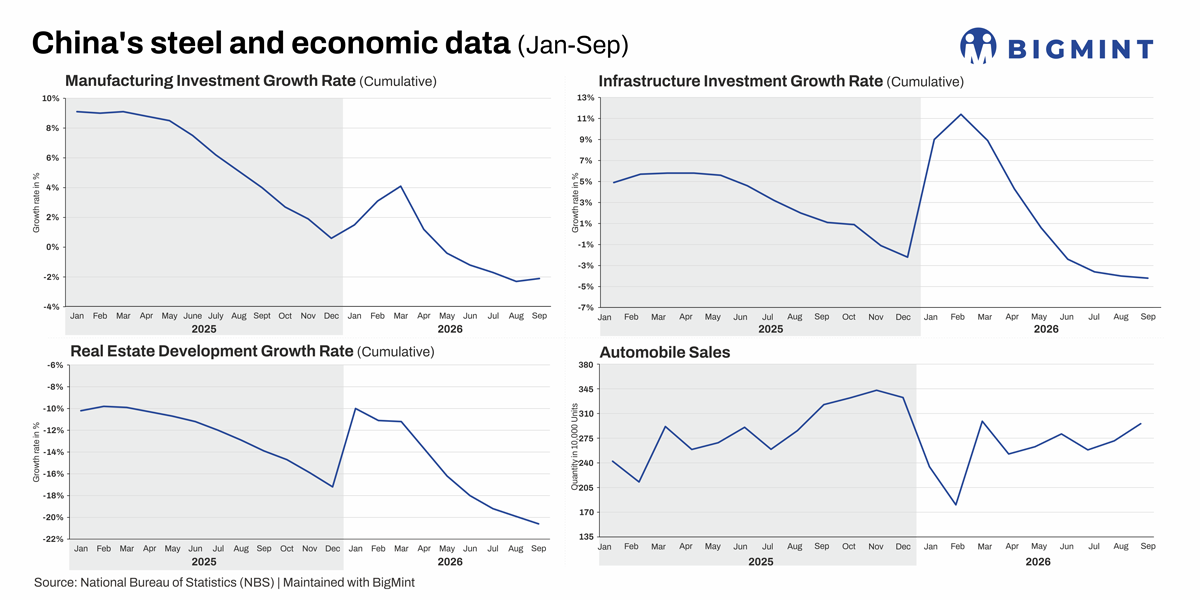
- Property remains largest drag on steel demand, real estate investment down 20.6% in Sept
- Manufacturing, construction machinery provide demand base, supported by equipment renewal
- Policy support cushioning decline in construction demand, but yet to generate consumption recovery
Morning Brief: China’s steel demand is shifting towards manufacturing as the property downturn deepens, but the emerging industrial demand base remains too small to offset the loss of construction consumption. Crude steel production fell 2.9% y-o-y to 724.77 mnt in the first nine months of 2026, while pig iron output declined 3% to 628.44 mnt. Steel exports fell 2.6% to 85.64 mnt. The weaker production and export figures point to a market where demand is contracting while its composition is changing.
Property remains largest demand drag
Real estate continues to account for the biggest loss in steel demand. Development investment, new starts, construction, completion and sales all declined by double digits in the first eight months of 2026. By September, real estate investment growth had fallen to -20.6%.
The weakness is also affecting developers’ willingness to start new projects. Financing remains focused on completing existing housing and managing risks, while new development loans and land acquisition remain cautious. Lower starts and construction activity directly reduce consumption of rebar and other long steel products.
Infrastructure has provided some offset through government bond-funded projects. By 11 October, local governments had issued RMB 8.86 trillion of bonds, including RMB 3.58 trillion of newly issued bonds, with 59.71% invested in project construction. But the conversion of financing into physical activity has been slower. Infrastructure investment growth stood at -4.2% in September, indicating that policy funding is helping sustain activity without yet creating a strong new source of steel demand.
Manufacturing taking a larger share of steel demand
Manufacturing demand has held up better, particularly for flat steel used in equipment, new energy, shipbuilding and other industrial applications. Credit is being directed towards equipment renewal, technological upgrading and green investment, creating demand that is less dependent on property construction.
Construction machinery provides a clear example. September excavator sales rose 14.4% y-o-y to 22,717 units. Domestic sales increased 7.16%, while exports rose 20.7%. Loader sales increased 17.9% to 12,419 units, with domestic sales up 14.3% and exports up 21.3%. The recovery is being supported by both domestic and external demand, although the pace of excavator export growth has moderated.
The manufacturing recovery is not uniform. Automobile production fell 4.5% to 23.25 million units in 9M 2026. Manufacturing is therefore providing a more resilient demand base than construction, rather than replacing lost property demand one-for-one.
Credit reaching industry faster than property
The structure of credit growth helps explain this divergence. At the end of September, M2 increased 7.2% y-o-y and M1 rose 3.2%. RMB loans increased by RMB 11.52 trillion in the first three quarters, but total social financing was RMB 2.63 trillion below the same period last year.
Corporate loans increased by RMB 12.55 trillion, while household loans declined by RMB 1.03 trillion. Within corporate lending, medium- and long-term loans increased by RMB 6.53 trillion. Household credit remained weak, with medium- and long-term household loans increasing by only RMB 106.2 billion.
The credit split is feeding into steel demand. Manufacturing, infrastructure and technology-related sectors are receiving financing support, helping sustain consumption of hot-rolled, cold-rolled and medium-thick plate. Property-linked borrowing remains weak, limiting the recovery in rebar and other construction steel.
Policy support targeted, but conversion remains slow
The central bank’s September policy package lowered the PSL rate by 0.25 percentage points and expanded support for water networks, power grids and underground pipelines. It also added RMB 200 billion of re-lending for technological innovation and transformation and RMB 500 billion for agriculture and small businesses.
These measures improve financing conditions for infrastructure and industrial upgrading, but local government debt constraints and the lag between funding and physical work limit their immediate effect on steel consumption. The policy support is therefore more effective at preventing a sharper contraction than generating a new construction-led demand cycle.

Steel supply adjusting to weaker demand
The demand weakness is already reflected in steel production. Crude steel output fell 2.9% in 9M 2026, while pig iron production declined 3%. Steel exports also fell 2.6% to 85.64 mnt, reducing one outlet for domestic production.
Steel imports fell more sharply, declining 10.5% to 4.07 mnt. This indicates that weaker domestic demand has not been accompanied by greater dependence on imported steel. Instead, the domestic market continues to absorb most of the adjustment through lower production and reduced imports.
Iron ore imports, however, increased 4.1% to 954.97 mnt during the period. Coal imports rose 2.2% to 353.54 mnt even as domestic coal production declined 3.5% along with a sharp drop in domestic iron ore production. But raw material availability has not been the primary constraint on steel output. The larger constraint remains downstream demand.
Outlook
China’s steel market is becoming less construction-led as manufacturing and equipment-related sectors take a larger share of consumption. The shift is visible in stronger construction machinery sales, continued credit support for industrial investment and relatively resilient demand for flat steel.
The scale of the property contraction remains the limiting factor. Policy can support infrastructure and industrial investment, but the effect on physical steel demand depends on how quickly financing is converted into projects and equipment purchases.
China’s steel market is undergoing a structural shift in demand, with manufacturing carrying more of the market while property continues to contract. The pace of that shift will determine whether industrial demand can eventually compensate for the continuing loss of construction steel consumption.
Leave a Reply