- Tight South African supply supports firm ore prices
- Mills operating rates stay high, lifting alloy demand
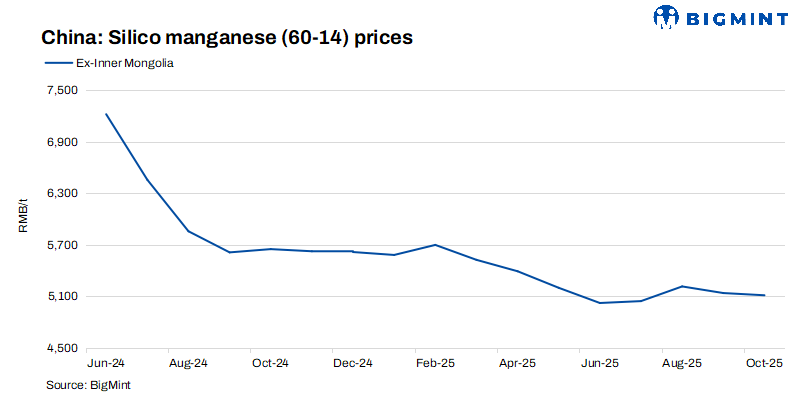
CBC: Chinese silico manganese (Mn: 65%, Si: 17%) prices edged up by RMB 30/tonne (t) ($4/t) w-o-w to RMB 5,570-5,840/t ($782-820/t) exw, including taxes.
Silico manganese prices experienced a slight uptick, supported by firm ore costs, steady steel mill operations, and a rebound in crude steel production. Although exports dipped m-o-m in September, overall January-September levels remained firm, reflecting continued demand stability.
Market sentiments
Raw material market trends
Manganese ore spot prices displayed mixed trends. At Tianjin Port, mainstream ore prices stayed stable, with consistent demand for medium- and high-grade Australian and Gabonese lumps. In contrast, South African semi-carbonate ore saw a slight price rise due to tight supply.
Inventories at Qinzhou Port continued to decline, while limited supply from South Africa further increased spot costs. This contributed to higher raw material costs.
Meanwhile, the coke market remained stable, with little impact on alloy production costs.
Overall, raw material supply remained supportive, though constraints in manganese ore supply are expected to persist. Tracking port inventories and global price trends remains a key focus.
Downstream market trends
Demand for silico manganese showed a temporary recovery as steel mill operating rates remained high and crude steel production rebounded m-o-m, boosting alloy consumption. However, silico manganese exports declined m-o-m in September, though cumulative exports from January to September remained strong, reflecting firm international demand.
Silico manganese inventories rose slightly m-o-m across the country, while stocks in Inner Mongolia and Ningxia remained manageable, with no significant deterioration in the supply-demand balance.
Outlook
Silico manganese prices are likely to remain volatile in the near term, driven by fluctuating raw material costs and uncertain end-user demand recovery. Market stability will likely depend on steel mill operating rates and global supply conditions.
Leave a Reply