- Mixed sentiments seen in manganese ore
- ZCE futures for May’25 decline by $9/t
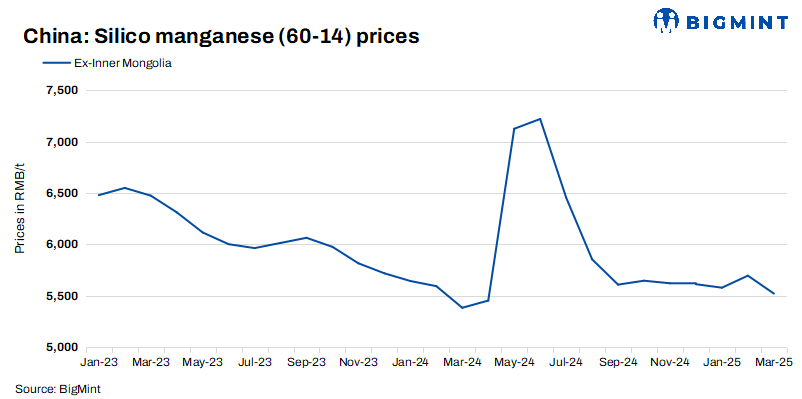
CBC: Chinese silico manganese (Mn: 65%, Si: 17%) prices were largely steady w-o-w, with a slight decline of RMB 55/t ($8/t) to RMB 5,930-6,200/t ($817-$854/t) exw, including taxes.
The silico manganese market overall remained stable. The futures market has seen a slight rebound, and coal has collectively shown positive movement, boosting market sentiment.
Market updates
Raw material market in consolidation phase: In the raw materials sector, the manganese ore market is also in a consolidation phase. Some products are being sold at lower prices, although overall prices remain stable. The market is characterised by a wait-and-see stance, with mixed sentiments among participants. Transaction volumes remain light, though cost support for silico manganese persists. The short-term outlook for manganese ore remains flat, with close attention being paid to manufacturers’ purchasing activity and port stock levels, as these factors could impact market dynamics in the coming weeks.
Downstream demand to remain subdued: Downstream demand for silico manganese will remain subdued in the short term, with futures continuing to exhibit weakness. Factories are reluctant to sell at high prices, and industry players are adopting cautious strategies due to the ongoing off-season.
Moreover, power restrictions and peak production policies in regions like Inner Mongolia and Ningxia are affecting silico manganese output. Consequently, market sentiments remains pessimistic, with limited short-term growth expectations in the silico manganese sector.
ZCE futures inch down: Silico manganese futures on China’s Zhengzhou Commodity Exchange (ZCE) for May 2025 deliveries declined by RMB 52/t ($7/t) to RMB 6,070/t ($836/t) on 31 March against RMB 6,122/t ($844/t) on 24 March.
Outlook
The silico manganese market remains under pressure, with weak downstream demand and low steel mill inventories. While manganese ore stocks provide some price support, the market is likely to experience further fluctuations as participants monitor inventory replenishment and demand recovery.
Leave a Reply