- US-bound rates remain firm on resilient demand, Asian port congestion
- Europe trades soften as Suez capacity returns, Golden Week approaches
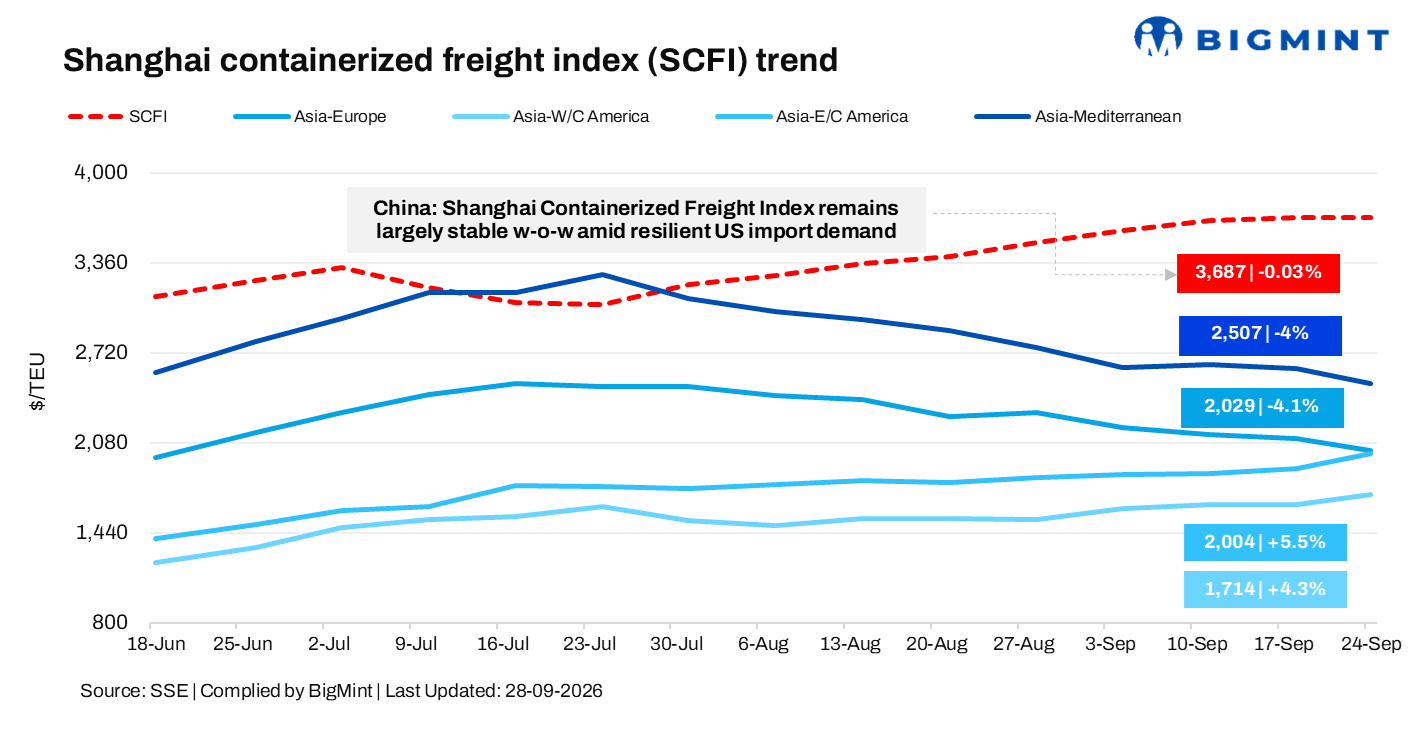
The Shanghai Containerized Freight Index (SCFI) was broadly stable in the week ended 25 September 2026, edging down by 0.03% to 3,686.62/twenty-foot equivalent unit (TEU) on 24 September from 3,687.83/TEU a week earlier. The near-flat headline masks a widening divergence between US and Europe-bound trades, with resilient US import demand and persistent congestion supporting transpacific rates, while the return of vessels through the Suez Canal is increasing effective capacity on Europe services.
Transpacific rates continued to strengthen, with Asia-West Coast America increasing w-o-w and Asia-East Coast America rising. Resilient US demand, continued congestion at major Asian ports, and capacity management through blank sailings were key supports.
The Asia-Europe market moved in the opposite direction, with rates falling w-o-w. Increasing Suez Canal activity is restoring vessel capacity and improving network efficiency, while the approach of China’s Golden Week is likely to weaken cargo availability after the holiday.

Asia-Mediterranean rates also declined w-o-w, with the route experiencing greater pressure from the restoration of Red Sea/Suez capacity. Mediterranean capacity has been returning faster than North Europe, contributing to a sharper correction in rates. Nevertheless, security risks in the Red Sea and wider Middle East continue to create uncertainty over how quickly carriers will fully normalize Suez routings.
Outlook
The SCFI is likely to remain divergent rather than uniformly directional into early October. Transpacific rates could stay elevated in the immediate term as shippers complete pre-Golden Week movements and congestion keeps effective capacity constrained, but the upside may become harder to sustain after the Chinese Golden Week holidays.
Europe-bound trades face greater downside pressure as Suez capacity expands and the ongoing holiday season reduces cargo availability. Meanwhile, Middle East/Red Sea security risks remain the key swing factor that could disrupt the expected capacity recovery.
Leave a Reply