- Transpacific rates firm on pre-Golden Week demand and tight capacity
- Asia-Europe rates ease amid Suez capacity restoration and softer demand
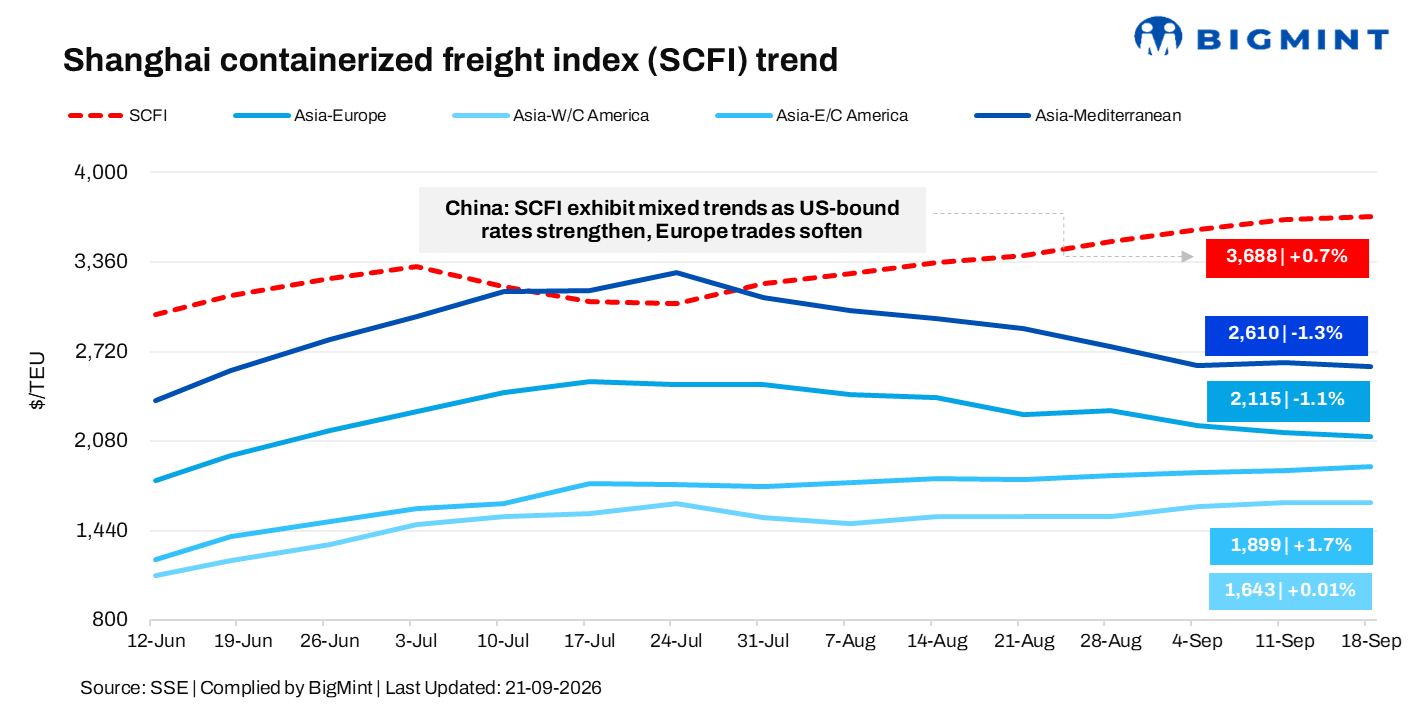
The Shanghai Containerized Freight Index (SCFI) recorded a mixed performance across major trade lanes in the week ended 18 September 2026. The index rises 0.7% w-o-w to 3,687.83/TEU on 18 September against 3,662.18/TEU on 11 September. Transpacific rates strengthened, supported by firm cargo demand and tighter effective capacity, while Europe-bound services weakened as post-summer demand softened and Suez Canal capacity continued to return. The divergence highlights a widening gap in carrier utilisation and booking conditions across key routes.
Transpacific markets remained supported by sustained cargo activity ahead of China’s Golden Week, with some shippers bringing forward shipments to secure space before the holiday period. Prolonged peak-season volumes, blank sailings and disciplined capacity deployment have kept vessel utilisation elevated. Port congestion is also reducing available capacity, while higher bunker costs are adding to carriers’ operating expenses. Market sentiment therefore remains relatively firm, with shippers facing limited scope for significant freight-rate relief as carriers continue to manage capacity closely.
Asia-Europe trades moved in the opposite direction, with rates declining as demand lost momentum after the summer peak. The gradual resumption of Suez services has increased available capacity and reduced some of the supply constraints that had supported freight rates. Asia-Mediterranean services also weakened amid softer booking activity and improving Suez-linked capacity.

However, the decline in Europe-bound rates is being tempered by continued uncertainty around Red Sea and Middle East security conditions. Elevated bunker prices and congestion are adding further cost pressure for carriers and could discourage aggressive rate reductions. Market sentiment on these routes remains cautious rather than decisively bearish, as any renewed disruption to Suez operations could quickly tighten available capacity and alter freight pricing.
Outlook
SCFI is likely to remain supported on transpacific routes through late September and early October, as pre-Golden Week cargo front-loading, high vessel utilisation and carrier capacity management keep space relatively tight. Elevated bunker costs and port congestion could provide additional support to freight rates.
Europe-bound routes may face continued downward pressure as seasonal demand eases and Suez-linked capacity gradually returns. However, persistent Red Sea security risks and elevated operating costs could limit the pace of declines, leaving the overall SCFI trend mixed through early October.
Leave a Reply