- Three consignments turned away despite pre-shipment clearance
- Exporters seek non-GMO certification clarity following regulatory mismatch
China has rejected at least three consignments of Indian non-basmati rice, citing the alleged presence of genetically modified organisms (GMOs), triggering fresh uncertainty in bilateral agri-trade and raising concerns among exporters. The affected cargoes were reportedly tested and cleared before export by the China Certification & Inspection Group (CCIC), yet were turned away by Chinese customs upon arrival, pointing to inconsistencies in inspection protocols. Exporters argue that India does not permit commercial cultivation of GM food crops, making the allegations difficult to substantiate.
The development has prompted exporters to approach the Agricultural and Processed Food Products Export Development Authority (APEDA) and the Indian Council of Agricultural Research (ICAR), seeking an official “non-GMO” declaration to facilitate smoother trade flows.
Trade dynamics and regulatory divergence
Market participants view the move as more than a routine sanitary and phytosanitary (SPS) issue, with some suggesting it could reflect strategic trade positioning by China. Experts note that China maintains a stringent, process-based biosafety regime, often applying zero-tolerance thresholds for GMO traces, which can lead to cargo rejections even when contamination is minimal.
The selective scrutiny has also raised questions, as similar GMO-free certifications are not consistently demanded from other major rice exporters such as Thailand, Vietnam, or Pakistan.
Limited volumes, but strategic market
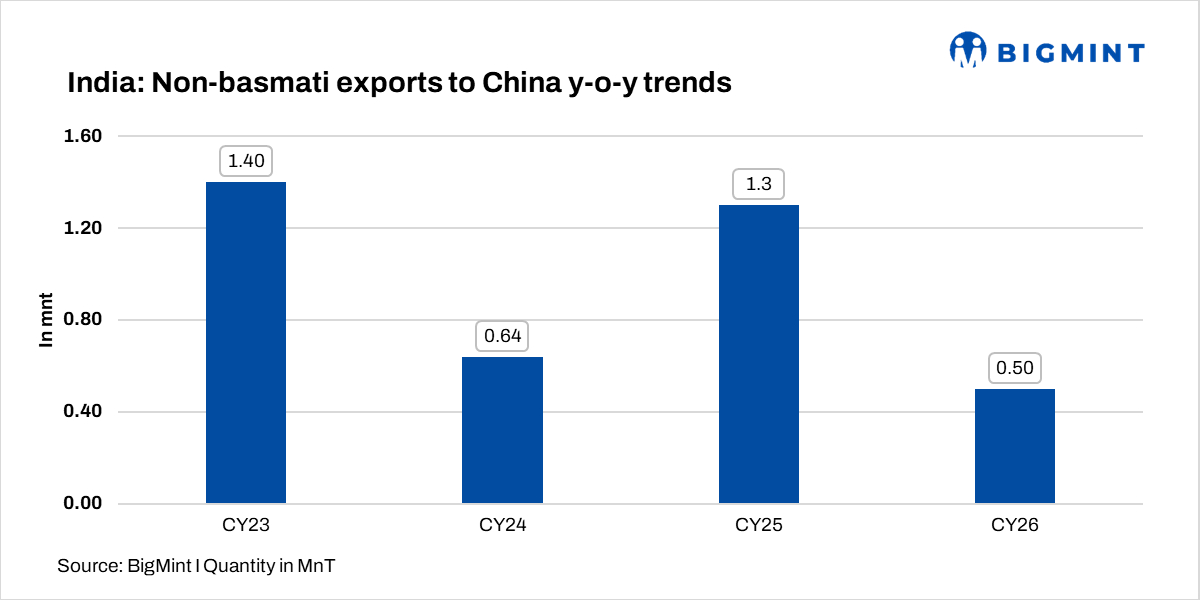
India’s non-basmati rice exports to China stood at around 1.4 million tonnes (mnt) in CY’23, before declining sharply by 54% year-on-year to 643,632 t in CY’24. Shipments rebounded in CY’25, rising over 100% y-o-y to 1.3 mnt, reflecting a recovery in trade flows. However, exports during January-February 2026 reached 508,526 t, indicating a slower start to the year compared to the previous annual pace, according to data maintained by BigMint.
Despite the volatility, China accounts for only a small portion of India’s 14 mnt non-basmati export basket. However, it remains a strategically important and growing market, with import demand projected at 3.1 mnt in 2025-26, supported by sustained price sensitivity, structural demand for broken rice in the feed segment, and policy support following export restriction relaxations by the Agricultural and Processed Food Products Export Development Authority.
Exporters warn that continued uncertainty around GMO compliance could disrupt shipments, delay contracts, and weigh on India’s competitiveness in the Chinese market.
Leave a Reply