- Coal imports drop to 269 mnt in 7MCY’25
- Exports by Indonesia fall sharply by 18% y-o-y
- Imports drop on clean energy growth, lower thermal generation
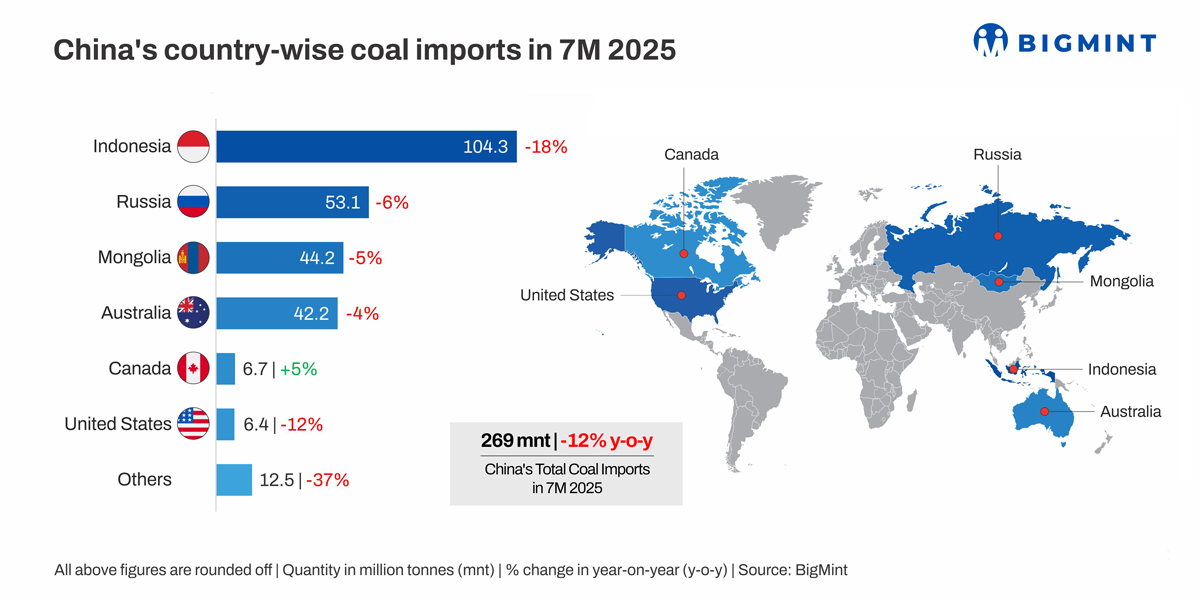
Morning Brief: China, the world’s top producer and consumer of coal, recorded an over 12% decline in total coal imports in January-July 2025 (7MCY’25), according to latest data available with BigMint. Total coal imports, including thermal and metallurgical coal, dropped to around 269 million tonnes (mnt) in 7MCY’25 as against 307 mnt in the corresponding period of CY’24.
Country-wise imports
Indonesia, by far the largest coal importer to China and the world, witnessed a sharp 18% drop in shipments to China in 7MCY’25. Total Indonesian coal exports were assessed at around 104 mnt during the review period compared with 127 mnt in 7MCY’24.
Although exports from other key countries also edged down, the rate of y-o-y decline was far lower compared to Indonesia’s. While Australian coal shipments dropped 3.7% y-o-y to 42 mnt, Russian exports dipped 5.5% to 53 mnt. Mongolian coal exports, too, fell 4.7% y-o-y to around 44 mnt.
However, China’s coal imports from the US dropped a sharper 12% y-o-y to around 6 mnt in 7MCY’25 amid the tariff-related tug-of-war between the world’s two largest economies and the trade uncertainties it has triggered.
Why did China’s coal imports drop in 7MCY’25?
Higher domestic coal production: According to latest data, China increased its domestic coal output by 5% y-o-y in 7MCY’25 to 2.8 billion tonnes (bnt) from 2.65 bnt in the year-ago period. The reason behind China’s coal boom lies in the power shortages experienced during 2020 and 2022 when surging demand and drought-induced dearth of hydropower had triggered a crisis-like situation.

In 2021, a misalignment between the price of coal and the government-set price of coal-fired power incentivised coal-fired power plants to cut generation. Power shortages in 2020 and 2022 revealed issues of rigid grid management and limited availability of power plants, when demand increased due to extreme weather and higher energy-intensive economic activity.
Therefore, to preempt shortages, the Chinese government approved the addition of new coal-fired power capacity (with energy security in view) despite the record expansion of renewable energy in the country. Higher coal production in China obviated the need to maintain a high level of imports as in CY’24, which saw a record surge with total coal imports reaching 560 mnt.
Coal-fired power generation drops: Fossil-fuelled power use in China trended downwards in 7MCY’25 compared to CY’24. Thermal power fell 1.3% over the first seven months as a whole amid fluctuating trends across different regions, weaker electricity demand growth and a surge in power output from renewables.
A warmer-than-usual March and April reduced the demand for heating, while a milder Chinese summer further weighed on thermal generation amid surging hydropower output.
Record renewable power additions: Solar, wind, and nuclear energy produced an extra 270 terawatt hours (TWh) of electricity in the first half of CY’25, according to data by Carbon Brief. This not only met the 170 TWh rise in demand but also cut fossil fuel use. Solar stood out with 170 TWh – equivalent to the annual output of Mexico or Turkey. Wind added 80 TWh, and nuclear contributed 20 TWh.
China will add 500 GW in new wind and solar power in 2025. For perspective, the country is on track to install enough new renewable energy in CY’25 to cover the energy needs of Germany and the UK combined. Low-carbon sources make up 40% of China’s electricity mix, up from 36% in early 2024.
Rapid solar growth means CY’25 could break records. In fact, China added 212 gigawatts (GW) in just six months, right before a mid-year policy change. This has been, so far, the key reason behind China’s decline in coal imports for electricity generation.
Outlook
Strict mine inspections and safety monitoring protocols have controlled the rapid growth in Chinese coal production. Safety inspections have become paramount to avoid fatalities ahead of the 3 September military parade. Declining coal prices in China very often leads to lackadaisical safety control at mines leading to fatalities, according to reports.
However, the IEA predicts that China’s increased production in response to 2021 shortages and high energy prices has led to an oversupply in coal markets. As efforts to expand production persist, further reduction in import volumes are likely in H2CY’25 due to moderate demand even as the Chinese economy battles tariff headwinds and lower industrial growth.
Leave a Reply