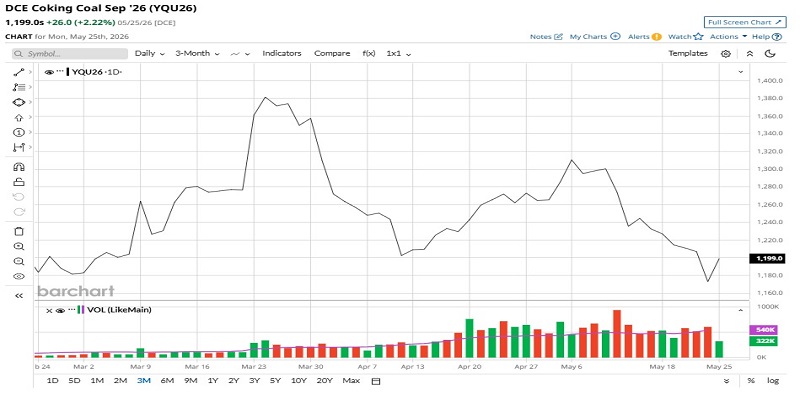
- Met coal futures surge 8% on fears of wider supply disruptions in China
- Rise in Chinese imports may increase coking coal costs for Asian steelmakers
A deadly gas explosion at a coal mine in China’s Shanxi province has sent fresh tremors through Asian coal markets, triggering a sharp rally in metallurgical coal futures and reviving concerns over tighter domestic supply at a time when steel margins remain fragile.
The explosion at the Liushenyu coal mine in Qinyuan county, Changzhi city, on the night of 22 May has emerged as China’s deadliest mining disaster in nearly 17 years, with authorities confirming more than 80 fatalities and launching an extensive safety review across Shanxi’s coal belt. While the direct production loss from a single mine is unlikely to materially alter China’s coal balance, the market reaction underscores fears of a broader regulatory response that could constrain output across multiple operations, particularly in the coking coal segment.

The incident has quickly altered sentiment in a market that had softened in recent weeks amid concerns over weak steel demand and broader macroeconomic headwinds. Instead of focusing on lost tonnage alone, traders are increasingly pricing in the risk of a wider safety crackdown in Shanxi — China’s largest coal-producing province and a critical source of metallurgical coal.
Met coal futures spike nearly 8% as supply fears intensify
China’s metallurgical coal market reacted sharply after trading resumed, with coking coal and coke futures effectively hitting their daily upper trading limits as participants reassessed supply risks from Shanxi.
The most-traded coking coal contract on the Dalian Commodity Exchange (DCE) surged 7.97% to RMB 1,266.5/t, reaching its highest level since 12 May, while the benchmark coke contract climbed 7.99% to RMB 1,879/t. The move spilled into broader ferrous markets, with steel rebar and hot-rolled coil futures also firming amid expectations of higher raw material costs for mills.

China ferrous futures reaction following Shanxi mine explosion (25 May)
The sharpness of the rally suggests markets are pricing in not merely the loss of production from Liushenyu, but the possibility of a broader safety-led supply squeeze across Shanxi’s underground coking coal operations — a pattern historically seen after major mining accidents in China.
Regulatory ripple effect driving sentiment
The physical output loss from one mine alone is not sufficient to justify such a strong market reaction. Instead, sentiment is being driven by expectations of regulatory spillover.
Following the accident, authorities reportedly suspended operations at mines linked to the operator and initiated wider inspections across Shanxi. Market participants fear that stricter safety reviews could temporarily curtail production at underground and smaller private mines, delay maintenance restarts, and reduce operating intensity across key coking coal regions.
A market survey cited by traders suggested inspections could temporarily affect as much as 288,000 t/day of raw coking coal production if restrictions broaden and persist.
This concern is particularly acute in Shanxi, which occupies a central role in China’s coking coal supply chain. Even targeted inspections affecting a limited number of operations could tighten the availability of select hard coking coal grades and support domestic prices.
Steel mills brace for higher input costs
For Chinese steel mills, the immediate challenge lies in higher and potentially more volatile raw material costs.
Mills with limited inventory cover may move to front-load purchases to avoid supply disruptions, while others are likely to optimise coking blends by increasing the use of pulverised coal injection (PCI), semi-soft coking coal, or lower-cost secondary grades to preserve margins. Higher-cost producers may also trim output if raw material inflation outpaces steel price gains.
The accident arrives at a delicate time for China’s steel sector, where profitability has already come under pressure from sluggish construction demand and uneven manufacturing activity.
Seaborne met coal market could find support
For the seaborne metallurgical coal market, the Shanxi disruption introduces fresh upside risk after weeks of subdued sentiment.
If inspections persist through June and July, China could marginally increase imports of premium hard coking coal and mid-range PCI cargoes to offset tighter domestic availability. Such a move may intensify competition for Australian and Mongolian cargoes, potentially influencing procurement costs for Indian, Japanese and South Korean steelmakers.
Indian steelmakers, in particular, may need to monitor developments closely, especially for premium coking coal grades where tighter Chinese buying could affect delivered costs into Asia.
However, at this stage, the import story remains an upside risk rather than a certainty. Much will depend on the scale and duration of the safety campaign.
Thermal coal impact remains secondary — for now
Unlike metallurgical coal, the impact on thermal coal remains largely sentiment-driven at this stage.
Because the affected mine primarily produced coking coal, direct implications for China’s thermal coal balance are limited. Nevertheless, if inspections widen to include mines supplying power coal, thermal coal prices could find additional support, particularly during the summer demand season when utilities typically prioritise stock security.
In such a scenario, Chinese buyers may modestly increase imports of medium- and high-calorific value cargoes from Indonesia, Russia, and Australia. But for now, thermal coal remains a secondary story, with the strongest impact concentrated in the metallurgical coal complex.
Outlook
At present, the market appears to be pricing in a targeted but meaningful safety campaign rather than a structural supply shock.
If inspections remain concentrated around higher-risk underground coking coal operations, Chinese domestic prices may remain elevated in the near term, lending support to seaborne benchmarks without fundamentally tightening global supply. However, if authorities broaden the crackdown into a deeper restructuring of smaller mining operations, implications for both metallurgical coal trade flows and Asian pricing could become more pronounced.
For now, the clearest takeaway is that metallurgical coal has emerged as the primary beneficiary of the disruption, with coking coal and coke futures posting their strongest gains in weeks as traders rapidly price in supply risk from Shanxi.
Leave a Reply