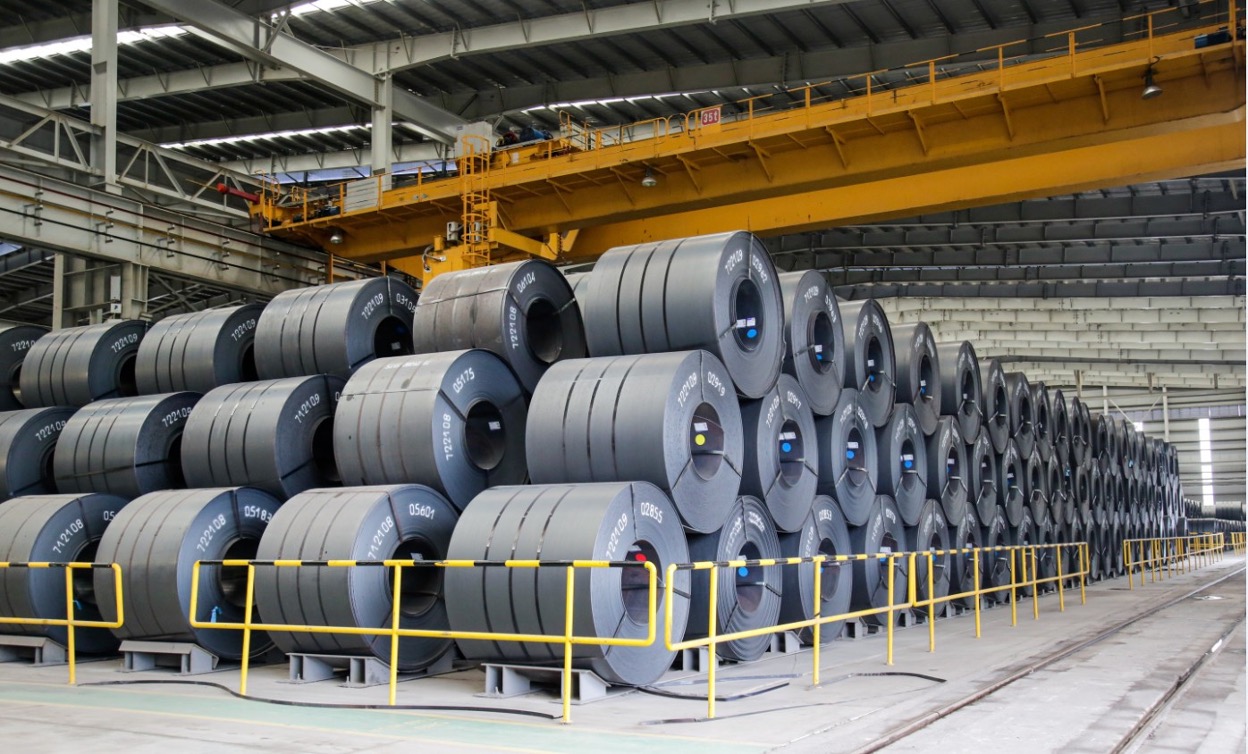
- Mills switch to producing flats for better margins, lifting supply
- Trade protection measures cause HRC exports to drop sharply
Mysteel Global: After September’s broad retreat in China’s hot-rolled coil (HRC) prices, the market this month is expected to come under further strain from softening demand amid stable or even loose supply, Mysteel’s latest monthly report on the flat steel indicates.
Output of hot coils is expected to remain ample in October due to the relatively high profit margins steel mills can earn, especially when compared with the barely profitable margins the mills currently enjoy on long steel products such as rebar.
As of 30 September, the profit margins earned by the blast furnace mills regularly monitored by Mysteel making HRC averaged RMB 37/tonne (t) ($5.2/t), higher by RMB 33/t from the average margin on sales of rebar, the latest data show. Mysteel’s price monitoring ceased during China’s eight-day National Day and Mid-Autumn Festival holidays over 1-8 October.
The more attractive returns on coil sales had led some steel mills to switch their production from rebar to HRC late last month. As a result, weekly HRC output by the end of September stayed high at 3.24 million tonnes (mnt), down by a negligible 0.17% from the last week of August and up by a large 9.4% y-o-y.
As most integrated mills rolling HRC can still make a profit, they are generally inclined to maintain steady supply and avoid large production cuts in October, a Shanghai-based analyst observed.
On the other hand, downstream demand for the flat product is still projected to be slow to recover after the National Day holidays, the report suggests.
Although the Purchasing Managers’ Index (PMI) for Chinese manufacturing in September moved up by a small 0.4 percentage point from August to 49.8%, it still hovered below the 50% threshold connoting expansion, as Mysteel Global highlighted. In addition, the sub-index for new orders also logged a tiny 0.2% m-o-m increase to sit at 49.7%, though still within the contraction zone, meaning production of steel-intensive items such as vehicles, appliances and machinery is still seen as weak.
Indeed, though the PMI indices may imply a gradual recovery of manufacturing sector health, in the short run, the results give limited cause for optimism about overall domestic demand, given that the speed of economic recovery remains quite slow, and no new macro-economic stimulus programmes have been unveiled to give consumption a boost.
As for the HRC export market, increasing trade protection measures being applied by China’s major steel export destinations, such as Vietnam and South Korea, are seen as constraining flat steel exports. According to China’s General Administration of Customs, during August, the country’s HRC exports reached 1.49 million tonnes (mnt), lower by a large 12.8% m-o-m and by a striking 39.29% y-o-y.
Slow domestic demand for the hot coils, coupled with the tepid HRC export market, had caused a small build-up of HRC inventories by the end of September that intensified during the holiday.
By 24 September, HRC inventories at the 194 commercial warehouses in the 55 cities across the country Mysteel regularly surveys had mounted to 4.06 mnt, higher by 168,100 t or 4.3% from the end of August.
If transactions for hot coils do not pick up this month, the accumulating inventories will dampen market sentiment and cause the flat steel’s prices to soften.
On 10 October, Mysteel assessed China’s national spot prices of Q235B 4.75mm HRC at RMB 3,399/t, including the VAT, lower by RMB 39/t or 1.1% m-o-m.
Note: This article has been written in accordance with a content exchange agreement between Mysteel Global and BigMint.
Leave a Reply