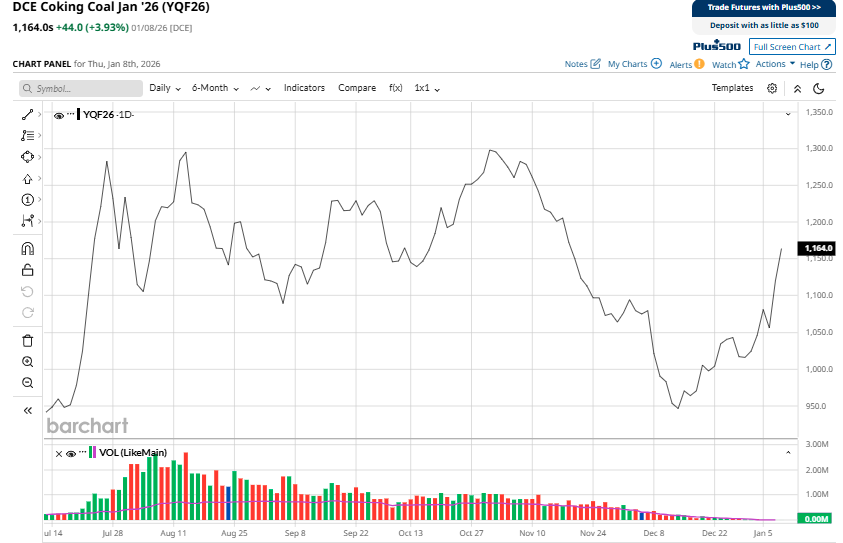
- Macro support, options launch expectations drive rally
- Physical market remains stable, inventories comfortable
China’s most actively traded coking coal futures contract on the Dalian Commodity Exchange (DCE) surged by nearly 8% during the night session on 7 January, hitting the daily upper limit and marking one of the sharpest single-session gains in recent months. The rally lifted prices to around RMB 1,160-1,170/tonne (t), with linked coke futures also locking limit-up, signalling broad strength across the ferrous complex.
Market participants attributed the move primarily to improved macro sentiment and anticipation of coking coal options trading, rather than an immediate tightening of physical supply.
Notably, China’s policymakers have reiterated a supportive monetary and liquidity stance, lifting risk appetite across commodities during a period of relatively thin trading. This backdrop amplified price movements in futures markets, even as spot fundamentals remained comparatively subdued.
The recent strength in futures has outstripped conditions in the physical market. Chinese spot coking coal prices remain broadly stable, supported by comfortable inventory levels, while steel demand shows only incremental improvement. This highlights a disconnect between paper market sentiment and near-term supply-demand dynamics.
Analysts caution that while futures strength reflects improving expectations and financial positioning, a sustained uptrend will depend on steel demand recovery and inventory drawdowns. Nevertheless, the sharp move underscores the DCE futures market’s role as a sentiment barometer, particularly ahead of structural changes such as the introduction of options.
Another factor was the potential impact on coal supply due to Yulin municipal government’s rollback of approval for capacity additions to 52 coal mines. This decision, driven by insufficient coal supply for power generation, implies the cancellation of 19 million tonnes (mnt)/year of additional coal capacity, according to a report. Moreover, the 52 coal mines accounted for half of the total approved to increase production capacity.
Leave a Reply