- US-China coal trade collapsed after 2025 tariff escalation
- Deal forms part of post-summit trade relationship reset
China has committed to import at least 10 million tonnes (mnt) of US coal in 2027 and another 10 mnt in 2028, marking one of the key commodity-trade outcomes of President Xi Jinping’s state visit and summit with President Donald Trump in Washington.
The commitment forms part of a broader roadmap being developed by Washington and Beijing to improve bilateral trade and economic relations following the severe tariff confrontation that disrupted trade between the world’s two largest economies in 2025.
The September summit produced several measures aimed at rebuilding commercial engagement, including recommendations for preferential tariff treatment covering $30 billion of non-sensitive goods in each direction, operationalisation of the US-China Board of Trade and establishment of a Board of Investment.
Against this backdrop, the coal commitment assumes significance beyond the headline 20 mnt volume. It potentially represents an early step towards reopening a major commodity trade corridor that was effectively shut by the tariff confrontation beginning in early 2025.
Tariff war triggered collapse in coal trade
The renewed trade confrontation began almost immediately after President Trump returned to office in January 2025.
On 1 February, the US announced an additional 10% tariff on Chinese imports. Beijing retaliated within days, imposing an additional 15% tariff on US coal and LNG from 10 February. The dispute escalated further in April as both countries imposed additional reciprocal duties.
The effect on coal trade was dramatic. The US Energy Information Administration reported that US coal exports to China fell 92% y-o-y in 2025, with tariffs among the principal reasons for the decline.
BigMint data show China’s US coking coal imports falling from 10.67 mnt in 2024 to 2.91 mnt in 2025 and then to zero during January-August 2026.
Trade flows show scale of disruption
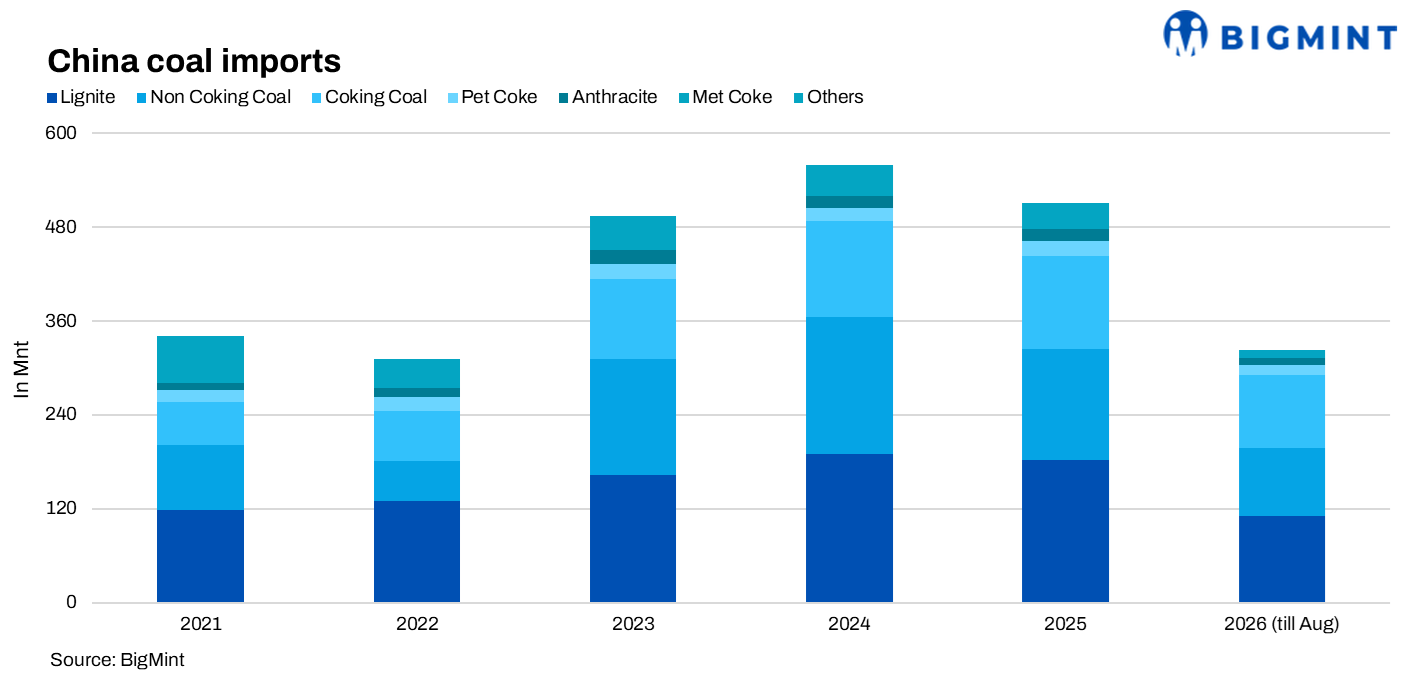
China’s imports from the US across coal, coke and petcoke categories totalled 12.58 mnt in 2023 and increased to 16.02 mnt in 2024. They subsequently more than halved to 7.65 mnt in 2025 and stood at only 3.61 mnt during January-August 2026.

Includes other categories in BigMint dataset. Quantity in mnt | Source: BigMint
The composition is particularly revealing. Petcoke continued to move between the two countries, reaching 4.74 mnt in 2025 and 3.58 mnt during January-August 2026, while coal itself was effectively squeezed out.
Petcoke should, however, be treated separately from the announced coal commitment unless subsequent implementation details specifically include it.
Coking coal offers clearest route
Coking coal could provide the clearest route towards meeting a substantial part of China’s commitment.
China imported 5.88 mnt of US coking coal in 2023 before purchases surged 81% y-o-y to 10.67 mnt in 2024. Following the tariff confrontation, imports plunged 73% to 2.91 mnt in 2025 and disappeared during January-August 2026.
The 10.67 mnt imported in 2024 is particularly significant because it is almost identical to the minimum 10 mnt/year purchase commitment now announced for 2027 and 2028.
The agreement could therefore potentially restore a bilateral coking coal trade that existed on a substantial scale immediately before the tariff war.
Thermal coal starts from smaller base
The potential thermal coal component is less straightforward.
China imported only around 0.24 mnt of US non-coking coal in 2024, none in 2025, and approximately 0.03 mnt during January-August 2026.
A programme heavily weighted towards thermal coal would therefore represent a significant departure from recent trade patterns.
US thermal coal also faces longer sailing distances and strong competition from Indonesia, Russia, Australia and Mongolia. Quality, sulphur specifications, freight and tariff treatment would determine its competitiveness.
Coal deal part of broader trade reset
The timing of the commitment is as important as its size.
The Washington summit follows the Trump-Xi meeting in Beijing earlier in 2026 and represents another step towards establishing a more structured framework for managing bilateral trade.
Coal is particularly relevant because it was one of the commodities directly targeted by China’s retaliatory tariffs in 2025. A commitment to resume substantial US purchases therefore provides a tangible example of the two countries attempting to rebuild trade flows disrupted by the tariff confrontation.
The broader package includes more favourable tariff treatment for selected non-sensitive goods and mechanisms for continued trade and investment discussions.
India could face greater competition
A revival in US-China coking coal trade could have implications for India.
Chinese buyers returning to the US market could increase competition for Atlantic-origin metallurgical coal among China, India, Brazil, Europe and other steel-producing markets.
If Chinese purchases rebuild towards the 10 mnt level seen in 2024, greater competition for US high-volatile and low-volatile coking coal could support mine realisations and potentially influence CFR India prices.
The impact will depend partly on whether US producers increase output to accommodate Chinese demand or whether cargoes are redirected from other destinations.
Tariff treatment remains crucial
A major question is whether the new agreement removes the tariff barrier that contributed to the collapse in coal trade.
Coal was announced separately from the preferential-tariff product list accompanying the broader agreement. The applicable Chinese import duty on US coal therefore remains an important outstanding issue.
The metallurgical/thermal split, product specifications, pricing, designated buyers, shipment schedules and enforcement provisions also remain unclear.
Outlook
The 20 mnt commitment potentially brings US-China coal trade full circle. China’s commitment to buying at least 10 mnt/year of US coal in both 2027 and 2028 is remarkably close to its pre-tariff coking coal purchases.
Moreover, the commitment is more than an additional 20 mnt of trade. It is part of the broader post-summit roadmap to rebuild US-China commercial relations after the disruption of 2025.
If purchases are predominantly metallurgical coal, they could reopen a major US-China coking coal corridor and increase competition for Atlantic cargoes available to India. A sizeable thermal coal allocation would represent a greater departure from recent trading patterns and depend heavily on freight and tariff economics.
The next signals to watch will be tariff treatment, the coking-versus-thermal allocation, and the first physical contracts between Chinese buyers and US suppliers.
Leave a Reply