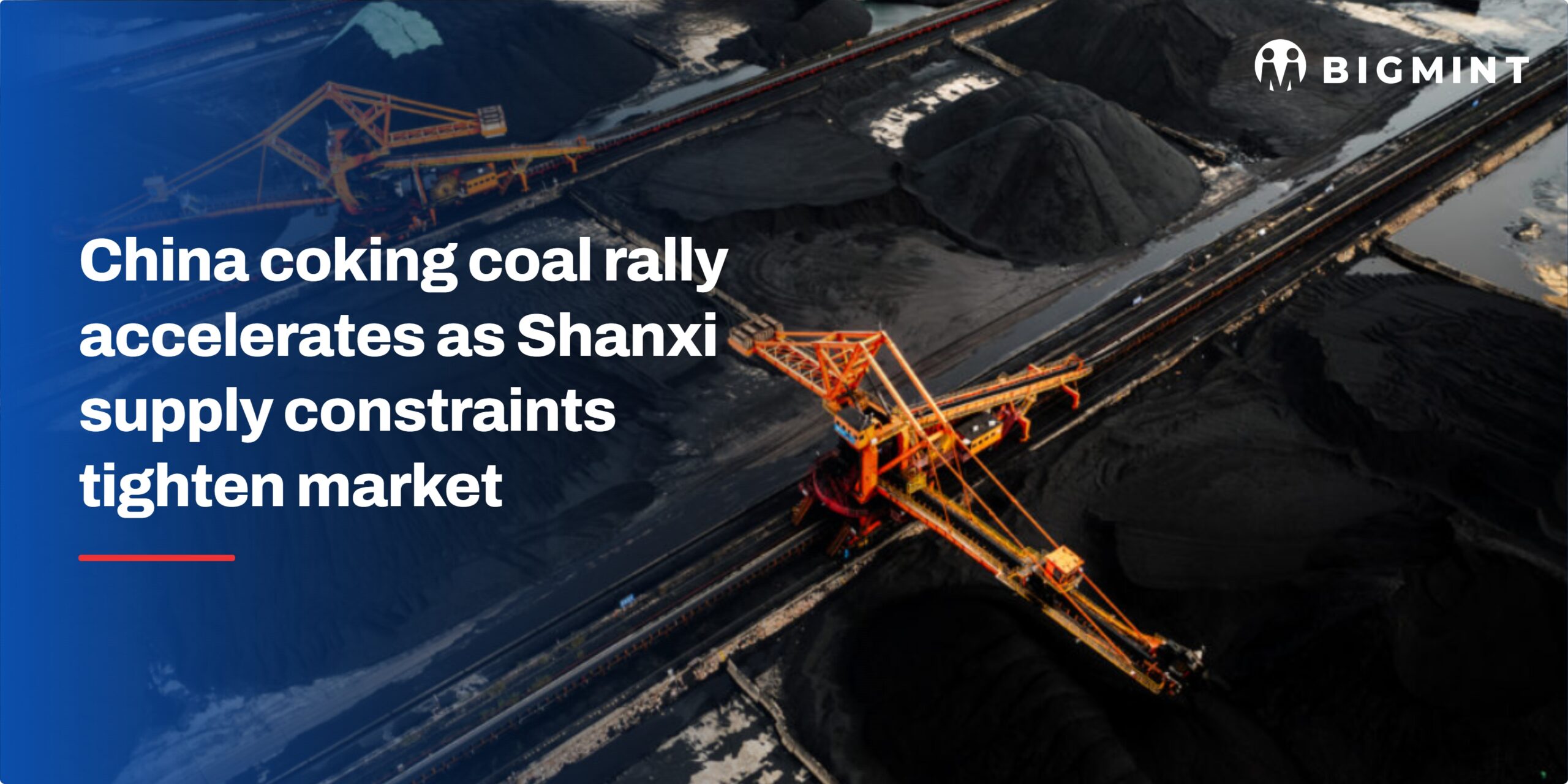
- Dalian coking coal futures surge to highest since October 2024
- Safety inspections tighten supply despite weak Chinese steel output
China’s coking coal market has entered another sharp rally, with domestic supply constraints in Shanxi combining with falling inventories and increasingly expensive imported material to push prices higher across the ferrous raw-material chain.
Dalian coking coal futures surged as much as 15% during the week to RMB 1,583.5/t ($235/t), their highest level since October 2024, according to the market report. The rally represents a dramatic reversal from the lows seen around mid-2025 and is increasingly feeding through into physical coking coal and metallurgical coke markets.
The significance extends beyond China. Tightening Chinese supply is occurring alongside disruptions in Australia and firm Indian import requirements, increasing competition for internationally traded metallurgical coal and raising raw-material costs for blast furnace steelmakers.
Shanxi emerges as the key supply constraint
The immediate catalyst is domestic supply.
Shanxi, China’s largest coking coal producing region, has faced intensified mine safety inspections following a major mining accident earlier this year. More than 130 mnt/year of coal capacity was reportedly suspended during safety checks in late May, with an estimated 50-60 mnt/year still offline.
Recent official statements indicate that safety scrutiny remains intense. Authorities in Changzhi, one of Shanxi’s major coal-producing centres, reiterated on 12 August that mines must complete inspection, rectification and acceptance procedures before orderly production resumptions can proceed.
This is important because the market had expected production to recover as mines gradually restarted. Instead, the pace of normalisation has remained uncertain, keeping available coking coal supply tight.
The resulting price recovery has been substantial. China’s official data show indicative main coking coal prices rising from around RMB 1,558/t in mid-May to RMB 1,925/t by late June, an increase of roughly 24% even before the latest futures rally.
Imported coking coal follows domestic market higher
China’s supply constraints are increasingly spilling into the imported market.
By 17 August, Australian low-sulphur premium coking coal at Jingtang port was indicated around RMB 1,960/t, up RMB 70/t from the previous Friday. Canadian material was around RMB 1,920/t, also up RMB 70/t, while Russian low-sulphur coking coal increased RMB 30/t to RMB 1,460/t.
Mongolian coal has strengthened particularly sharply. At Ganqimaodu, Mongolian low-sulphur washed coking coal reached around RMB 1,575/t on 18 August, while raw coking coal rose to RMB 1,340/t. During 10-16 August alone, Mongolian raw and washed coking coal prices increased by around RMB 100-175/t w-o-w.

The breadth of these increases suggests that the rally is no longer confined to futures. Domestic supply tightness is raising the replacement value of imported coking coal across several origins.
Coke producers face renewed cost pressure
The next transmission mechanism is metallurgical coke.
Higher coal costs are squeezing coke producers, many of whom were already operating with weak margins. This has encouraged output curtailments and attempts by producers to pass higher raw-material costs through to steel mills.
Recent physical coke indications illustrate how far costs have already moved. Quasi-first-grade dry-quenched coke was around RMB 1,970/t in mid-August, while first-grade dry-quenched material was approaching RMB 2,000/t or higher depending on location and specification.
This creates the possibility of a reinforcing cycle: less coking coal supply raises coal prices; higher coal costs squeeze coke margins; coke producers restrict production or seek higher prices; and steelmakers face rising input costs.
Weak steel demand creates the contradiction
The rally is unusual because it is occurring against a relatively weak Chinese steel backdrop.
China produced 76.93 mnt of crude steel in July, down 4% y-o-y and the lowest monthly output of 2026. January-July production fell 3% to 577.04 mnt. Only around one-third of Chinese steelmakers were profitable by end-July, compared with approximately half in June.
That makes the current coking coal rally fundamentally different from a conventional demand-led commodity upswing.
Coal prices are rising despite weaker steel production.
This suggests supply is currently exerting greater influence over the coking coal market than underlying steel demand.
It also represents the principal risk to the rally. Unless steel demand strengthens during China’s traditional post-summer construction season, mills may increasingly resist further increases in coke and raw-material prices as their margins compress.
Global implications extend to India
China’s domestic disruption comes at an awkward time for the wider seaborne market.
Australian coking coal supply has also faced disruptions and slower-than-expected mine ramp-ups, while India remains structurally dependent on imported coking coal.
Premium hard coking coal averaged around $236/t FOB Australia during January-July 2026, approximately 25% higher y-o-y. India is expected to increase coking coal imports by another 2-3 Mnt in FY27 from around 64 Mnt previously, increasing its exposure to tightening global supply.
For Indian blast furnace steelmakers, the impact is material: industry estimates suggest every $10/t increase in coking coal can add roughly $7-9/t to steelmaking costs.
Outlook
China’s coking coal rally increasingly looks like a supply-driven squeeze rather than a demand-driven bull market.
The immediate direction will depend heavily on how quickly Shanxi mines are permitted to resume normal operations. A faster restart could release supply and cool futures prices rapidly.
But if inspections remain stringent and inventories continue to tighten, domestic Chinese buyers could turn increasingly towards Mongolian and seaborne material.
That would broaden the consequences beyond China.
The key risk for the global metallurgical coal market is therefore not simply that Chinese prices remain high, but that China’s domestic supply problem increasingly becomes an import-demand story — placing Chinese buyers into greater competition with India and other seaborne consumers.

Leave a Reply