- Crackdowns on overproduction, heavy rains curb output
- Demand strengthens as thermal power generation rises
Mysteel Global: Raw coal output in China’s top five producing regions declined in August, official data showed, mainly as Beijing intensified its crackdown on illegal mining practices despite a seasonal peak in coal consumption.
The five biggest producing regions — Shanxi, Inner Mongolia, Shaanxi, Xinjiang, and Guizhou — churned out 331.48 million tonnes (mnt) of raw coal last month, lower by 1.6% from a year earlier, according to the National Bureau of Statistics (NBS). Together, they accounted for nearly 85% of the national supply.
North China’s Shanxi province retained its position as the top producer in August at 107.71 mnt, though output was down by 6.7% y-o-y, the NBS data showed. Inner Mongolia followed with 103.34 mnt, posting a 0.3% rise y-o-y. Shaanxi’s production rose 1.1%, while Xinjiang and Guizhou logged falls of 10.5% and 3.7%, respectively.
The decline underscores the bite of Beijing’s regulatory drive. In late July, the National Energy Administration launched inspections across eight mining hubs to punish producers running beyond 110% of approved capacity in the first half of 2025. Inner Mongolia recently disclosed that 15 mines breached the cap and were ordered to suspend output for rectification, with several resuming after week-long halts, according to a Mysteel survey tracking the event.
Moreover, coal mines have been facing mounting pressure from stringent environmental inspections. According to market sources, a central-government inspection team dispatched to Shanxi on 29 July submitted its findings to the provincial government on 12 September. In its findings focused on the coal industry, the team urged the Shanxi government to strengthen oversight of mining activities in ecologically sensitive areas and to strictly control excessive production.
In addition, coal production was heavily curtailed by heavy rains in early August, with Inner Mongolia and Shaanxi bearing the brunt.
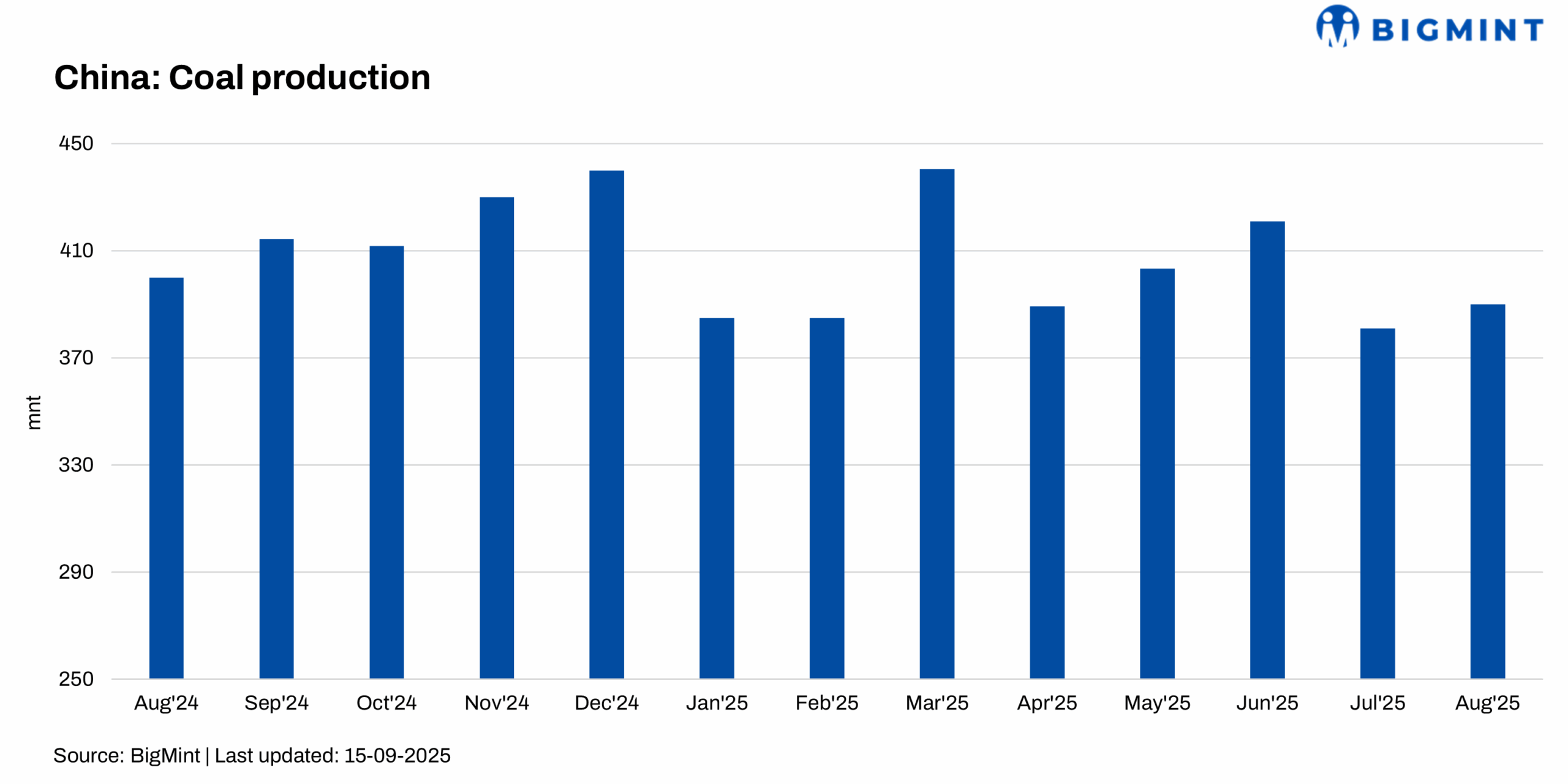
Due to these factors, coal production nationwide fell 3.2% y-o-y to 390.5 mnt in August, the NBS data showed.
The pullback came even as coal demand strengthened. Thermal power generation — overwhelmingly coal-fired — jumped 4.2% in August as sweltering heat drove air-conditioning loads. At the same time, hydropower, nuclear, wind, and solar all posted declines, deepening China’s reliance on fossil fuel.
Analysts say the shift signals a fundamental rebalancing. An oversupply of coal that weighed on prices for much of 2024 is beginning to ease, with output cuts expected to persist as Beijing keeps the anti-overproduction policy in place. That could tighten supply further into the final months of the year, even as winter restocking kicks in.
Note: This article has been written in accordance with a content exchange agreement between Mysteel Global and BigMint.
Leave a Reply