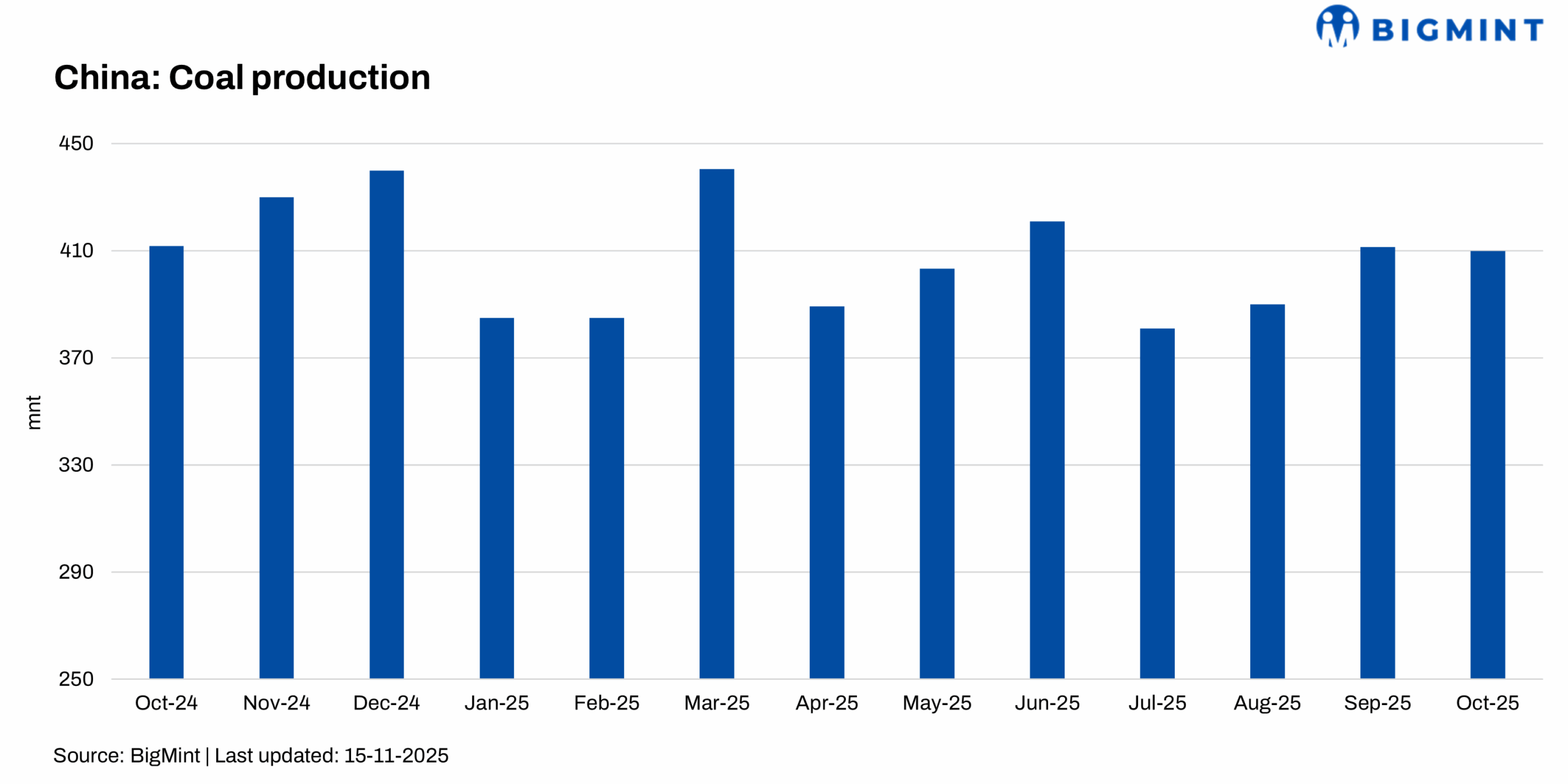
- Strict controls, safety inspections prompt production discipline in Oct
- Prices rise as demand outpaces supply amid unseasonal cold weather
Mysteel Global: Raw coal production in China’s key mining regions continued to contract in October, according to the latest regional breakdown from the National Bureau of Statistics (NBS), leading to tighter supply against demand.
The combined output of the top five coal-producing regions — Shanxi, Inner Mongolia, Shaanxi, Xinjiang, and Guizhou — reached 345.99 million tonnes (mnt) last month, down 1.3% y-o-y and 0.4% m-o-m, the NBS data showed. Together, they accounted for 85.1% of China’s total coal production in the month.
Among the top five, Shanxi, Inner Mongolia and Xinjiang recorded y-o-y declines, while Shaanxi and Guizhou registered increases.
Shanxi, the country’s top mining province, produced 111.38 mnt of raw coal in October, down 2% y-o-y. The province accounted for 27.4% of the national total. Similarly, Inner Mongolia saw its output fall 4.6% y-o-y and Xinjiang witnessed an 8.3% decline, according to the official data.
Shaanxi and Guizhou eked out y-o-y rises of 3.1% and 5.8%, respectively, thanks to new additions to mining capacity.
Since the central government started to crack down on overproduction in July, coal mines across major producing regions have been disciplined in their observance of output limits to avert punishment, including mining suspensions. This, together with the disruptions caused by stringent safety inspections conducted by local, provincial, and central government authorities, has already led to a tight supply-demand balance.
Mysteel Global noted that throughout October, spot thermal coal prices — based on Mysteel’s assessment on 5,500 kcal/kg NAR at northern transfer ports — had increased 9.1%, while coking coal prices — based on Mysteel’s coking coal composite index — saw a 7.9% rise.
In late October, the arrival of an unseasonal cold air mass across North China kept daytime temperatures well below seasonal norms, triggering the start of household heating about two weeks earlier than usual in some urban areas. This intensified the supply-demand mismatch for coal, sparking concerns about supply shortages in the coming months.
To safeguard winter energy security and prevent excessive price increases, the National Development and Reform Commission, the country’s top economic planner, highlighted energy supply stabilisation by boosting coal production and transportation at a meeting held recently.
This guidance suggests major producing regions may operate at or near their approved capacity limits in the remaining two months, Mysteel Global noted.
In the first ten months of this year, the country’s total raw coal output reached 3.97 billion tonnes, 1.5% higher than the year-ago level. The top five contributed 3.36 billion tonnes, marking a 2.3% rise y-o-y.
Note: This article has been written in accordance with a content exchange agreement between Mysteel Global and BigMint.
Leave a Reply