- Higher domestic output reduces import dependence
- Renewables push, policy shift lead to lower imports
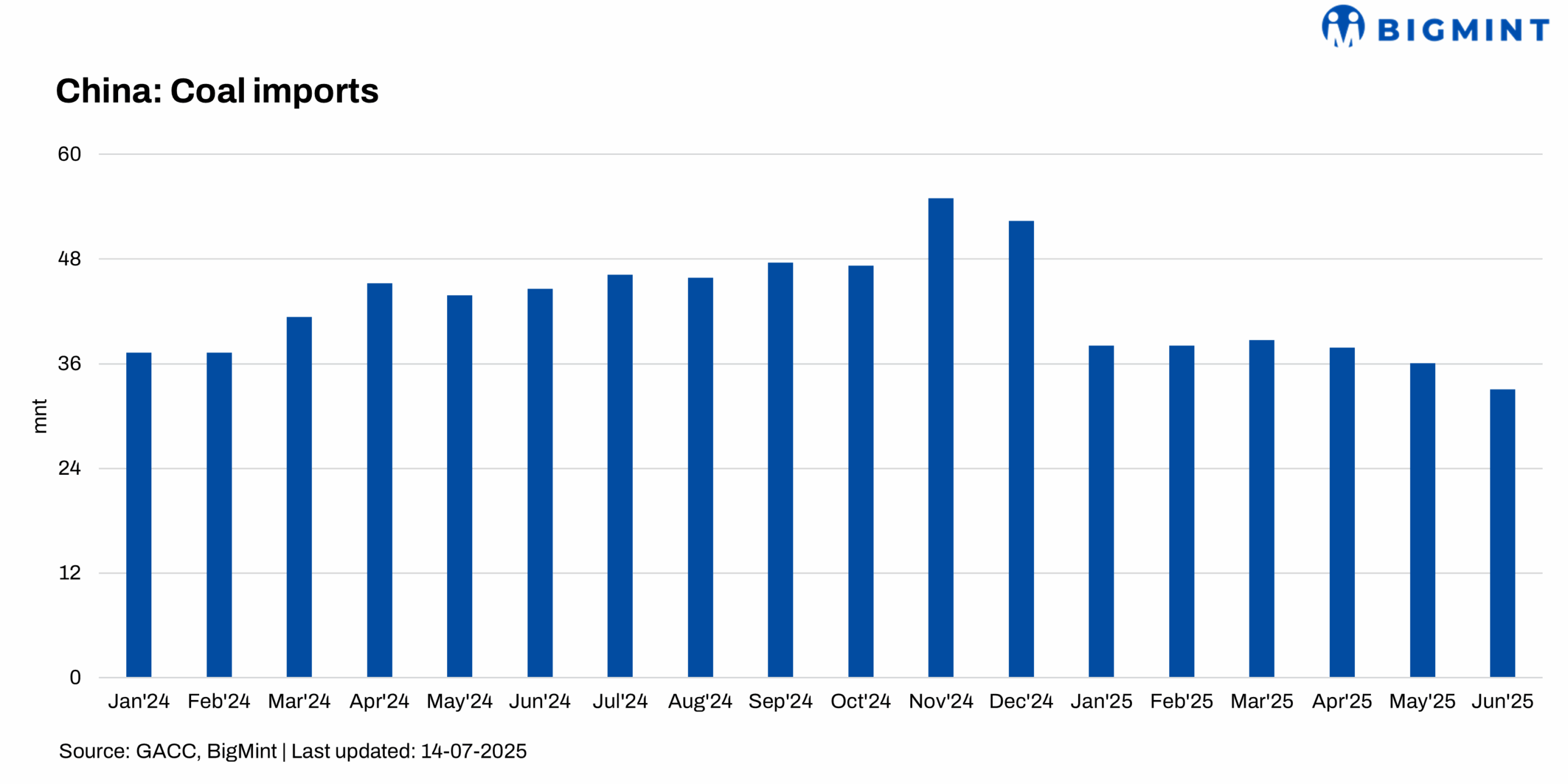
China’s total coal and lignite imports fell by 11.14% y-o-y in H1CY’25 (January-June 2025) to 221.7 million tonnes (mnt) from 249.48 mnt in H1CY’24. On an m-o-m basis, imports dropped 8.33% to 33.04 mnt in June from 36.04 mnt in May.
Higher domestic output reduces import dependence
The decline in imports appears to be linked with a sharp rise in domestic coal production. Output stood at 1,998.51 mnt in January-May, up from 1,860.12 mnt in the same period last year. This increase helped meet local demand, thereby easing the need for imports.
Demand declines amid steel industry restructuring directive
Lower coal demand from industrial users, particularly in steelmaking, may also be a factor. Crude steel production dropped 1.7% y-o-y to 431.6 mnt in January-May, while pig iron output declined 1.2% to 356.8 mnt.
This decline aligns with Beijing’s March announcement to restructure the steel sector, involving planned output cuts for the year and government-imposed production curbs to meet carbon emission targets.
Shift to renewables, power sector reforms cuts coal usage
China’s increasing focus on energy self-sufficiency and renewable sources such as solar, wind, and hydroelectricity is also contributing to a gradual shift away from coal imports.
Furthermore, coal-fired power plants now operate under a capacity-based payment system, where revenue is based on installed capacity rather than actual electricity generation. While this ensures financial stability for power producers, it may also be reducing actual coal usage, thereby impacting imports.
Outlook
Coal imports may remain under pressure as China boosts domestic production, expands renewable energy, and enforces industrial reforms, signalling a sustained shift towards cleaner, self-reliant energy sources.

Leave a Reply