- Secondary smelters curb output on weak auto, appliance demand
- Higher LME prices, geopolitical tensions keep import costs elevated
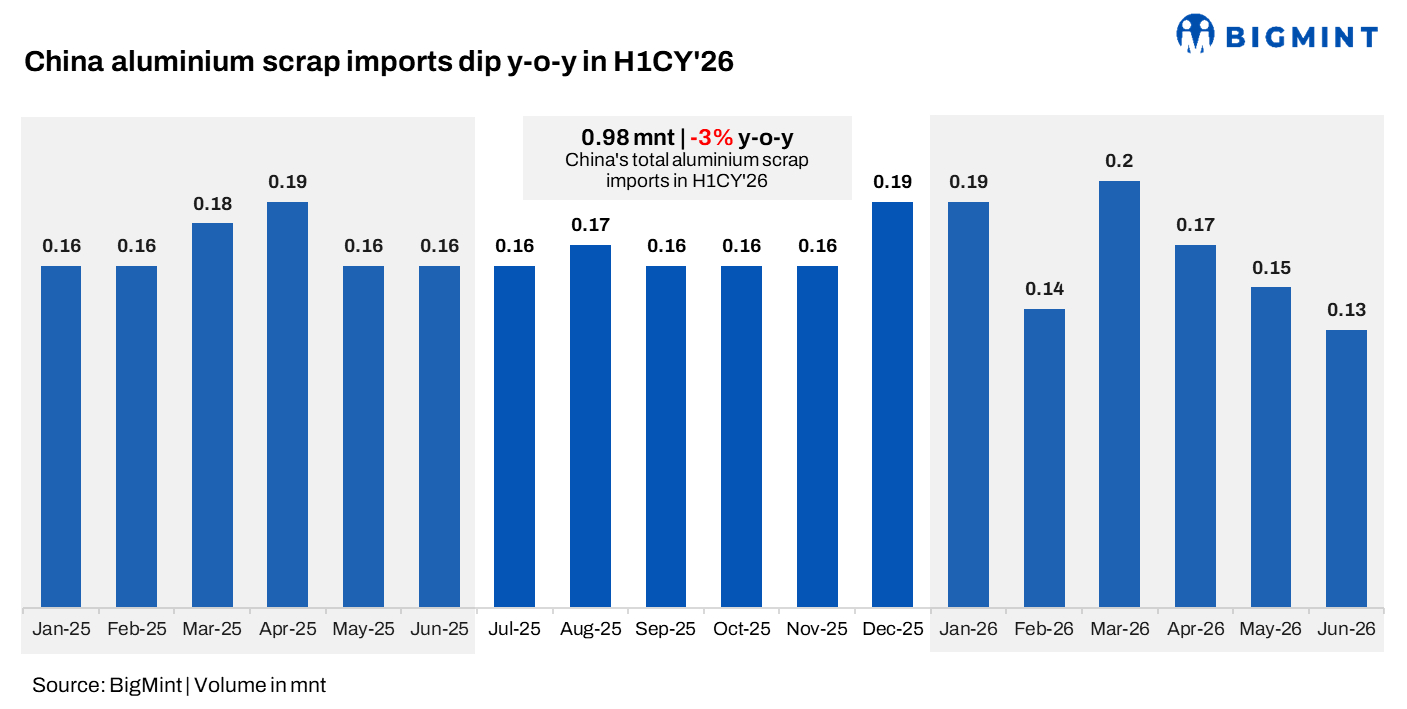
China’s aluminium scrap imports declined in the first half of 2026 amid weak demand and elevated import prices, with imports totaling 0.982 million tonnes (mnt) during January-June 2026, down 3% y-o-y from 1.012 mnt in the corresponding period of 2025, according to data released by China’s General Administration of Customs (GACC).
In June, aluminium scrap imports stood at 0.133 mnt, down 12.6% from May, marking the third consecutive m-o-m decline. Imports were also 14% lower compared to June last year.
Thailand remained China’s largest aluminium scrap supplier, although shipments continued to weaken. Imports from Thailand fell to 0.026 mnt in June, down 10.4% m-o-m and 22.4% y-o-y. During H1CY’26, China imported 0.199 mnt of aluminium scrap from Thailand, a significant 24.2% decline compared to the same period last year.
Overall, Thailand, the UK, and Japan were China’s three largest aluminium scrap suppliers during H1CY’26, accounting for 20.2%, 13.2%, and 10.2% of total imports, respectively.
The sustained decline in aluminium scrap imports since April has been driven by weaker demand from China’s secondary aluminium producers, persistently high international scrap prices, and an inverted price spread between the Chinese and overseas markets, which has reduced the competitiveness of imported scrap. At the same time, tighter overseas scrap collection, export restrictions, environmental regulations, and trade policy measures have constrained the availability of high-quality, cost-competitive recycled raw materials in the global market.

Demand from key downstream sectors, including the automotive and home appliance industries, remained subdued, prompting many secondary aluminium smelters to scale back production. As a result, secondary aluminium alloy production among monitored domestic smelters declined for the second consecutive month to 0.465 mnt in June, 0.8% lower than in May.
Meanwhile, ongoing geopolitical tensions in the Middle East continued to support global primary aluminium prices, keeping costs elevated across the aluminium value chain. Higher LME aluminium prices have also contributed to rising overseas scrap prices, further reducing the economic viability of imports into China.
Despite easing slightly from the previous month, the average price of imported 6063-grade aluminium scrap in Guangdong Province remained close to its highest level since January 2023, reflecting continued tightness in the international scrap market.
Outlook
Looking ahead, China’s aluminium scrap imports are expected to remain under pressure as the unfavourable domestic-overseas price arbitrage persists, while stricter export controls and environmental regulations in major supplying countries continue to limit the availability of aluminium scrap in the international market.
Leave a Reply