- Q2CY’26 marks highest second-quarter iron ore output since CY’18
- Sales rise 3% y-o-y on higher production, inventory drawdown
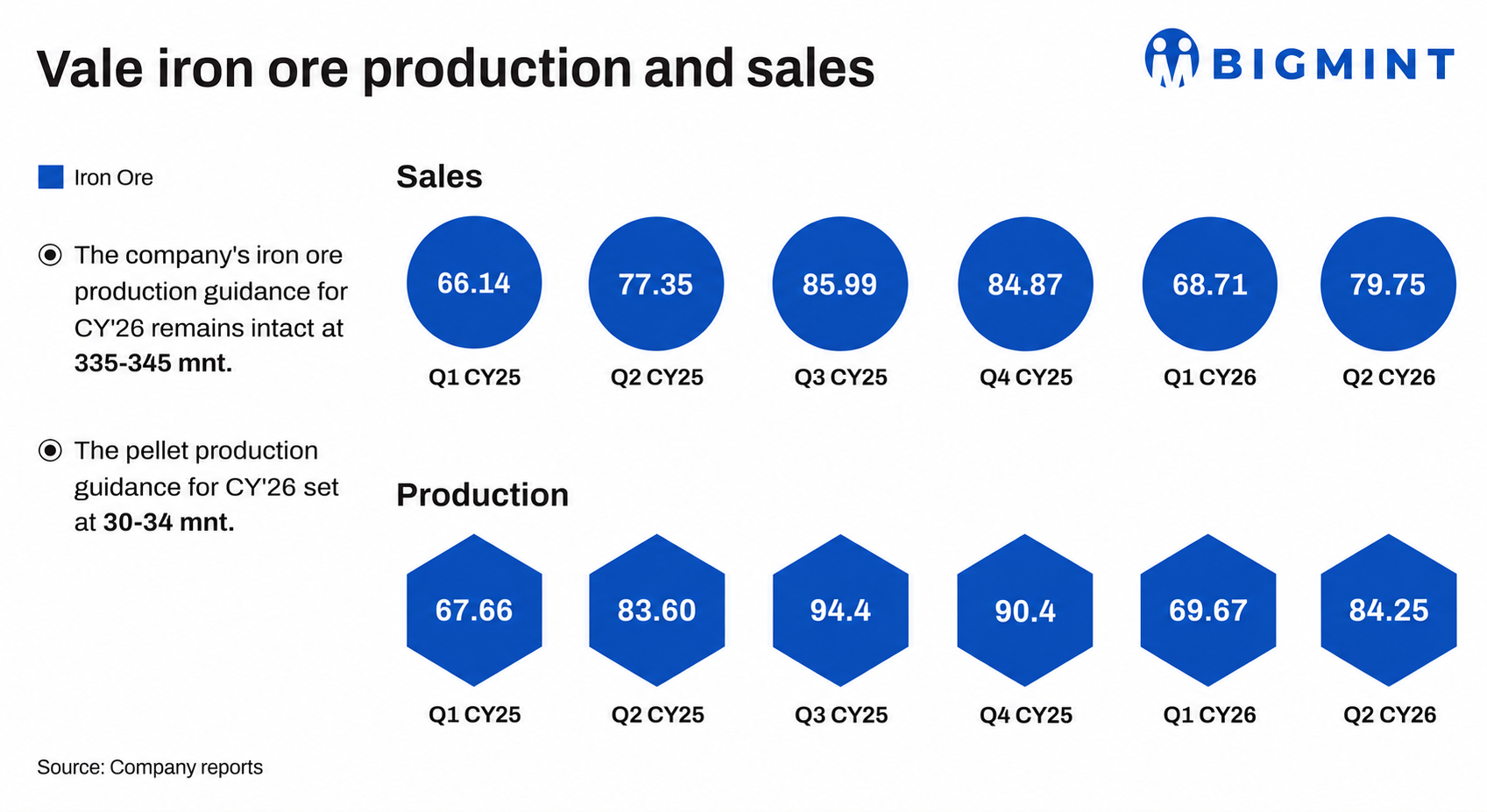
Brazilian miner Vale reported iron ore production of 84.3 million tonnes (mnt) in Q2CY’26, up 0.8% y-o-y from 83.6 mnt in Q2CY’25. The increase was supported by record production at S11D, along with higher output from the Capanema and VGR1 projects, helping the company achieve its strongest second-quarter iron ore production since 2018.
Operational improvements support iron ore output growth
Compared to Q2CY’25, iron ore production registered a marginal increase, supported by stronger performance across key mining hubs and continued ramp-up of expansion projects. Production, however, rose sharply by 20.9% q-o-q from 69.7 mnt in Q1CY’26, following the seasonally weaker first quarter.
Production trends remained mixed across systems.
- Northern System output declined 4% y-o-y to 39.6 mnt, mainly due to lower run-of-mine availability at Serra Norte. However, S11D posted a record second-quarter production of 23.4 mnt, supported by improved operational reliability.
- Southeastern System production increased 15.6% y-o-y to 24.3 mnt, driven by the continued ramp-up of the Capanema project, improved productivity at Alegria, and resumed operations at Agua Limpa.
- Southern System output fell 7.7% y-o-y to 12.1 mnt, as the suspension of Fabrica and Viga operations weighed on production. The decline was partly offset by higher output from the VGR1 plant.
Overall, improved performance at Vale’s growth projects and better operational efficiency offset lower production from mature mines.
Pellet output rebounds on improved feed availability
Pellet production stood at 7.3 mnt in Q2CY’26, down 7% y-o-y from 7.9 mnt in Q2CY’25.
The decline was primarily attributed to the temporary suspension of the Oman pellet plants following geopolitical tensions in the Middle East and the resulting logistical constraints. During the period, pellet feed originally allocated to Oman was redirected to Tubarao pellet plants and fines sales, while maintenance activities were carried out. Operations at the Oman facilities partially resumed towards the end of June.
Pellet sales, however, increased 3.5% y-o-y to 7.7 mnt, indicating stable downstream demand.
Sales increase 4% y-o-y
Iron ore sales (including fines, pellets, and ROM) stood at 79.7 mnt in Q2CY’26, up 3.1% y-o-y from 77.3 mnt in Q2CY’25, supported by higher production and inventory drawdowns. Fines sales rose 3.4% y-o-y to 69.9 mnt, while pellet sales increased 3.5% y-o-y. However, ROM sales declined 6% y-o-y, reflecting the company’s evolving product strategy.
The increase in sales volumes highlights improved supply availability compared to the corresponding period last year.
Realisations rise 12% y-o-y; premiums soften q-o-q
Vale’s average realised iron ore fines price stood at $95.0/t, up 11.6% y-o-y, although marginally lower than Q1CY’26 due to pricing adjustments and softer premiums. Average realised pellet prices increased 2.2% y-o-y to $137.0/t, supported by firmer pellet premiums.
The company’s all-in iron ore premium reached $4.4/t, up 7.3% y-o-y but down 29% q-o-q, primarily due to a higher share of mid-grade Carajas ore and Pellet Feed-China in the sales mix. However, strong market premiums for low-alumina products continued to support overall price realisations.
CY’26 guidance
- Vale has retained its CY’26 iron ore production guidance at 335-345 mnt.
- Pellet production guidance also remains unchanged at 30-34 mnt, with output expected to improve as the Oman pellet plants gradually return to normal operations.
Leave a Reply