- Pellet output recovers on improved feed availability
- Sales rise 4% y-o-y in line with higher production
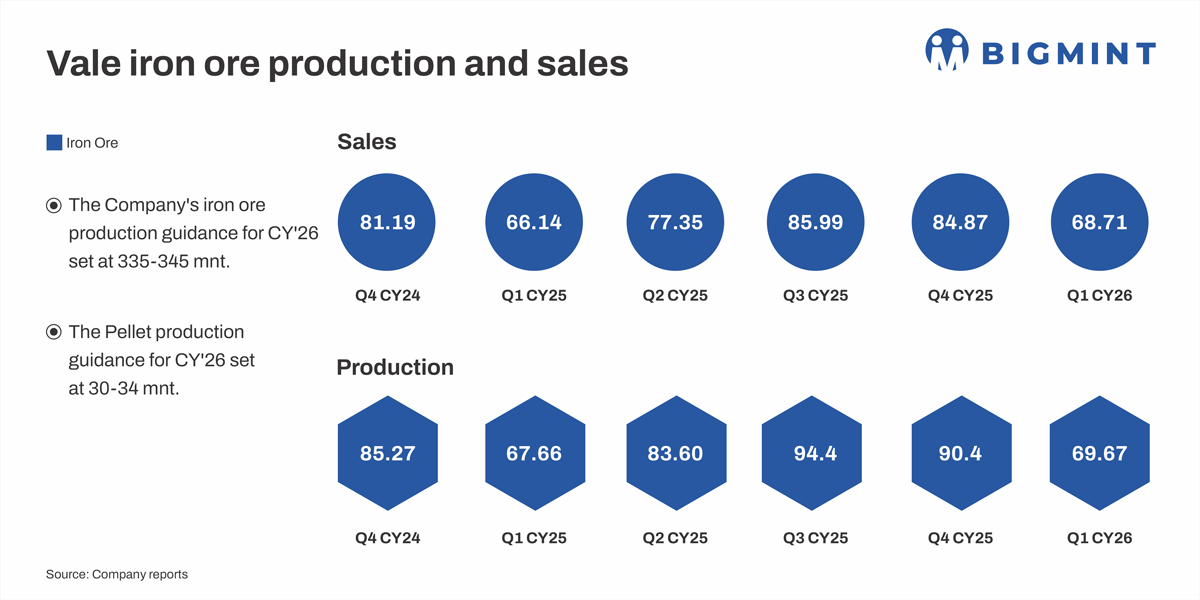
Brazilian miner Vale reported iron ore production of 69.7 million tonnes (mnt) in Q1CY’26, up 3% y-o-y from 67.7 mnt in Q1CY’25. The increase was supported by the ramp-up of new projects and improved operational performance, although seasonal rainfall continued to impact operations on a quarterly basis.
Meanwhile, Vale has kept its iron ore production guidance steady at 335-345 mnt for CY’26, reflecting confidence in its growth pipeline.
Operational improvements support iron ore output growth
Compared to Q1CY’25, iron ore production increased modestly, driven by stronger output from key mining hubs and ongoing ramp-ups. Production, however, declined 22.9% q-o-q against 90.4 mnt in Q4CY’25, impacted by seasonal rainfall and typical first-quarter disruptions.
Production trends remained mixed across systems.
- Northern System output declined 3.6% y-o-y to 33.2 mnt, mainly due to lower run-of-mine availability at Serra Norte, though S11D achieved record Q1 production, supported by improved asset reliability.
- Southeastern System production rose 19.2% y-o-y to 19.2 mnt, aided by the ramp-up of the Capanema project, improved performance at Brucutu, and reduced maintenance downtime at the Itabira complex.
- Southern System output remained largely stable to 10.4 mnt, with incremental gains from VGR1 offsetting weather-related disruptions.
Overall, better asset utilisation and project ramp-ups helped offset weather-related constraints.
Pellet output rebounds on improved feed availability
Pellet production stood at 8.2 mnt in Q1CY’26, rising 13.7% y-o-y from 7.2 mnt in Q1CY’25, reversing the decline seen last year.
The improvement was driven by higher pellet feed availability, particularly from Itabira and stronger operational performance at the Tubarao pelletising plants.
Meanwhile, the Oman pellet plant underwent planned maintenance, while logistical disruptions linked to geopolitical tensions temporarily impacted operations. Vale indicated that feed earmarked for Oman will be redirected to domestic facilities and fines sales during this period. Vale has kept its pellet production guidance steady at 30-34 mnt for CY’26.
Pellet sales increased 2.7% y-o-y to 7.7 mnt, indicating relatively stable downstream demand.
Sales increase 4% y-o-y
Iron ore sales (including fines, pellets, and ROM) stood at 68.7 mnt in Q1CY’26, up 3.9% y-o-y from 66.1 mnt in Q1CY’25, supported by higher production and inventory drawdowns. Fines sales rose 4.7% y-o-y to 59.4 mnt, while pellet sales increased 2.7% y-o-y. However, sales fell 19% q-o-q, largely due to weather-related shipment constraints. ROM sales, however, declined 16.3% y-o-y, reflecting a shifting product strategy.
The overall increase in sales volumes highlights improved supply-side conditions compared to last year’s weather-affected quarter.
Realisations up 6% y-o-y; premiums rise 29%
Vale saw stronger pricing in Q1CY’26, with iron ore fines realisations rising 5.5% y-o-y to $95.8/t. All-in premiums climbed 29% to $6.2/t, supported by a better product mix and higher low-alumina premiums, while pellet realisations fell 5% y-o-y amid softer global trends.
CY’26 guidance
- Vale has kept its iron ore production guidance steady at 335-345 mnt for CY’26.
- Pellet production guidance has also been maintained at 30-34 mnt.

Leave a Reply