- Exports cross 3 mnt for first time on robust Asian demand
- Lower acreage to reduce 2026 production, supporting prices
Brazil’s cotton industry has reinforced its position as the world’s largest cotton exporter after shipments exceeded 3 million tonnes (mnt) for the first time during the first ten months (August-May) of the 2025-26 marketing year. According to Abrapa’s June 2026 Cotton Brazil Market Report, exports reached a record 3.002 mnt, up 16.6% y-o-y, with two months still remaining in the marketing season. The milestone highlights sustained international demand for Brazilian fibre despite a weaker production outlook for the 2026 crop.
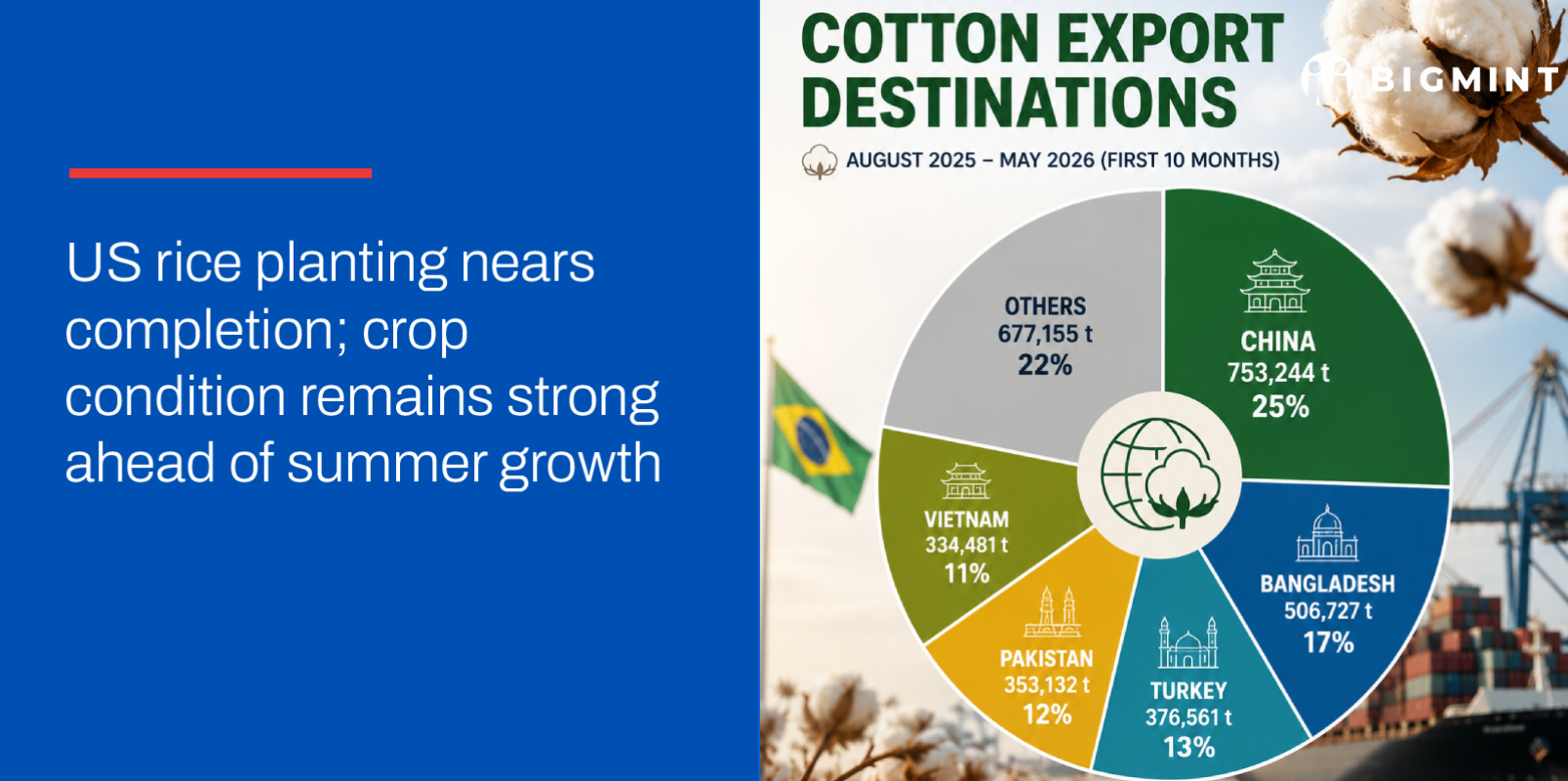
May exports totalled 291,100 tonnes (t), a 51.5% increase from the corresponding month last year, generating export revenue of nearly $449.6 million. China remained the largest buyer, importing 753,200 t during the marketing year, followed by Bangladesh at 506,700 t and Turkiye at 376,600 t. Together, these three markets accounted for nearly 55% of Brazil’s total cotton exports, underlining the country’s growing importance in supplying Asia’s textile industry.
Production outlook weakens
Despite the record export performance, Abrapa revised its 2026 crop estimates lower. Cotton planted area is now projected at 2.0 million hectares, down 7.8% from the previous season, while lint production is forecast at 3.90 mnt, an 8.2% decline y-o-y. Average lint yield is expected to remain broadly stable at 1,954 kg/ha, indicating that reduced acreage, rather than lower productivity, will drive the decline in output. Grower sales have also slowed, with around 72% of the crop sold compared with 97% at the same stage last year, suggesting producers are holding stocks in anticipation of improved prices.
The report also showed the CEPEA/ESALQ cotton index averaging 84.7 cents/lb in May, above the average ICE New York futures price of 81.7 cents/lb, reflecting firm domestic demand and supportive market fundamentals.
Global market implications
Brazil’s export growth has been supported by continued investments in fibre quality, sustainability, and traceability through the Cotton Brazil programme, strengthening its acceptance among international mills. The country’s Responsible Brazilian Cotton (ABR) certification has further enhanced its competitiveness in premium export markets.
With Brazil accounting for an increasing share of global cotton trade, a smaller 2026 crop could tighten exportable supplies and shift additional demand towards competing exporters such as the United States and Australia. However, continued demand from China, Bangladesh, Pakistan, Vietnam and Turkiye is expected to keep Brazilian cotton at the centre of global trade flows. Market participants will closely monitor weather conditions, logistics and harvest progress, as efficient port operations and container availability remain critical to sustaining record export volumes.
Outlook
Brazil is expected to maintain strong export momentum through the remainder of the 2025-26 marketing year. However, lower production next season, coupled with slower farmer selling and resilient Asian demand, is likely to provide underlying support to international cotton prices while reinforcing Brazil’s strategic role in the global cotton supply chain.
Leave a Reply