- India emerges as leading buyer despite need-based procurement
- Global market sentiment stays muted in Q1 amid volatile freights
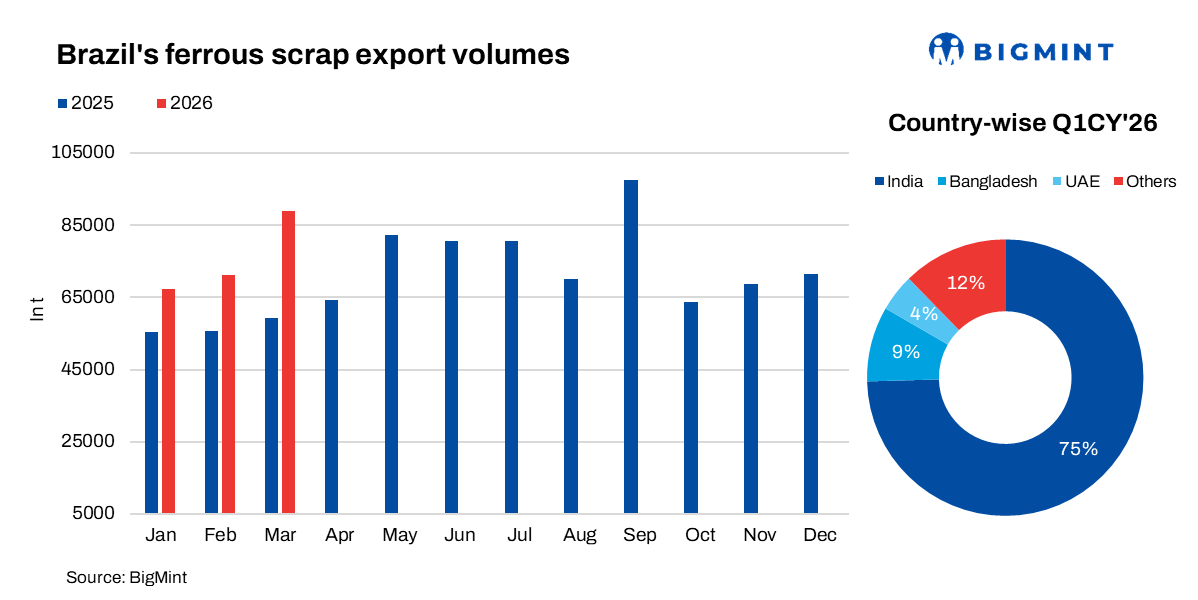
Brazil’s ferrous scrap exports increased by 35% y-o-y to 0.23 million tonnes (mnt) in Q1CY’26 from 0.17 mnt in the corresponding period last year, supported mainly by stronger shipments to India. Export activity improved during the quarter as Brazilian cargoes remained competitively priced amid relatively favourable freight economics compared with alternative origins.
India remains largest buyer
India remained the largest buyer of Brazilian ferrous scrap during the quarter, with imports increasing to around 0.17 mnt in Q1CY’26 compared with 0.11 mnt in Q1CY’25. Market participants noted that Indian mills largely continued hand-to-mouth buying strategies amid sluggish steel demand and cautious market sentiment, although Brazilian material continued attracting buying interest due to workable pricing levels.
Meanwhile, Bangladesh’s imports from Brazil declined by 33% y-o-y to 0.02 mnt during the quarter. Brazil also shipped around 0.01 mnt each to the UAE, Bolivia, and Paraguay.
Global scrap trade sentiment remains subdued
Despite higher export volumes, overall global scrap trade sentiment remained subdued during the quarter amid volatile freights, geopolitical uncertainty, weak steel margins, and cautious purchasing activity across Asian markets.
A market participant noted, “Buyers across key importing regions largely avoided aggressive bookings, while mills continued focusing on lower-priced and shorter-shipment cargoes amid uncertain finished steel demand conditions.”
Domestic steel slowdown tightens exportable scrap availability
Brazil’s domestic steel sector witnessed a mild slowdown during the quarter, limiting scrap generation and tightening exportable scrap availability. Crude steel production declined by 2.4% y-o-y to 8.06 mnt in Q1CY’26 from 8.26 mnt in the corresponding period last year, while hot metal production fell by 2.6% to 6.43 mnt. Meanwhile, hot metal production was reported at 2.17 mnt in January, 1.99 mnt in February, and 2.27 mnt in March.
A market participant also noted, “Improving domestic metallics demand encouraged Brazilian mills to increase local scrap procurement, thereby reducing surplus material available for exports.”
Outlook
BigMint expects cautious buying sentiment and fluctuating freight conditions to limit aggressive growth in Brazilian scrap exports in the coming months, while India is likely to remain the key destination for Brazilian cargoes due to competitive pricing.
Leave a Reply