- BF-rebar prices surge on improved project demand, supply squeeze
- Domestic HRC prices rise to 4-year high, mills hike prices for Sep’26
- Premium coking coal prices hit 2.5-year high, to support steel prices in Q3FY’27
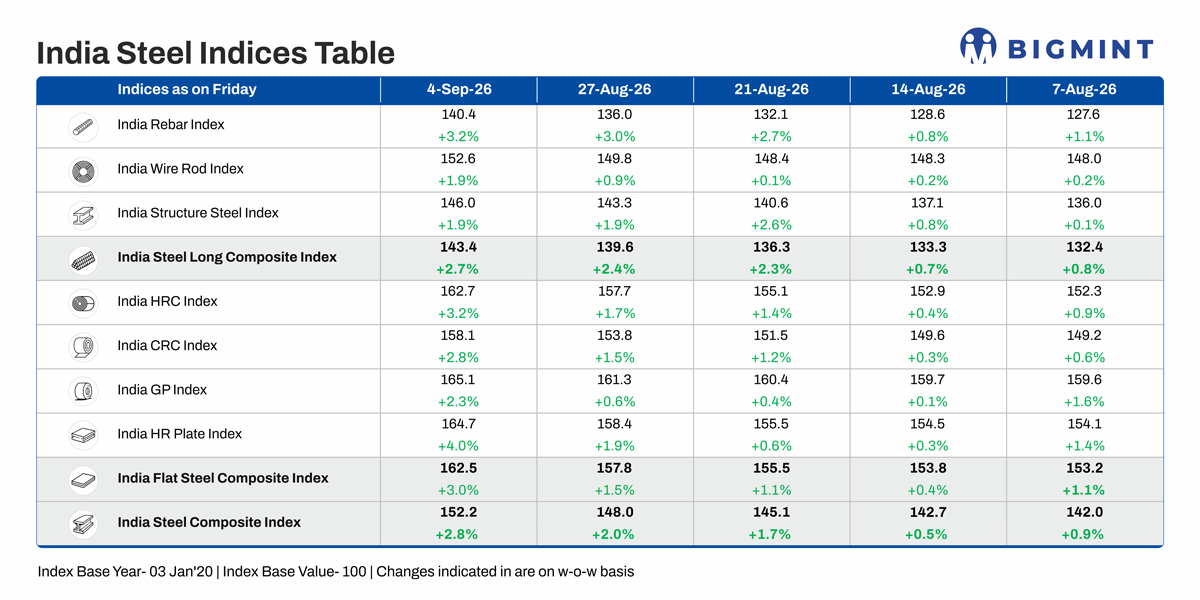
Morning Brief: BigMint’s India steel composite index increased by 2.8% w-o-w, as assessed on 4 September, rising for the seventh straight week since late July as domestic steel prices continue to remain on an upward trajectory. This is because of a broad tightening across the steel value chain during August. Iron ore, pellets and coking coal prices have strengthened, lifting replacement costs for steelmakers.
Maintenance shutdowns have reduced primary steel availability and mills have tightened allocations to the trader channel. Domestic HRC prices hit a four-year high in September as buyers have begun to replenish inventories ahead of anticipated price increases. Production and consumption continue to grow but trade-level availability remains tight.

Both the HRC and rebar sub-indices increased by 3.2% w-o-w as the primary mills announced price hikes. Trade sentiment has likewise strengthened.
Highlights of price movements
BF-route prices see sharp spike amid tight availability: BigMint’s assessment for rebar (IS 1786 Fe 550D, 12–32 mm, BF route) increased to INR 57,200/t ($606/t), up INR 2,200/t w-o-w from INR 55,000/t during the previous assessment. Prices are ex-Mumbai for the distributor-to-dealer segment and exclude 18% GST.
Availability of BF-route rebar has tightened, providing producers and distributors with greater pricing strength. Market sources indicated that several mills have stopped accepting fresh project bookings, while some producers have not announced project prices, further limiting available material in the project segment.
Demand from project customers improved last week, with higher procurement and increased booking activity reported. Buyers appeared more willing to grab volumes as expectations of stable-to-firm prices encouraged advance purchases. However, availability in the project segment was tight as some mills either stopped taking fresh bookings or refrained from announcing project prices, according to sources.
IF-rebar market buoyed by rising input costs: Buying activity was limited last week, but rising sponge iron prices, along with firm iron ore and coal costs, kept mill input and conversion costs elevated. Mill inventories stood at around eight days, while order booking visibility remained limited to three-five days. Secondary rebar prices may remain range-bound, with elevated input costs providing support but subdued buying interest capping further gains.

HRC prices climb to 4-year high: BigMint’s assessment for HRC (IS2062, Grade E250, 2.5–8 mm/CTL) increased to INR 62,000/t on 4 September, up by INR 1,900/t w-o-w from INR 60,100/t on 27 August. The assessment for CRC (IS513, Grade O, 0.9 mm/CTL) increased to INR 71,100/t on 4 September, up by INR 3,300/t w-o-w. Prices are ex-Mumbai and exclusive of 18% GST.
Major integrated steelmakers increased flat steel list prices by INR 750-1,500/t for September deliveries as improving demand expectations from the construction, infrastructure and automotive sectors coincided with rising input costs. Material availability has become increasingly tight in the trader channel. Mills reportedly fulfilled only around 75% of desired distributor allocations as supplies were increasingly directed towards automotive and other B2B customers.
Lower trader-channel availability strengthened sellers pricing power and reduced the scope for discounting.
Buying activity also improved. Buyers increasingly replenished inventories ahead of expected price increases while continuing to procure for immediate requirements. Although overall demand remained moderate and stable rather than exceptionally strong, firmer CRC-linked demand continued to support HRC consumption and trade activity.

The combination of controlled dispatches, lean inventories, stronger CRC demand and anticipatory procurement provided a firm foundation for spot prices.
HRC export prices rise marginally on domestic support: HRC export prices for the Middle East and Vietnam rose by $10/t w-o-w, while remaining unchanged for the EU amid the summer holiday slowdown.
The EU’s October-December quota is already fully booked and additional volumes would attract the applicable out-of-quota duty, making new bookings unviable. Persistent gap between mills’ offers and Vietnamese bids continued to limit trading activity. Amid higher domestic realisations, mills remained unwilling to lower export offers to meet buyer bids, with no fresh HRC bookings to Vietnam heard last week.
Steel imports declined 8.6% to 1.60 mnt during January-August, reducing the share of overseas material in the domestic market. Exports expanded rapidly, with shipments reaching 2.30 mnt during the first eight months of 2026, up 142.1% y-o-y.
Premium coking coal prices hit 2.5-year high: Premium Australian coking coal prices have risen to their highest levels in two-and-a-half years, as per BigMint data, providing support to steel prices. BigMint’s melting scrap index rose by over INR I,000/t w-o-w while Fe 62% iron ore fines prices in Odisha increased by around INR 100/t.
Outlook
In the BF-rebar segment, continued maintenance at major mills, fresh project bookings and improving procurement activity may provide further support to prices. Some large mills have already hiked prices. In the IF segment, high coal and DRI costs will offer support to prices.
In the flats segment, sources are expecting demand and prices to increase through the next quarter. “Holding back supply only adds to mills’ interest costs,” said a source, “so they may be expecting higher prices to recover some of their losses.”
With project activity picking up, demand is expected to improve. Large end-users, particularly OEMs, are facing delivery delays from manufacturers, which could push them to the spot market. This additional demand may support prices.
Also, supply concerns around coking coal and rising coke costs in China have nudged Chinese mills back to the seaborne steelmaking coal market, thereby pushing spot prices higher and raising mils’ import costs. Higher coking coal costs will show up in steel prices in the next quarter, as mills will have no option but to transfer the added costs to prices.
Leave a Reply