- IF rebar prices correct across markets on weak retail offtake, rising inventories
- BF rebar bucks overall trend, edges up w-o-w on tight prompt supply
- HRC faces fresh pressure from stock liquidation and weaker export offers
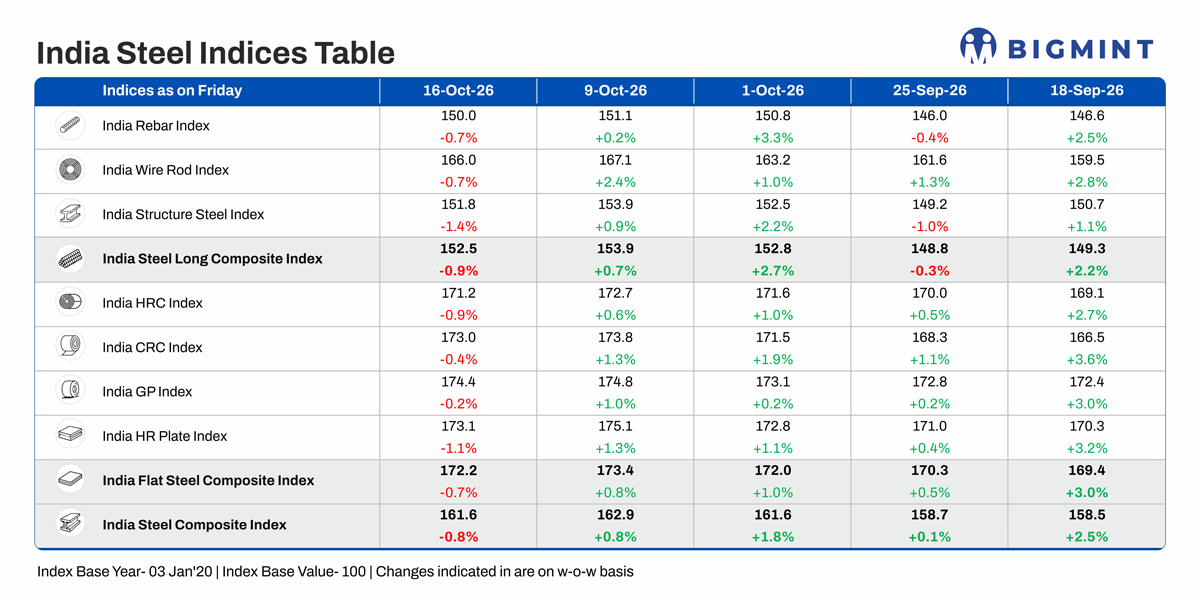
Morning Brief: BigMint’s India steel composite index declined 0.8% w-o-w as of 16 October 2026, reversing the 0.8% increase recorded in the previous assessment. The correction came after a sustained rally through 11 staright weeks since mid-July, with both the long and flat steel segments registering declines.
The long steel composite index fell 0.9% w-o-w, while the flat steel index declined 0.7%. The latest movement marks a moderation in steel prices as festive season liquidity constraints, cautious buying and weaker retail offtake in parts of the market offset continued strength in project demand and supply tightness in the BF-route rebar segment.

Long steel correction led by IF-route rebar: The decline in the long steel index was driven primarily by weakness in the induction furnace (IF)-route rebar market. IF-route rebar prices fell by INR 500-1,600/t across markets during the week, with Raigarh, Hyderabad, Jalna and Jaipur seeing some of the sharpest corrections.
The correction reflects subdued retail offtake ahead of the festive period. IF-route producers are carrying around 8-10 days of inventory, while confirmed order visibility is only around 3-5 days, creating a mismatch between available material and immediate demand. Buyers remained focused on immediate consumption rather than bulk procurement, putting pressure on secondary-route prices.
This weakness was sufficient to pull the overall long steel index lower despite continued strength in the BF-route segment.
BF-route rebar, in contrast, remained firmly supported. BigMint’s benchmark assessment (IS 1786 Fe 550D, 12-32 mm, BF route) increased by INR 400/t w-o-w to INR 64,300/t, up from INR 63,900/t. Prices are ex-Mumbai for the distributor-to-dealer segment and exclude 18% GST. Prices were driven by sustained project demand and limited prompt availability. Several major mills raised list prices by up to INR 1,000/t last week, while mill inventories remained low at around 5-7 days.

The divergence between the two segments has become increasingly pronounced. In Mumbai, the BF-IF rebar differential widened to around INR 10,800/t, while IF-route material still accounts for an estimated 65-70% of India’s rebar market. This means that weakness in the much larger secondary segment is having an impact on the long steel index even as primary-route prices continue to reach multi-year highs.
Flat steel index slips as HRC prices correct: The flat steel composite index declined 0.7% w-o-w. HRC was the principal contributor to the correction. BigMint’s bi-weekly assessment for HRC (IS 2062, Grade E250, 2.5-8 mm/CTL) declined by INR 1,000/t to INR 63,700/t, down from INR 64,700/t. CRC (IS 513, Grade O, 0.9 mm/CTL) declined by INR 1,200/t to INR 73,400/t. Prices exclude 18% GST. HR plate also declined, while GP was comparatively more resilient.
The physical HRC market weakened across most regions. Trade-level HRC prices declined by INR 100-900/t w-o-w in most markets, while south India bucked the trend with increases of INR 200-600/t on relatively better demand.
The correction appears to have been driven less by a fundamental deterioration in steel demand and more by short-term liquidity and inventory considerations. Ahead of the festive period, traders and distributors are seeking to liquidate stocks and improve cash flows, resulting in discounts. Buyers largely restricted purchases to immediate requirements.
This contrasts with the rebar market, where tight prompt availability has allowed mills to maintain pricing power. HRC inventories remain relatively comfortable, giving buyers greater flexibility and making it more difficult for recent mill price increases to be fully passed through to the trade market.

Inventory levels remained relatively comfortable overall, although availability varied by product and specification. The need to liquidate stocks and manage working capital ahead of the festive period resulted in varied pricing strategies, with some sellers offering discounts to generate liquidity, while the shortage of thinner-gauge CRC supported prices of certain specifications.
HRC export offers to EU decline: Indian HRC export offers to the European Union (EU) declined by around $10/t w-o-w to $660/t FOB, compared with $670/t in the previous week. Buyers remained reluctant to book material at prevailing levels, as the gap between their price expectations and sellers asking levels continued to weigh on fresh bookings. Therefore, HRC prices did not receive support from the export market.
Raw materials prices weaken: Domestic iron ore prices remained stable but sentiment weakened somewhat as OMC cut base prices for its October auction. Domestic and imported scrap prices corrected on weak downstream sentiment, while imported premium hard coking coal declined only marginally to $293/t CNF Paradip. Therefore, raw material costs did not provide a strong catalyst for a deeper correction in steel prices.
Outlook
The domestic steel market is likely to remain in a consolidation phase as festive disruptions and cautious procurement weigh on spot trading. BF-route rebar is expected to remain relatively firm because of tight prompt availability, project demand and the gradual pace of production recovery following maintenance. However, further gains could be constrained if mills restore output faster or if festive season buying slows materially.
For HRC, the near-term direction is likely to remain more balanced. Liquidity pressures and comfortable inventories could keep trade prices under pressure during the festive period. However, lower imports and stronger exports continue to support the domestic flat steel market.
The broader outlook therefore remains cautiously firm. BigMint expects HRC and CRC prices to remain firm. The weekly fall in the composite index appears to represent a pause after the sharp September-early October rally rather than the beginning of a sustained downtrend. The next leg of the market will depend on whether post-festive restocking revives demand, whether distributors rebuild inventories, and how quickly domestic mills restore normal production.
Leave a Reply