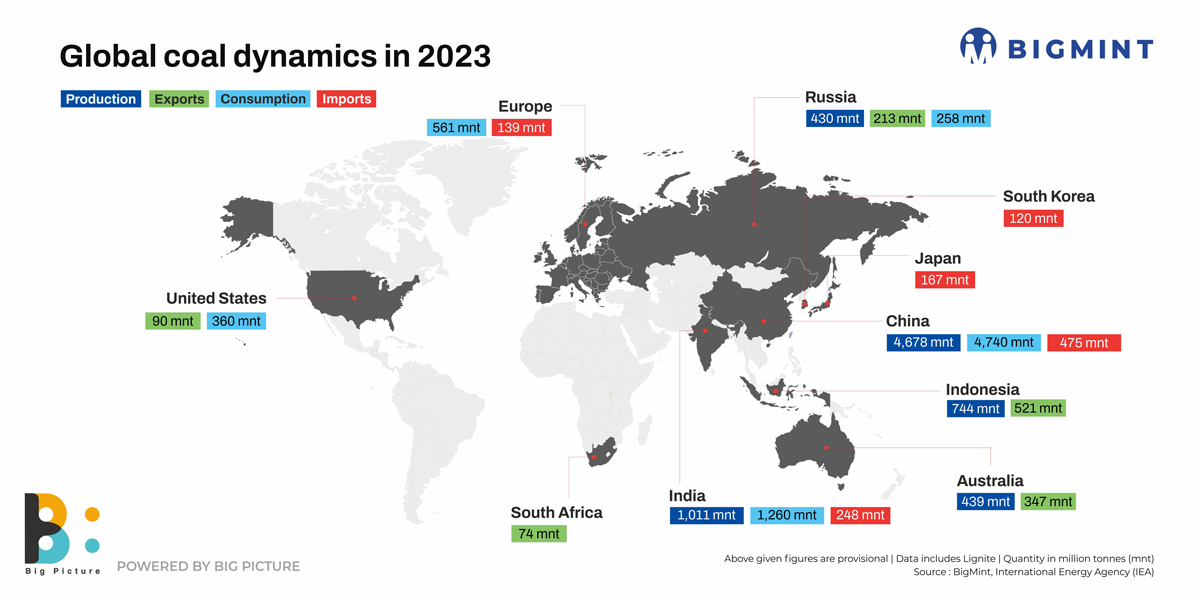
Morning Brief: FutureCoal, The Global Alliance for Sustainable Coal, stands as the world’s only multilateral, neutral, and progressive organisation representing the entire global coal value chain. It advocates for responsible practices, equitable representation, and collaboration to drive sustainable coal practices and decarbonisation. In an exclusive interview with BigMint, Daleen Lopez Ruiz, Director, Business Development & Membership, FutureCoal , talks about the “coal circular economy” and how it is empowering coal-producing nations to make the most of their natural resources.

Excerpts from the interview:
The focus of the global coal market has shifted to Asia, specifically China and India. How fast are the advanced Western economies seeking to move away from coal and other fossil fuels?
The global coal market is witnessing a significant shift towards Asia and BRICS, particularly driven by China and India’s ambitions for economic growth. While Western nations seek ways to move away from fossil fuels, coal still plays a significant role, accounting for 16% of the EU’s electricity generation in 2022. Coal helps keep the lights on, stepping up when other energy sources cannot meet demand, such as gas, wind, nuclear, hydro, and solar, especially during shortages.
Germany and Poland demonstrate the significance of coal and lignite plants, particularly as Germany phased out nuclear power and Poland heavily relies on combined heat and power. Coal provides affordable heating for industries and homes, especially during harsh winters. Meanwhile, China and India prioritise energy security and diversification, cementing coal’s role in their energy portfolios.
How are geopolitical crises, energy inflation, trade wars, sanctions, and growing trade protectionism impacting the global coal market?
All these factors have impacted the coal market, similar to other markets. Amidst this, gas shortages have heightened discussions around energy security. Prices have surged in recent years, and along with them, the cost of sustaining economic growth has also risen. However, there is a silver lining – these higher prices are prompting coal producers to innovate and invest in more efficient and environmentally friendly practices.
Countries like India are intensifying their reliance on coal as a power source, seeing it as a pillar of energy security and stability during uncertain times. They are not simply adhering to traditional methods; instead, they are reimagining coal’s role through cleaner energy forms and fertilisers, thereby reducing dependence on other more volatile markets.
It’s a story of transformation: coal isn’t just surviving; it’s evolving to meet the world’s energy needs, all while considering its environmental impact and adopting solutions for reducing emissions.
As all big coal-consuming nations, such as China, Japan, the EU, South Korea, etc., are increasingly turning to renewable energy, what impact will this have on the economies of major exporting countries such as Indonesia and Australia? How will these countries cope with the pressure of rapidly depleting exports and trade revenues?
Let us take a moment to clear up a common misconception: coal and renewables do not have to be mutually exclusive. Take China, for example, which is a global leader in both renewable energy and coal production. We believe these two sources can work together, providing a reliable and diverse energy mix that serves nations’ interests worldwide.
It is important to remember that coal is not just another commodity for leading coal-exporting nations- it is a vital resource. Initiatives like FutureCoal’s Sustainable Coal Stewardship (SCS) and the development of diverse commodity products allow coal to contribute significantly to economic development and environmental sustainability. In Australia, the coal mining sector has generated AU$105 billion in revenue. This highlights the sector’s crucial role in creating value for the mining industry, contributing to the balance of payments, and generating tax revenues to finance essential services.
Exciting growth prospects are also on the horizon, such as emerging markets for extracting critical minerals from coal mining by-products and repurposing ash waste from power plants and steel mills into construction materials.
Critics often focus solely on the negative aspects of fossil fuels, overlooking the untapped value of coal and its waste streams. These resources can help ease the demand for critical minerals and reduce emissions from cement production, which currently account for 8% of global carbon emissions.
Businesses in Indonesia and Australia serve nations that have recently established coal-powered energy infrastructures. Despite commitments from some European countries to phase out coal in the short term, there is no clear indication that this market will disappear overnight. So, let us keep the conversation going and continue exploring how to make the most of every resource we have.
In developing economies, especially India, coal-based power will likely last for another 40-50 years, if not more. How will these economies bear the pressure of increasing climate action and regulations in the future?
Asia, with its rapidly growing economies like India, China, and Indonesia, has become a focal point for global attention. These nations are at the forefront of Sustainable Coal Stewardship (SCS), demonstrating how to invest in innovative coal abatement technologies while maintaining a focus on our climate objectives. India’s recent policy announcements underscore its dedication to striking a balance between energy security and climate responsibility.
Investing in coal abatement technologies is imperative if we are to achieve our climate targets, as countries can only meet these objectives through a diversified energy approach. India is spearheading this effort by prioritising coal gasification, with the aim of elevating power plant efficiency standards to a world-class level and laying the groundwork for cleaner and more sustainable energy.
It is noteworthy that India’s coal fleet is now more efficient than North America’s, marking considerable progress.
The ASEAN initiative, launched in the mid-2000s, exemplifies this approach. The programme emerged from the necessity for energy diversification, aiming to reduce dependence on gas and renewables and fill the void left by the absence of nuclear power. Coal has emerged as a significant contributor to achieving energy security. Alongside a range of renewable initiatives to support the strategy,
Is there a future for sustainable coal use? Can coal continue to be used if we could just decarbonise the entire supply chain through technological means?
FutureCoal believes in encouraging the global coal value chain to adopt sustainable coal practices. This is our way of driving our industry forward. Decarbonisation is often oversimplified to mean phasing out fossil fuels. We need to rethink this approach. The focus should be on reducing emissions and achieving carbon neutrality, which can be done in many ways.
Advanced technologies are already here, but only a few countries have been brave enough to explore the potential of using fossil fuels. But the momentum is building. High-efficiency coal power, zero-emission mining, and reducing resource use and waste production are all key to responsible coal utilisation.
The technology to decarbonise all value chains is available. Electrification of end-user sectors like transport, industrial processes, and households requires reliable 24/7 power, making coal’s role in ensuring affordability and reliability crucial. Capturing and permanently storing CO2 can provide the secure energy needed for our electrified future. Unfortunately, this area has received minimal support from governments and venture capitalists compared to research in other areas.
With greater government support, emissions from existing assets can be reduced overnight, avoiding the need to develop entirely new alternative methods from scratch. Major developing economies such as India, China, Japan, and various Asian nations invest billions in developing and implementing the latest coal technologies alongside their impressive renewable energy ambitions. This strategic move underscores their commitment to coal as a crucial component of energy security and climate goals, aligning closely with FutureCoal’s vision of a sustainable coal future.
Carbon capture and reuse for manufacturing biofuels, hydrogen, and chemicals are giving the carbon economy a new shape through circularity, enhancing its value. Is this trend positive for coal? Can it just give coal a new lease of life?
It is truly inspiring to see countries around the globe embracing our vision for a ‘coal circular economy.’ This approach empowers coal-producing nations to make the most of their natural resources by transforming them into valuable products. Our Sustainable Coal Stewardship blueprint provides a clear roadmap to maximise the value derived from each tonne of coal, balancing economic gains and environmental benefits.
Our blueprint is divided into three phases: Pre-Combustion, Combustion, and Beyond-Combustion. Each phase is designed to enhance energy security and reduce emissions. The Beyond-Combustion phase is particularly exciting as it unlocks coal’s potential to produce high-value products like blue hydrogen, synthetic liquid hydrocarbons, and critical minerals.
This vision is gaining traction as nations invest in and roll out facilities that produce various products from coal. From China’s largest hydrogen and ethanol plant to India’s ambitious coal gasification plans, countries are exploring coal’s untapped potential. Add to those joint ventures like the Japan-Australia hydrogen project and US investments in coal projects for critical minerals extraction, and it is clear that coal’s versatility goes far beyond combustion.
Coal offers limitless possibilities, opening up new avenues for innovation, sustainability, and economic prosperity. It is an exciting time to be part of this industry!