- Copper rally extends, tin breaks records
- Domestic non-ferrous prices hold steady
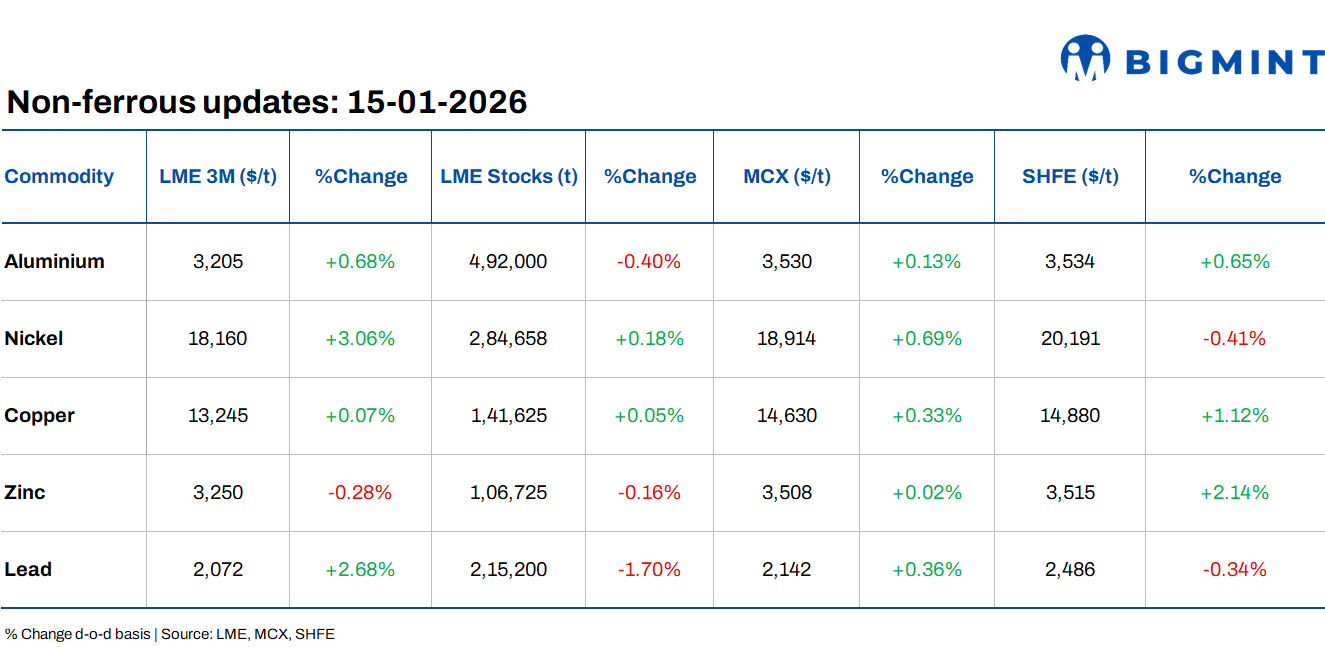
Base metals prices on the London Metal Exchange (LME) were mixed in the latest session, with selective gains across the complex. Aluminium prices rose 0.68% to $3,205/t, despite LME stocks easing 0.40% to 492,000 t. Nickel led the gains, jumping 3.06% to $18,160/t, while inventories edged up 0.18% to 284,658 t, pointing to steady inflows.
Copper prices inched up 0.07% to $13,245/t, supported by a marginal 0.05% increase in stocks to 141,625 t. Zinc slipped 0.28% to $3,250/t, with inventories down 0.16% to 106,725 t. Lead, however, gained 2.68% to $2,072/t, even as LME stocks fell sharply by 1.70% to 215,200 t, reflecting tighter availability.
Domestic market overview
In India’s non-ferrous metals markets, aluminium Tense scrap prices remained unchanged d-o-d, with ex-Delhi and ex-Chennai assessments at INR 207,000/t and INR 202,000/t, respectively, indicating stable demand across regions. Meanwhile, copper armature scrap prices, ex-Delhi, unchanged at INR 1,104,000/t, reflecting mild downward pressure after recent highs.

Other updates
PIF partners with Red Sea Aluminium to develop integrated aluminum complex
Saudi Arabia’s Public Investment Fund (PIF) and Red Sea Aluminium Holdings have agreed on initial terms to develop an advanced integrated downstream aluminum complex in Yanbu. The project will introduce advanced smelting and continuous-casting technologies, including one of the Middle East’s largest continuous casting facilities, to produce high-value aluminum products for local and global markets. Announced at the Future Minerals Forum, the partnership supports PIF’s strategy to localize supply chains, strengthen the metals and mining ecosystem, boost manufacturing capabilities, and drive economic diversification, while also focusing on workforce development and export-led growth.
Mining stocks rally reshapes global rankings
Global mining equities entered 2026 with strong momentum, driven by record-high copper prices and a sustained rally in gold and silver. The collective market value of the world’s top 50 mining companies has climbed above $2 trillion, doubling from Covid-era lows. Agnico Eagle crossed the $100 billion valuation mark for the first time, joining an expanding group of mega-cap miners, while Southern Copper and Zijin Mining surged on the back of copper’s strength. In contrast, traditional heavyweights BHP and Rio Tinto have lagged peers amid investor caution over merger and acquisition prospects, highlighting a broader shift where commodity-focused miners are outperforming diversified giants.
Copper and tin prices scale new highs in early 2026
Base metals extended their strong momentum at the start of 2026, led by copper, which hit a fresh all-time high of $13,310/t on the London Metal Exchange before easing. The metal has already gained around 6% this year, building on a stellar 40% rise in 2025, as demand from artificial intelligence, renewable energy, and electrification remains robust amid ongoing supply concerns and geopolitical risks. Tin also surged to a record, jumping as much as 6% to $52,495/t, supported by heavy investor inflows linked to the computing and data-center boom, although physical market indicators suggest near-term supply remains adequate.
Global markets react to geopolitical easing and sector rotation
Global markets saw notable moves on January 15, 2026, as investors responded to comments by US President Donald Trump that helped calm fears of heightened tensions with Iran, leading to a drop in oil prices and easing safe-haven demand for gold. Asian equities were mixed, with technology stocks generally sliding as part of a broader rotation into cyclicals and value sectors, while some markets such as South Korea’s KOSPI reached new highs after central banks-maintained interest rates. Currency and bond markets also reflected shifting sentiment, with the Japanese yen rebounding from recent lows amid intervention warnings. US stock futures were largely flat following recent declines in major indices.
Leave a Reply