- Trafigura sees India’s copper, zinc demand doubling over next decade
- Energy transition reinforces long-term commodity demand prospects
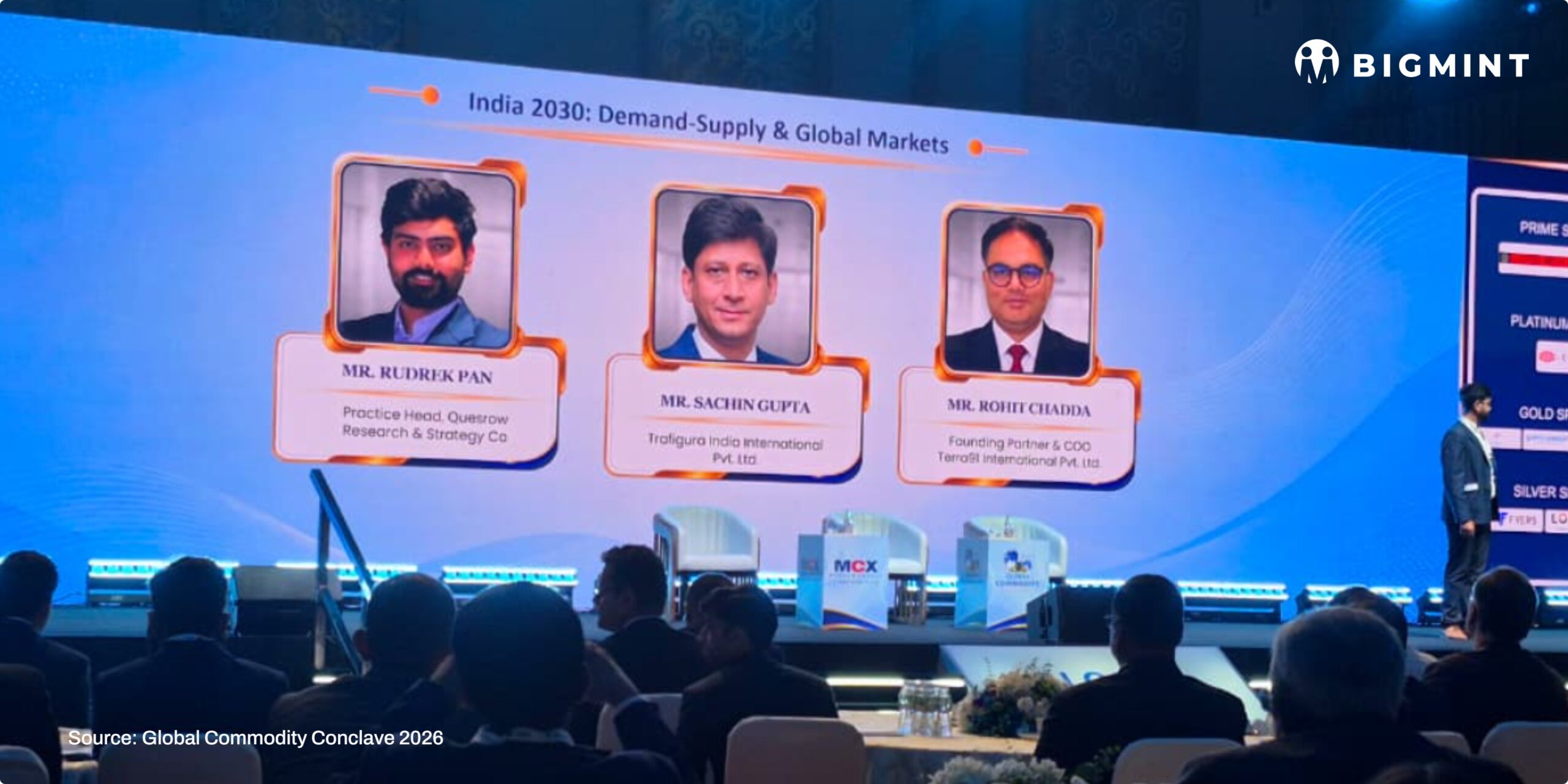
The Global Commodity Conclave (GCC) 2026, hosted by MCX with BigMint as the Event Partner, is being held from 12-14 August 2026 at the Jio World Convention Centre, Mumbai. Speaking at the session “India 2030: Demand-Supply & Global Market,” Sachin Gupta, CEO of Trafigura India, a leading global base metals and energy market trader, outlined the structural shifts expected to reshape global commodity markets and highlighted India’s expanding role in future base metal demand.
Base metals enter structurally stronger demand cycle
Sachin Gupta described base metals as the “new oil”, driven by investments in energy security, power grids, semiconductors, artificial intelligence, electric vehicles and data centres. He said Trafigura remains strongly constructive on aluminium, copper and zinc, while also seeing significant growth potential for battery metals such as lithium, nickel and cobalt, alongside minor metals including antimony and germanium.
According to Gupta, sectors such as power generation, grid expansion, EVs and data centres could account for around 45% of copper, 30% of aluminium, and 46% of zinc demand by 2035, highlighting the increasing metal intensity of the global economy.
A key structural change will be the diversification of demand away from China. While Chinese consumption is expected to remain strong, Gupta estimates that around 50% of incremental base-metal demand over the next decade could come from non-Chinese markets, with India emerging as an important contributor.
Supply constraints could create sizeable deficits
Sachin Gupta highlighted that the biggest challenge facing the industry is not demand but the availability of sufficient new supply. Several aluminium, copper, and zinc projects have been announced globally but have yet to reach committed stages.
If these projects fail to materialize, the global market could face potential shortages
Copper faces additional pressure from weak smelter economics, with treatment and refining charges (TC/RC) moving into negative territory. Gupta noted that this effectively means smelters are paying miners to process concentrates, creating a significant challenge for the copper refining industry.
In aluminium, China’s production capacity remains capped at around 45 mnt, while domestic demand continues to rise. Meanwhile, disruptions in Middle Eastern aluminium capacity have further tightened the global supply outlook.
India offers long-term consumption opportunity
Turning to India, Gupta said the country remains one of Trafigura’s important markets despite near-term macroeconomic challenges, including higher tariffs, geopolitical tensions, elevated energy costs and currency depreciation.
He highlighted India’s low urbanisation rate of around 37%, which could rise to approximately 51% by 2045, as a major long-term growth driver. Rising incomes and urbanisation are expected to increase demand for housing, appliances, automobiles, infrastructure and other metal-intensive products.
India’s per-capita built-up area and income remain significantly below developed economies and other major Asian markets, indicating substantial room for consumption growth. Gupta also highlighted the expanding middle-income population, particularly households earning $10,000-20,000 annually, as an important source of future consumption.
Power, EVs, data centres to drive metal demand
India’s power sector is expected to be a major source of future base-metal demand. Gupta said the country’s key challenge is meeting peak power demand, which reached around 270 GW during the summer, rather than average demand during non-peak periods.
While coal is expected to retain an important role in India’s power mix, most incremental capacity is likely to come from renewable energy. The expansion of renewable generation, storage systems, and power grids will therefore create additional demand for copper and aluminium.
Gupta also revised Trafigura’s outlook for India’s EV adoption, bringing forward the expected EV inflection points to around 2030 from the previously projected 2035, citing faster-than-expected adoption of electric cars and two-wheelers. Increasing availability of competitively priced EV models from Indian manufacturers is supporting this shift.
Data centres represent another emerging demand driver. India’s data centre capacity, currently around 2.9 GW, could reach 5-8 GW by 2030, according to Gupta, creating additional demand for metals through power infrastructure, cooling systems and construction.
India’s base metal consumption could double
The Trafigura India CEO expects India’s consumption of key metals to rise sharply over the next decade. Copper demand, currently around 1.3-1.4 mnt, could double, while aluminium demand of approximately 5.5 mnt is also expected to increase significantly. Zinc consumption, currently close to 950,000 tonnes (t), could similarly double.
Steel demand is also expected to strengthen as per-capita consumption approaches the industry’s perceived inflection point of around 100 kg.
Despite these projections, Gupta noted that India’s per-capita copper and aluminium consumption would remain well below levels seen in developed economies even by 2045, underscoring the country’s substantial long-term demand potential.
India Base Metal outlook remains bullish
He pointed to the sharp rise in commodity prices since 2020 as evidence of the changing structural backdrop. Copper has risen from around $6,000/t in 2020 to above $14,000/t, while aluminium and zinc prices have also moved significantly higher.
He concluded that the global shift towards green energy, electrification, digital infrastructure, and energy security will remain strongly metal intensive. With supply growth struggling to keep pace with structural demand, Trafigura remains highly constructive on commodities, while India is positioned to become an increasingly important driver of global base-metal consumption.
The Global Commodity Conclave (GCC) 2026, hosted by MCX and partnered by BigMint
Leave a Reply