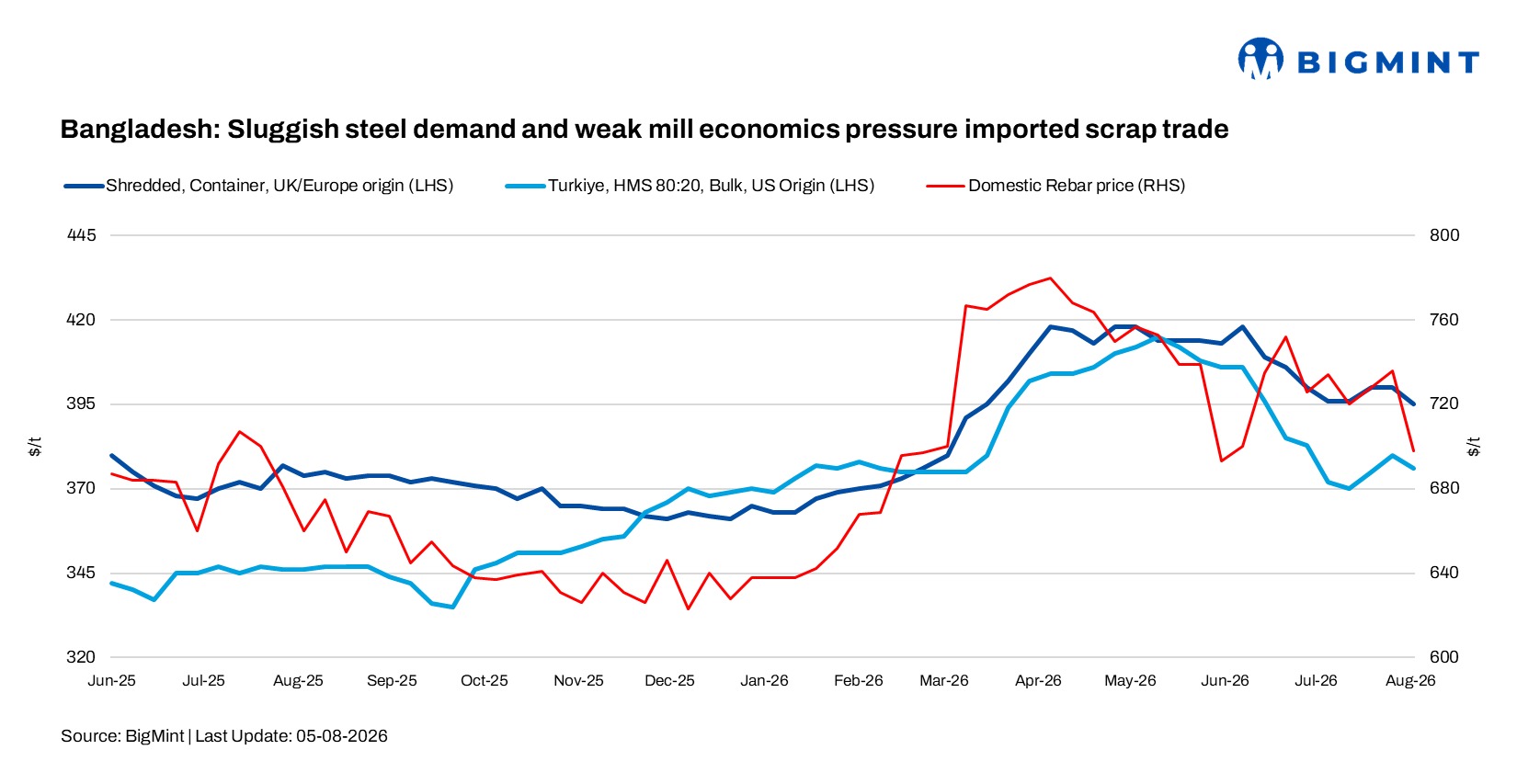
- Finished steel sales remain weak amid monsoon disruptions
- Domestic scrap gains preference over higher-priced imports
Bangladesh’s imported ferrous scrap market remained subdued during the week ended 5 August as weak finished steel demand, monsoon-related disruptions, and ongoing LC (letter of credit) constraints continued to limit fresh import activity. While international scrap prices remained broadly firm, mills largely relied on domestic scrap and maintained need-based procurement, keeping both deep-sea and containerised trading activity muted.
BigMint’s weekly assessments, CFR Chattogram
- European-origin containerised HMS (80:20): $363/t, down by $7/t w-o-w
- European-origin containerised shredded: $395/t, down by $5/t w-o-w
- Japanese-origin bulk H2: $375/t, down by $7/t w-o-w
- US-origin bulk HMS (80:20): $394/t, down by by $6/t w-o-w
Market updates
Australia-origin HMS 90:10 offers declined to $365/t CFR Chattogram from $375/t last week, while buyers maintained bids near $360/t CFR. The last reported indicative deal was concluded at $368/t CFR when offers exceeded $370/t last week.
Australia-origin HMS 80:20 was offered around $355-358/t CFR, while Brazil-origin HMS remained near $360/t CFR. Shredded scrap offers were heard at $390-400/t CFR against buyer bids of $380-390/t CFR, while Singapore-origin PNS was offered around $410/t CFR with bids near $400/t CFR.
As per trader sources, deep-sea trading remained sluggish as buyers maintained bids at $380-385/t CFR Chattogram for HMS 80:20 bulk, while suppliers sought $395-396/t CFR, resulting in limited fresh bookings. A Singapore-origin HMS 80:20 cargo was reportedly concluded at $390-395/t CFR Chattogram.
Japanese H2 scrap offers were heard at $380-385/t CFR, with heavy scrap (HS) around $415-420/t CFR. However, buyers showed little interest, considering Japanese material uncompetitive compared with lower-priced US-origin cargoes.
A South East Asian supplier source noted that Bangladesh continued to attract Far East-origin scrap cargoes due to relatively steady steel production, although procurement remained cautious as mills evaluated financing costs and replacement values.
Domestic market
Domestic market sentiment remained weak as LC issues continued to restrict imports, forcing mills to rely heavily on local scrap. Domestic scrap traded at BDT 48,000-50,000/t ($388-404/t), around $6-7/t cheaper than imported material, while rebar prices were heard at BDT 81,000-83,000/t ($655-671/t) in Dhaka and around BDT 85,000-88,000/t ($687-711/t) in Chattogram. Market participants said poor finished steel sales and continued mill losses prevented producers from purchasing imported scrap at prevailing prices.
Outlook
BigMint expects Bangladesh’s imported scrap market to remain range-bound in the coming week, as LC constraints faced by some mills, comfortable but selective inventory positions, and subdued construction activity continue to limit fresh import bookings. While firm global scrap offers are expected to support import prices, mills are likely to prioritise domestic scrap procurement until financing conditions ease and downstream steel demand improves.

Leave a Reply