- Buyers continue targeting lower import price levels
- Higher electricity tariffs squeeze mill operating margins
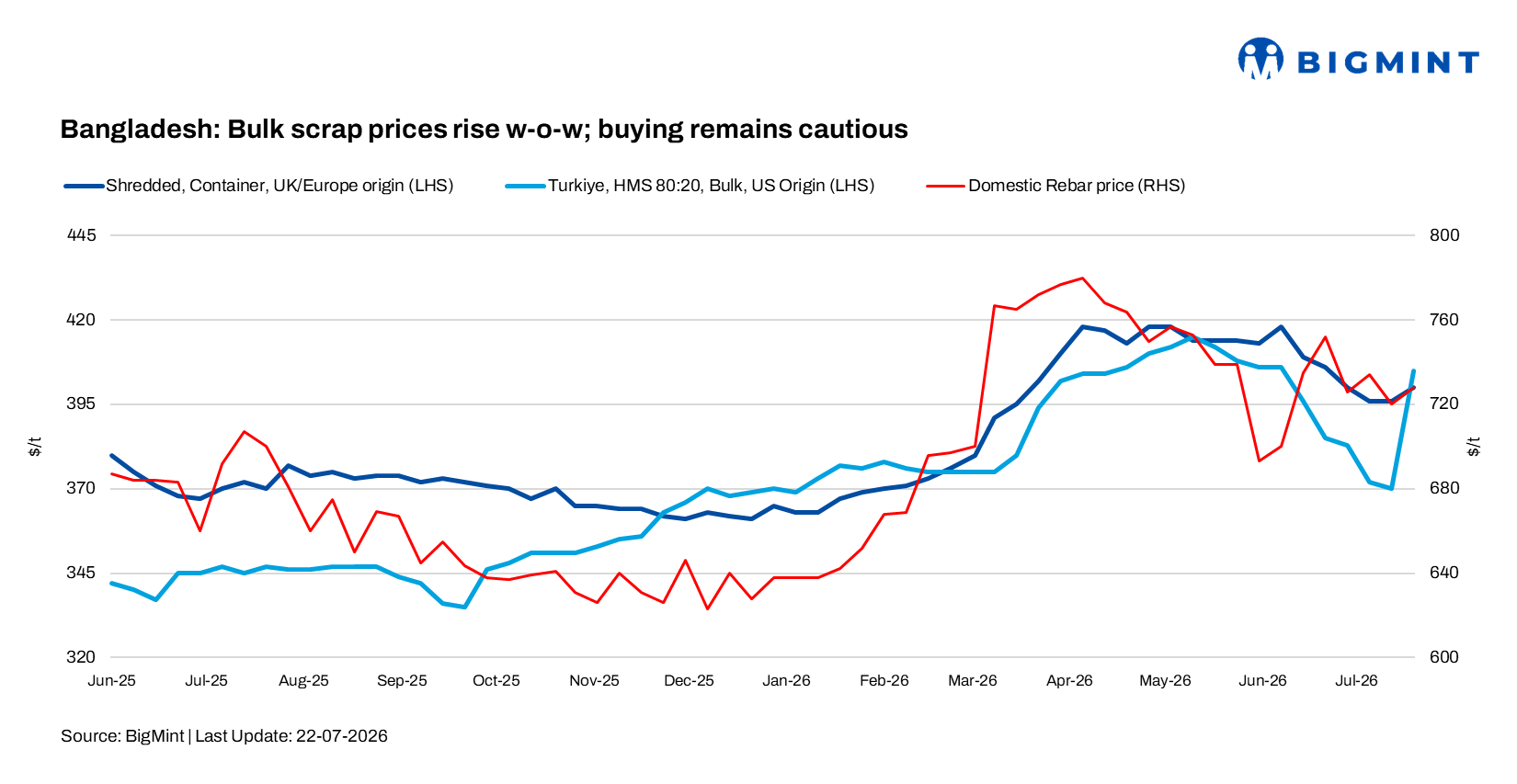
Bangladesh’s imported ferrous scrap market remained subdued during the week ended 22 July as weak long steel demand, monsoon-related disruptions, rising production costs, and limited government infrastructure spending continued to weigh on buying sentiment. Although a few deep-sea cargoes were booked during the week, mills largely restricted purchases to immediate requirements while continuing to seek lower prices.
BigMint’s weekly assessments,CFR Chattogram
- European-origin containerised HMS (80:20): $366/t, up by $3/t w-o-w
- European-origin containerised shredded: $400/t, up by $3/t w-o-w
- Japanese-origin bulk H2: $391/t, up by $7/t w-o-w
- US-origin bulk HMS (80:20): $399/t, up by $2/t w-o-w
Market updates
Containerised scrap trading remained slow as buyers continued targeting lower prices following the recent decline in Turkish imported scrap values. Australia-origin HMS 80:20 offers were heard at $360-365/t CFR Chattogram, against buyer bids around $330/t CFR.
Brazil-origin HMS 80:20 was offered at $350-355/t CFR, while Australia-origin shredded scrap was heard at $370-380/t CFR. UK-origin shredded bids were reported around $385/t CFR, and Australia/New Zealand-origin shredded offers near $380/t CFR. Philippines/Malaysia-origin GI bundles were offered at $328/t CFR, with bids at $320/t CFR.
Japanese H2 scrap offers were heard at $390-395/t CFR Chattogram, equivalent to JPY 52,000-53,000/t ($319-325/t) FOB Japan, although no fresh bulk transactions were reported as buyers remained cautious.
Recent trade
Australia-origin HMS 90:10: 2,000 t booked at $368/t CFR Chattogram
A Chattogram-based importer said, “The market remains quiet. Most buyers are waiting for lower prices after the decline in Turkish scrap values. Even larger importers are staying on the sidelines, with only selective bookings taking place.”
A Dhaka-based trader said, “The monsoon has significantly reduced construction activity and rebar sales. Limited government infrastructure spending, together with the 17% electricity tariff hike, has sharply increased steelmaking costs and squeezed mill margins.”
Another regional trader added, “Buying sentiment remains weak as mills continue operating at reduced rates during the summer. Higher electricity costs and subdued steel demand are discouraging inventory build-up.”
Domestic market
Domestic steel fundamentals remained weak as heavy rainfall continued to disrupt construction activity and reduce rebar sales. Domestic melting scrap was heard at around BDT 53,000-54,000/t ($429-438/t), while Grade-60 rebar was assessed at BDT 90,000-91,000/t ($729-737/t) in Chattogram and BDT 85,000-86,000/t ($689-697/t) in Dhaka. Higher electricity tariffs increased steelmaking costs, while weak downstream demand and financial constraints kept scrap procurement largely need-based.
Outlook
BigMint expects Bangladesh’s imported scrap market to remain under pressure in the coming week as monsoon disruptions, weak construction activity, higher power costs, and limited government infrastructure spending continue to dampen steel demand. While lower international scrap prices may encourage selective deep-sea bookings, mills are expected to maintain need-based procurement until market fundamentals improve.
Leave a Reply