- Strong regional demand offsets weaker Northeast Asian buying
- Lower Chinese imports and cautious NE Asia demand shift export
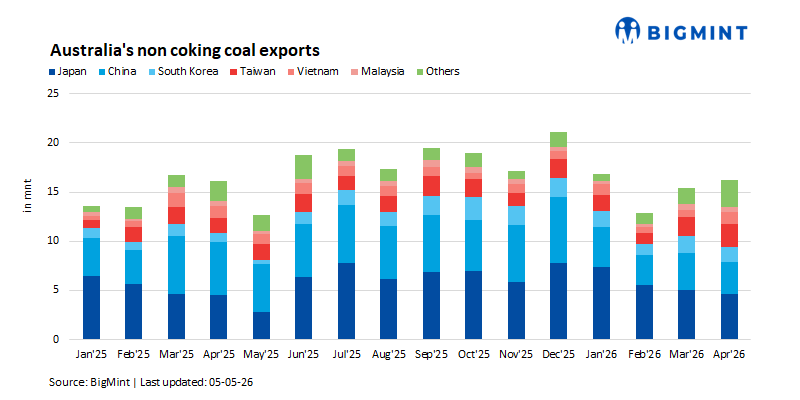
Australia’s non-coking (thermal) coal exports increased around 6% month-on-month to 16.27 mnt in April 2026, compared to 15.4 mnt in March, while registering a modest 1.16% year-on-year rise. This incremental growth reflects resilient export performance, primarily supported by improved demand from Southeast Asian markets, even as overall buying sentiment across Asia remained mixed.
The uptick suggests that regional demand rebalancing, rather than a broad-based recovery, was the key driver behind higher shipments.
Diverging regional demand trends shape export flows
Export dynamics in April were largely influenced by contrasting demand patterns across major Asian markets. In Northeast Asia, demand remained subdued due to adequate inventories and cautious procurement strategies. Japan, the largest importer, reduced purchases by 7.9% m-o-m to 4.65 mnt, reflecting sufficient stock levels at utilities.
Similarly, China’s imports declined sharply by 13.8% m-o-m and 40.7% y-o-y to 3.24 mnt, driven by lower reliance on Australian cargoes and increased sourcing from alternative suppliers, likely supported by competitive pricing and geopolitical considerations. South Korea also reported a 12.1% m-o-m decline to 1.52 mnt, although volumes remained significantly higher y-o-y, underpinned by stronger power generation demand compared to the previous year.
In contrast, Southeast Asia emerged as the primary growth engine, supported by restocking needs and firm electricity demand. Taiwan’s imports rose 23.2% m-o-m to 2.39 mnt (up 56.8% y-o-y), while Vietnam recorded a sharp 52% m-o-m increase to 1.14 mnt, indicating active replenishment despite lower annual volumes.
Although Malaysia saw a marginal 8.6% m-o-m decline, overall regional demand remained robust. Additionally, shipments to other destinations surged 76% m-o-m and 75% y-o-y to 2.8 mnt, highlighting ongoing diversification of export markets, which helped offset weaker demand from traditional buyers.
Gas supply disruptions due to Middle East tensions have shifted power generation focus back to coal, supported by earlier regulatory relaxations.
Improved port throughput underpins export growth
On the supply side, the rise in exports was facilitated by enhanced throughput across key Australian ports, indicating stable operational conditions. Newcastle led the growth with a 6.1% m-o-m increase to 12.05 mnt, supported by consistent vessel loading and efficient logistics.
Dalrymple Bay Coal Terminal (DBCT) recorded a 25.4% increase to 0.89 mnt, reflecting a recovery in cargo movement. Brisbane and Port Kembla reported significant gains of 85.7% and 166.7% m-o-m, respectively, likely due to improved scheduling and clearance of prior shipment backlogs.
However, performance remained uneven across terminals. Abbot Point and Gladstone registered declines of 18.3% and 13.6% m-o-m, respectively, suggesting localized constraints such as shipment timing issues, maintenance, or softer loading demand. Despite these variations, the overall increase across multiple ports indicates steady export infrastructure performance, enabling Australia to respond effectively to shifting demand patterns.
Outlook
Looking ahead, Australian thermal coal exports are expected to remain stable to slightly firm, supported by continued restocking demand from Southeast Asia and steady port operations. However, gains may be capped by weaker Chinese imports, comfortable inventory levels across key markets, and competition from alternative suppliers in the global market.

Leave a Reply