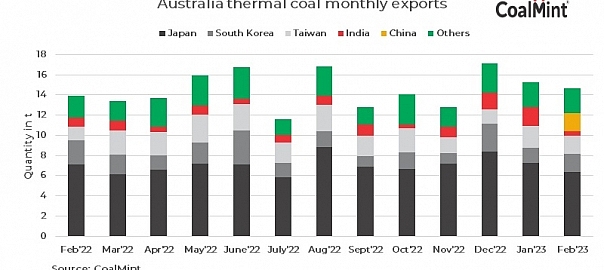
Australian thermal coal exports fell by 4% m-o-m to 14.6 mnt in February 2023 as per CoalMint’s vessel line-up data. Due to supply issues, Australian thermal coal shipments declined. Since supplies in January were disrupted by heavy rain and a railway derailment resulting into longer ship queues at ports in February.
Asia: Export falls despite trade resumption in China

Qty in mnt
Exports of Australian thermal coal to Japan totalled 6.38 mnt in February 2023, accounting for almost 43% of total exports. Yet, it has decreased by 12% as compared to a month ago. In a similar vein, Taiwan’s coal imports decreased by 15% m-o-m to 1.8 mnt.
Moreover, Australian thermal coal exports to India fell by 74% m-o-m in February 2023. The country’s export to India in February stood at 0.48 mnt while in January it was 1.86 mnt.
However, export to South Korea has increased, shipments rose by 13% m-o-m to 1.73 mnt. Exports to China totalled 1.75 mnt. Notably, China has begun importing coal from Australia, with the first shipment of thermal coal arrived in February.
Exports to Europe drop

Qty in mnt
In February, Australian thermal coal exports to Europe fell by 33% m-o-m to 0.25 mnt, there were no shipments to the European Union in the month.
However, exports to the Netherlands rose by 12% m-o-m to 88,000 t while exports to Italy resumed in February 2023 as there had been no exports in the previous month.
Port wise export

Qty in mnt
Exports from Gladstone Port fell by 61% m-o-m to 6.9 mnt. The fall was due to a train derailment outside the port on 29 January that interrupted coal deliveries, which restarted on 11 February. Similarly, Port Kemble has not recovered as exports fell by 44% to 0.23 mnt.
However, supplies from DBCT and Port Brisbane have increased by 60% and 39% m-o-m in February 2023. DBCT exported 1.13 mnt while for Port Brisbane it was 0.2 mnt.
Outlook
Australian thermal coal exports are expected to rise in March as there will be no supply constraints like January and February. In addition, coal exports to China are likely to increase as the country’s utilities and traders stepped up purchases of Australian coal in February.
Leave a Reply