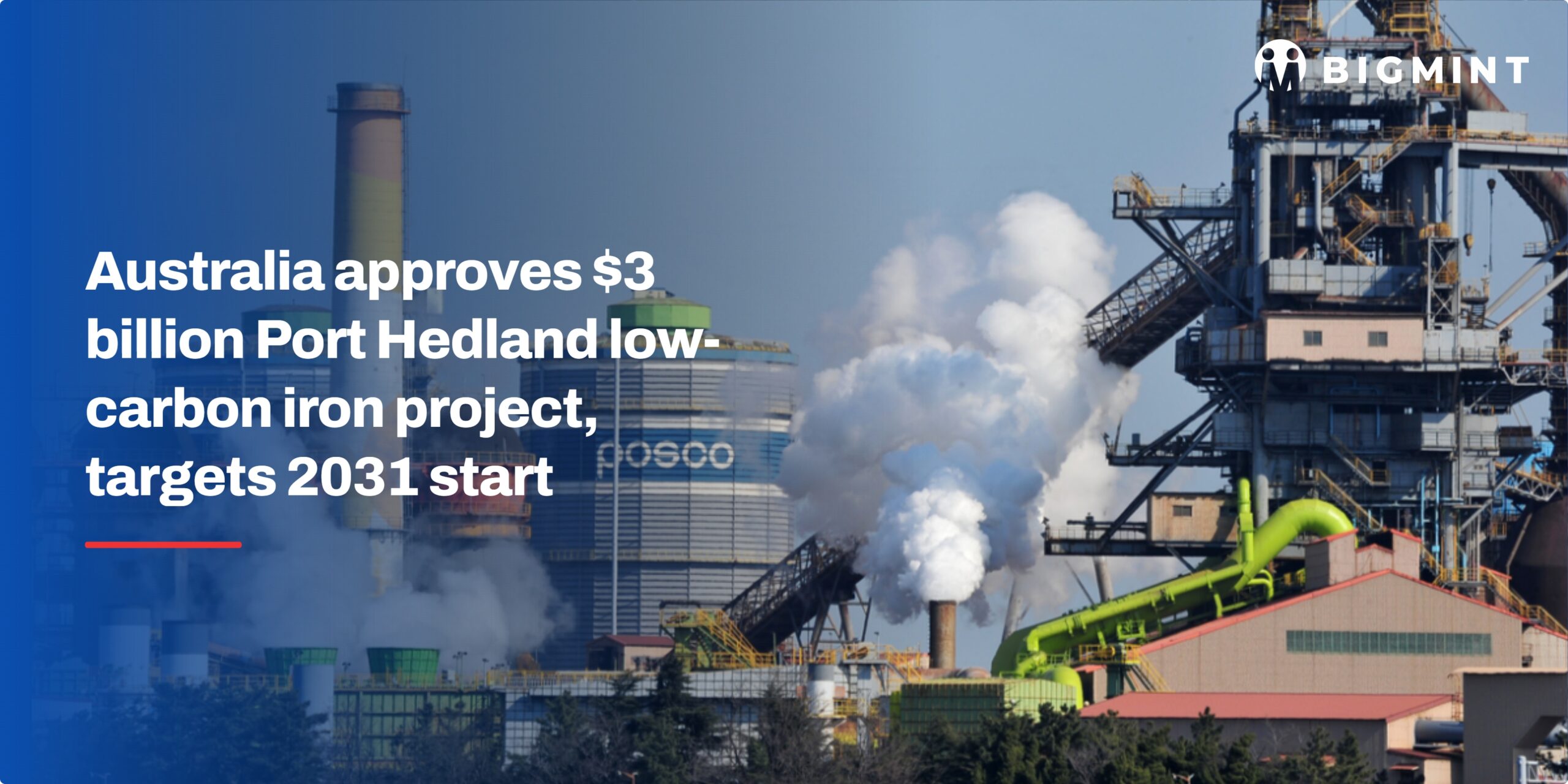
- POSCO-led consortium gets environmental clearance for 2 mnt HBI plant, targets 2031 start
- Gas-to-hydrogen conversion plans to deepen emissions cuts, strengthen green iron exports
Australia has granted environmental approval to the $3 billion Port Hedland Iron Project in Western Australia’s Pilbara, clearing a key regulatory hurdle for one of the region’s largest proposed low-carbon ironmaking investments. The project, led by POSCO Holdings, is targeting first production in 2031, although construction and financing remain subject to a final investment decision.
The approval, granted by the federal government on 7 October under the Environment Protection and Biodiversity Conservation Act 1999, covers a pellet plant and hot-briquetted iron (HBI) facility at the Boodarie Strategic Industrial Area, around 10 km southwest of Port Hedland. Construction is proposed to begin in the first quarter of 2027.
The project is being developed by Port Hedland Iron Pty Ltd, with POSCO Holdings holding a 51% stake, while Marubeni and China Steel Corporation each own 24.5%. The consortium plans to process 3-3.5 mnt of iron ore annually to produce around 2 mnt of HBI and 700,000 t of pellets for exports.
Gas-based start, hydrogen pathway
The project’s significance lies less in its initial production scale than in its proposed transition pathway. The plant will use MIDREX direct reduction technology, initially relying on natural gas as the reductant. However, the facility is being designed with provisions for hydrogen production and storage, allowing the project to progressively reduce its emissions intensity as hydrogen becomes commercially available.
This places the project within a broader shift in the global iron and steel industry towards DRI and HBI, particularly in regions with access to high-quality iron ore, natural gas and eventually low-cost renewable power and hydrogen.
The initial gas-based configuration means the project will not represent fully green iron production from day one. However, the ability to transition from gas to hydrogen could provide a pathway towards substantially lower-emission ironmaking.
Pilbara seeks to move beyond ore exports
For Australia, the project also represents an attempt to move further downstream in the iron ore value chain. The Pilbara is one of the world’s largest iron ore-producing regions, but most of its output is exported as ore. Producing HBI locally could allow Australia to capture more value from its resource base while supplying lower-emission iron units to steelmakers.
The project’s location also provides logistical advantages. HBI and pellets are expected to be exported through the Port of Port Hedland, with South Korea identified as the primary destination. This could strengthen Australia’s position as a potential supplier of lower-carbon iron feedstock to Asian steelmakers seeking to reduce emissions without immediately shifting entirely to hydrogen-based ironmaking.
The Western Australian government is also exploring renewable-energy options with POSCO, which could become increasingly important if the project moves towards hydrogen-based production. Power, water and natural gas are expected to be supplied by third parties under separate approvals.
FID remains critical
The approval is an important milestone, but it does not amount to a financing commitment. The project still requires a final investment decision (FDI), including approval from its Japanese and Taiwanese partners.
The environmental consent remains valid until 30 June 2088 and requires the project to commence by 7 October 2031 unless the conditions are amended. The long approval window provides flexibility, but the more immediate test will be whether the consortium can align project economics, energy supply and long-term offtake commitments sufficiently to proceed with construction.
The economics of the hydrogen transition will be particularly important. While the gas-based MIDREX configuration can provide a lower-emission route than conventional blast furnaces, replacing natural gas with hydrogen would require competitive renewable power, hydrogen infrastructure and reliable supply. The project’s ultimate emissions performance will therefore depend not only on the technology selected, but also on how quickly the surrounding clean-energy ecosystem develops.
The Port Hedland project’s success could demonstrate whether the Pilbara can evolve from being primarily a supplier of iron ore to becoming a producer and exporter of lower-emission iron for Asian steelmakers.
Leave a Reply