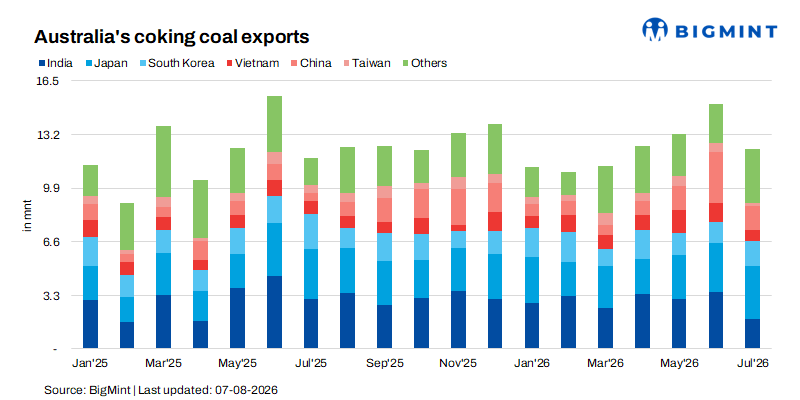
- China and Japan offset weaker Indian coking coal demand
- Diversified Asian demand strengthens Australia’s export resilience
Australia’s coking coal exports remained resilient during the first seven months of 2026, with shipments rising despite softer demand from its largest customer, India. Total exports reached 86.42mnt during January-July 2026, compared with 84.18mnt during the corresponding period of 2025, representing a 2.7% year-on-year increase. July exports also improved to 12.28 mnt, up 4.6% from 11.74 mnt a year earlier.
While headline export growth was modest, the underlying trade flows reveal a more significant shift. Indian steelmakers reduced purchases from Australia, but this was more than offset by stronger buying from Japan and a sharp rebound in Chinese imports, resulting in a broader and more diversified customer base for Australian exporters.

India remains Australia’s largest coking coal market
India retained its position as Australia’s largest destination for coking coal, although imports declined significantly compared with last year.

Indian imports declined by almost 3 mnt, reflecting more measured procurement by domestic steelmakers. However, the reduction was largely compensated by stronger demand from Japan and, more notably, China, where imports surged by more than 60% year on year. As a result, Australia’s overall coking coal exports continued to grow despite weaker purchases from its largest customer.
China’s recovery reshapes Australia’s export mix
A comparison of market shares highlights how Australia’s export portfolio evolved during the first seven months of 2026.

Although India remained Australia’s largest customer, its share of total exports declined by more than four percentage points. In contrast, China’s share increased sharply as trade between the two countries continued to normalise, while Japan also expanded its share through stronger and more consistent purchases.
Queensland terminals continue to dominate exports
Australia’s coking coal exports remained heavily concentrated through Queensland’s established export infrastructure.

Gladstone and Dalrymple Bay Coal Terminal (DBCT) remained Australia’s two largest coking coal export hubs, while the three major Queensland terminals — Gladstone, DBCT and Hay Point — collectively handled nearly 89% of all exports during the period, underlining the stability of Australia’s metallurgical coal supply chain.
Key takeaways
Australia’s coking coal export performance in 2026 illustrates the resilience of the global seaborne metallurgical coal market. Although Indian steelmakers reduced imports by almost 3 mnt, Australia was able to maintain export growth by broadening its customer base.
The most notable development was the strong rebound in Chinese imports, which rose by more than 60% y-o-y as trade flows continued to normalise. Japan also increased purchases, reinforcing its role as Australia’s second-largest market. Together, these gains more than offset weaker Indian demand and demonstrate that Australia’s export portfolio is becoming less reliant on any single buyer.
For India, the lower imports do not necessarily signal weaker steel production. Rather, they suggest that domestic steelmakers have adopted a more diversified raw material procurement strategy, supported by increased domestic coke production, greater use of alternative supply origins and changing blast furnace operating practices.
Looking ahead, the outlook for Australian coking coal exports will depend less on Indian demand alone and more on the combined purchasing behaviour of the three major Asian steelmakers — India, China and Japan. If China’s recovery continues and Japanese steel production remains stable, Australian exporters should remain well positioned even if Indian imports stay below last year’s levels.

Leave a Reply