Supply constraints ease
India’s imports up 11% to 3.28 mnt
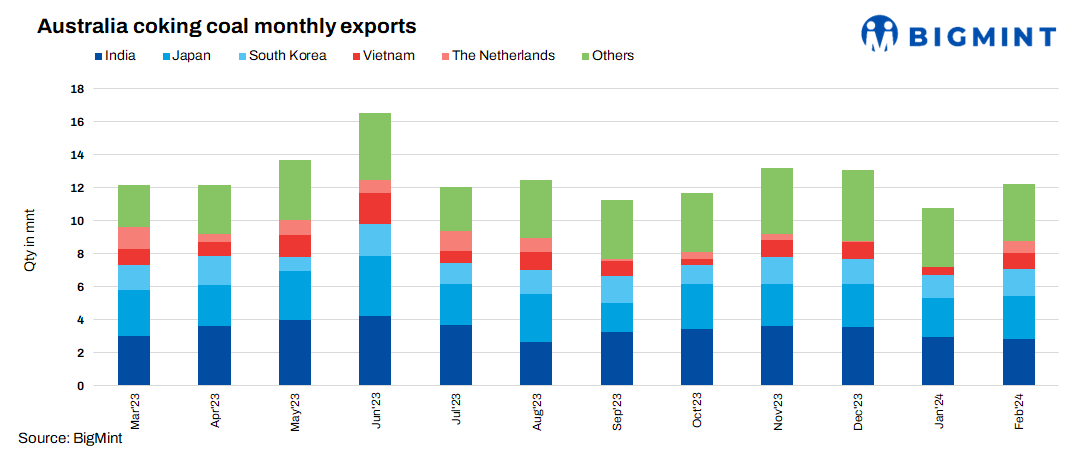
Australian coking coal exports increased by 13% m-o-m to 12.24 million tonnes (mnt) in February’24 as against 10.80 mnt in January. However, exports surged 34% at 12.24 mnt in February as against 10.80 mnt in February’23. The rise in Australian coking coal exports was attributed to the easing of supply constraints after cyclone Kirrily and improved demand from major importing countries.
Easing constraints
The northern Bowen Basin coal terminals of Abbot Point, Dalrymple Bay (DBCT), and Hay Point were affected by the cyclone. In the month of February, supply conditions improved as the rainy season came to an end, and many major ports in Australia, including Hay Point, Gladstone, and Port Kembla, completed maintenance, thus easing supply constraints.
Rise in demand from importing countries
Imports from India rose by 11% to 3.28 mnt driven by its attractive prices and smoother supply situation. Australia exports to Japan rose by 10%, while imports from Brazil rose twofold. Attacks in the Red Sea have prompted several shipping companies to divert vessels. The rerouting adds significant cost and time to vessel journeys. Therefore, the Red Sea crisis is also one of the reasons for the increase in exports from Australia, as buyers are more attracted to Australian coking coal than to US coking coal.

India, formerly the largest buyer of Australian coking coal, experienced an 11% m-o-m rise in imports at 3.28 mnt in February 2024, compared to 2.95 mnt in January 2024. driven by its attractive prices and smoother supply situation. Shipments to Japan increased by 10% m-o-m to 2.65 mnt in February as against 2.45 mnt in January. Exports to South Korea dropped 33% at 0.94 mnt in February. Imports by Indonesia (up by 35%) and China (down 12%) were recorded at 0.63 mnt and 0.74 mnt, respectively.

Exports from Gladstone fell by 9% m-o-m to 3.34 mnt in February as against 3.67 mnt in January. Shipments from DBCT stood at 3.95 mnt in February as against 3.29 mnt in January. Supplies from Hay Point and Abbot Point rose by 27% and 20%, respectively, in the month under review.
Outlook
It is anticipated that exports might increase in the near term due to easing of supplies. Demand from China in the spot market has also increased after the CNY holidays, while the Red Sea crisis is also driving exports. Buyers are preferring Australian coking coal over US considering the delivery time. All these factors may further contribute to an increase in Australian exports.