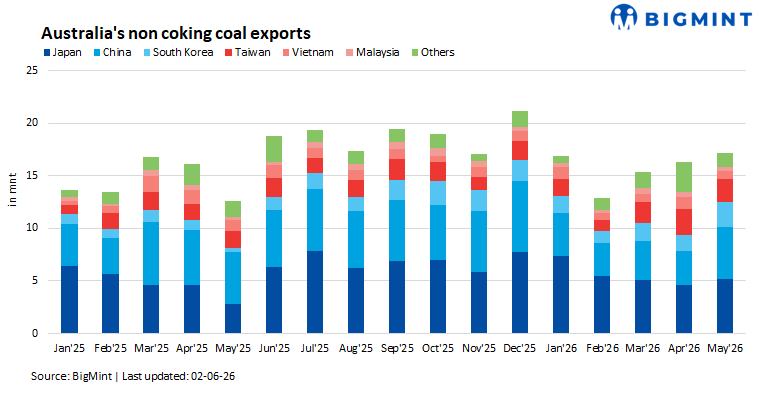
- Stronger buying from Japan, China, South Korea supports uptick
- Weak SE Asian demand, ample buyer inventories limit growth
Australia’s non-coking (thermal) coal exports increased by 1.5% m-o-m to 17.13 million tonnes (mnt) in May 2026, compared to 16.88 mnt in April 2026, while recording a strong 35.7% y-o-y increase from 12.62 mnt in May 2025.
The rise in exports was primarily driven by stronger buying from key northeast Asian consumers, particularly China, South Korea, and Japan, which more than offset weaker demand from several Southeast Asian markets. The growth highlights improving regional coal procurement activity amid rising summer power demand and replenishment requirements across major importing nations.
Cumulatively, Australia’s thermal coal exports during January-May 2026 reached 78.6 mnt, marking a 7% increase y-o-y. The growth was primarily driven by improved export availability, steady mining operations, and resilient demand from key Asian importers, which supported higher shipment volumes during the period.
Northeast Asian buyers support export growth
Export performance in May was largely shaped by renewed demand from northeast Asia.
Japan remained Australia’s largest destination, importing 5.17 mnt, up 9.3% m-o-m from 4.73 mnt in April and 87% higher y-o-y. The increase suggests stronger utility procurement ahead of the summer cooling season and continued preference for Australian thermal coal.
China recorded one of the strongest monthly increases, with its imports rising 52.5% m-o-m to 4.94 mnt from 3.24 mnt in April. However, volumes were down 1.9% y-o-y, indicating that while buying improved during the month, imports have yet to fully recover to last year’s levels.
South Korea also significantly increased purchases, with imports climbing 57.9% m-o-m to 2.40 mnt. On an annual basis, shipments surged 573.2% y-o-y, reflecting a very low base in May 2025 and stronger thermal generation requirements this year.
In contrast, demand from several Southeast Asian markets softened. Taiwan’s imports declined 20.7% m-o-m to 2.18 mnt, though volumes remained 33.9% higher y-o-y. Vietnam recorded the sharpest decline among major buyers, with imports falling 39.8% m-o-m to 0.74 mnt while also remaining 45.4% lower y-o-y. Malaysia’s purchases decreased 43.2% m-o-m and 28% y-o-y to 0.37 mnt, reflecting subdued spot market activity.
Overall, Japan, China, and South Korea accounted for nearly 73% of Australia’s thermal coal exports during May, highlighting the dominant role of Northeast Asia in supporting export growth.
Newcastle, Abbot Point drive loading activity
On the supply side, higher exports were supported by increased throughput at Australia’s major coal-loading terminals.
Newcastle remained the dominant export hub, loading 12.81 mnt during May, up 6.3% m-o-m and 47.2% y-o-y. The port accounted for nearly three-quarters of Australia’s total thermal coal exports and continued to benefit from stable logistics and strong vessel scheduling.
Abbot Point recorded the strongest growth among major terminals, with exports increasing 86.7% m-o-m to 1.83 mnt, while also posting a 41.5% y-o-y increase. Gladstone handled 1.35 mnt, down 7.5% m-o-m, although volumes were marginally higher by 1.8% y-o-y.
Dalrymple Bay Coal Terminal (DBCT) loaded 0.64 mnt, declining 28.1% m-o-m and 11.2% y-o-y, suggesting lower shipment schedules during the month.
Brisbane exports fell 36.9% m-o-m to 0.41 mnt, though volumes remained 26.1% above year-ago levels. Port Kembla handled 0.1 mnt, continuing to account for a small share of overall exports and remaining significantly below both monthly and annual levels.
Despite mixed performances across individual terminals, overall port operations remained stable, enabling Australian exporters to meet stronger Northeast Asian demand.
Outlook
Australian thermal coal exports are expected to remain supported in June due to seasonal power demand across northeast Asia and ongoing procurement from Japan, China and South Korea. The strong recovery in May demonstrates the continued importance of these markets in balancing export flows.
However, export growth may face headwinds from weaker demand in parts of Southeast Asia, comfortable inventory levels among some buyers, and ongoing competition from alternative coal suppliers. Port performance, Chinese import trends, and summer electricity demand across Asia will remain key factors influencing Australia’s thermal coal export trajectory in the coming months.

Leave a Reply