- Declines across major terminals indicate a broad demand-driven slowdown
- Exports were down 4% y-o-y, supported by stable production and consistent demand
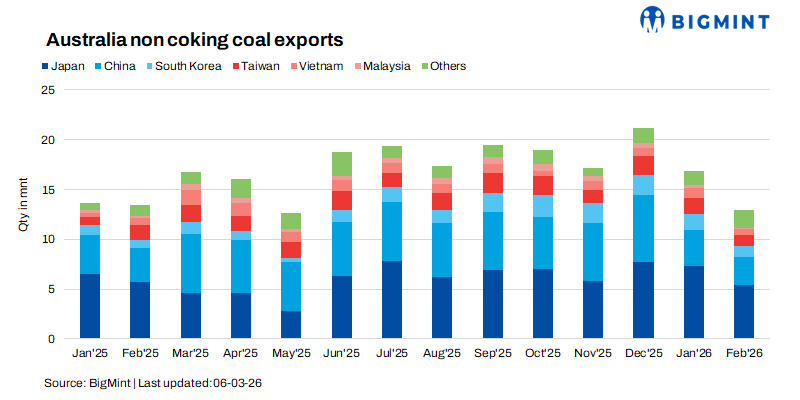
Australia’s non-coking coal exports recorded a significant contraction in February 2026, declining 23.2% month-on-month (m-o-m) to 12.92 million tonnes (mnt), compared with 16.83 mnt in January.
On a year-on-year (y-o-y) basis, shipments were marginally lower by 4% from 13.45 mnt in February 2025. The sequential decline was largely attributed to seasonal factors, moderated winter demand across key Asian markets, and logistical adjustments at major export terminals.
Import trends in key destinations
Among key destinations, Japan remained the largest importer despite a 25% m-o-m decline in shipments to 5.45 mnt, reflecting cautious procurement amid comfortable inventories. Exports to China also decreased by 25.2% m-o-m to 2.73 mnt, influenced by improved domestic coal availability, competitive supplies from alternative origins, and relatively softer seasonal demand.
Similarly, shipments to South Korea fell by 31% m-o-m to 1.14 mnt, while Taiwan’s imports declined by 28% to 1.11 mnt, indicating synchronized inventory management and lower power demand during the late winter period. Meanwhile, Vietnam and Malaysia recorded steeper declines, with shipments dropping 42.6% to 0.58 mnt and 55.2% to 0.13 mnt, respectively, as buyers adjusted procurement amid adequate stock levels.
Port performance and terminal activity
The contraction in shipments was mirrored across major Australian coal export terminals. The Port of Newcastle, the country’s largest coal export hub, handled 9.78 mnt in February, down 21% m-o-m. Abbot Point recorded a 28% decline to 1.14 mnt, while the Port of Gladstone saw exports fall 16.3% to 1.13 mnt.
Dalrymple Bay Coal Terminal experienced the sharpest decline, with volumes dropping 57.1% m-o-m to 0.33 mnt. Port Kembla reported no shipments during the month, marking the most pronounced fall among the terminals. In contrast, the Port of Brisbane recorded a relatively modest decline of 13% to 0.54 mnt, partially offsetting reductions at other terminals and indicating localized cargo movement stability.
Overall, the decline across multiple terminals suggests that the reduction in exports was driven by broader market dynamics rather than isolated operational disruptions.
Outlook
Australian thermal coal exports are expected to stabilize gradually, with winter demand in Northeast Asia and China’s import strategy remaining key drivers. Emerging demand from Southeast Asia may provide partial support. February’s decline appears largely cyclical, with a moderate recovery likely contingent on regional demand dynamics and price competitiveness.
Leave a Reply