- Timely rainfall improves chickpea yield prospects across northern NSW
- Australia’s lentil crop is forecast above last season’s record 2.15 MMT
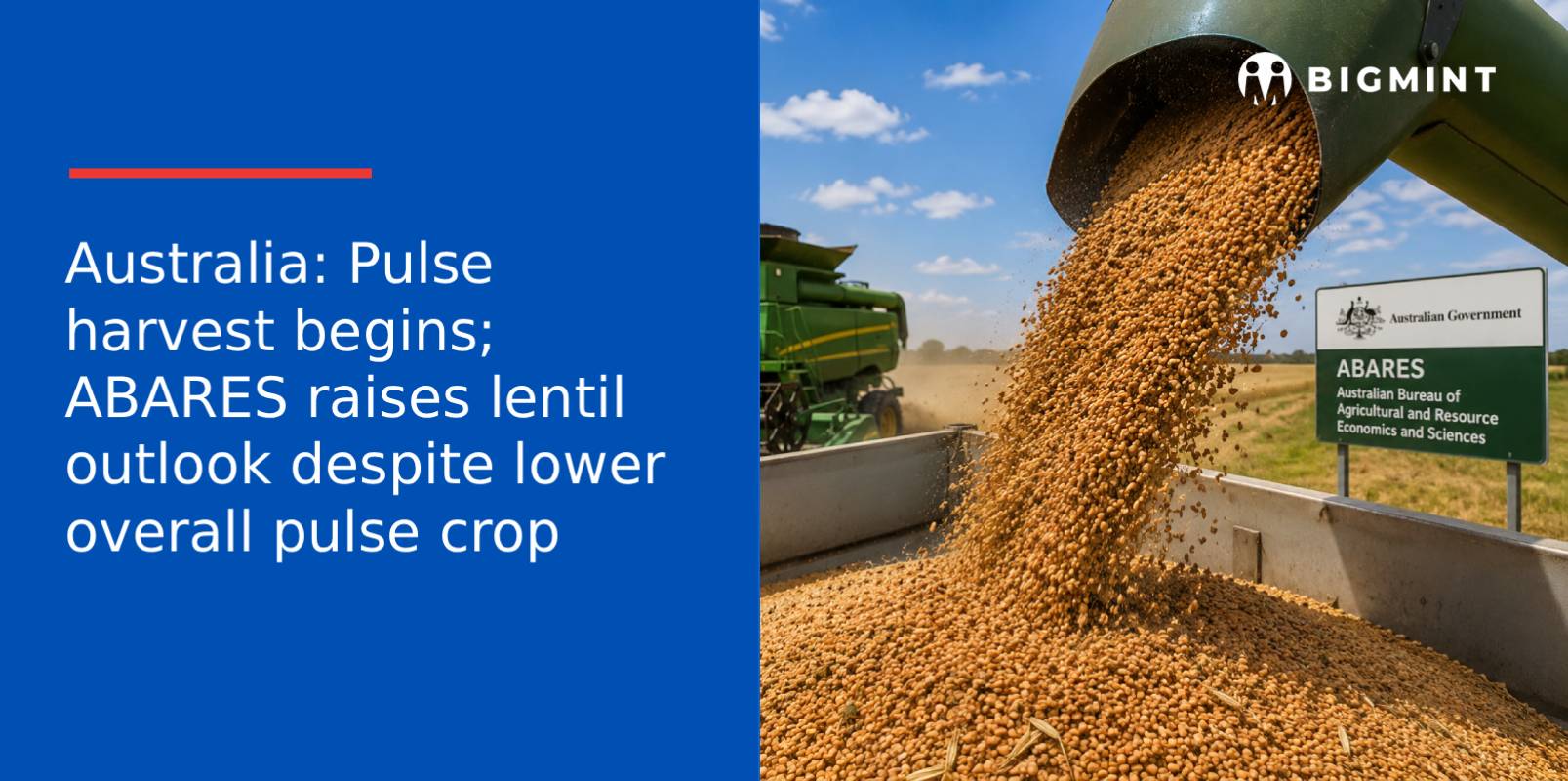
Australia’s 2026-27 winter pulse harvest has begun with chickpeas in Central Queensland, while recent rainfall has improved yield prospects across key growing regions. At the same time, the Australian Bureau of Agricultural and Resource Economics and Sciences (ABARES) has made minor revisions to most pulse crops in its latest quarterly crop report, raising its lentil production forecast while lowering overall pulse output after cutting its lupin estimate.
ABARES now forecasts Australia’s total pulse production at 5.445 mnt, down from the 5.595 mnt projected in June. The revision was driven primarily by a lower lupin forecast, while chickpea, faba bean, field pea and lentil estimates were changed only marginally.
Chickpea
Chickpea prices are higher than in late July as harvest begins, supported by limited farmer selling and expectations of a smaller crop following dry conditions in southern Queensland and northern New South Wales.
According to ABARES, Queensland’s chickpea area is estimated at 380,000 ha, down 25% from last year, with production forecast at 0.57 mnt, down 42% year-on-year and below the earlier estimate of 0.65 mnt. In New South Wales, chickpea area is estimated at 345,000 ha, down 47% from last year, while production is forecast at 0.45 mnt, representing a 62% decline from the previous season.
Recent 30-40 mm rainfall across key growing areas of NSW has nevertheless improved yield prospects. Fallow-planted chickpeas are expected to yield around 2 t/ha, while later-planted double-cropped chickpeas are expected to yield at least 1 t/ha, with potential to reach 1.5 t/ha. These later crops have yet to flower, while earlier fallow-planted crops have already entered the flowering stage. Mild winter temperatures and timely rainfall have improved flowering and pod development, supporting production potential despite the smaller planted area.
Australian chickpea exports remain modest, with Pakistan continuing as a key buyer, while India is currently not a major source of demand.
Lentil
Lentil prompt prices have eased from late July, while crop prospects in South Australia and Victoria continue to improve. Farmers are clearing storage space ahead of an expected large harvest, with new-crop selling underway in South Australia but yet to begin in Victoria.
In its latest crop report, ABARES revised Australia’s 2026-27 lentil production forecast slightly higher to 2.25 mnt from 2.208 mnt projected in June, extending expectations for another record crop.
ABARES forecasts Victoria’s lentil production at 933,000 t from 533,000 ha, representing increases of 0.8% and 0.6%, respectively, from last year. The agency said the state is expected to surpass last season’s record production of 925,000 t, supported by an ideal start to the growing season and continued expansion of cropping into grazing areas. South Australia’s crop is forecast at 1.2 mnt from 600,000 ha, also exceeding last year’s record production of 1.11 mnt.
Outlook
While lentil prospects have improved, ABARES lowered its lupin production forecast to 1.05 mnt from 1.21 mnt projected in June after below-average winter rainfall reduced soil moisture and prompted a cut in yield expectations across Western Australia. Yield estimates for the state were revised down to 1.91 t/ha from 1.98 t/ha previously. Faba bean and field pea forecasts were revised only marginally.
Australia’s pulse harvest is beginning with contrasting regional conditions. Recent rainfall has improved chickpea yield prospects in northern New South Wales, while favourable seasonal conditions continue to support expectations for another record lentil crop in South Australia and Victoria. The market will now focus on harvest progress, farmer selling and whether favourable growing conditions translate into the record lentil production forecast by ABARES.
Leave a Reply