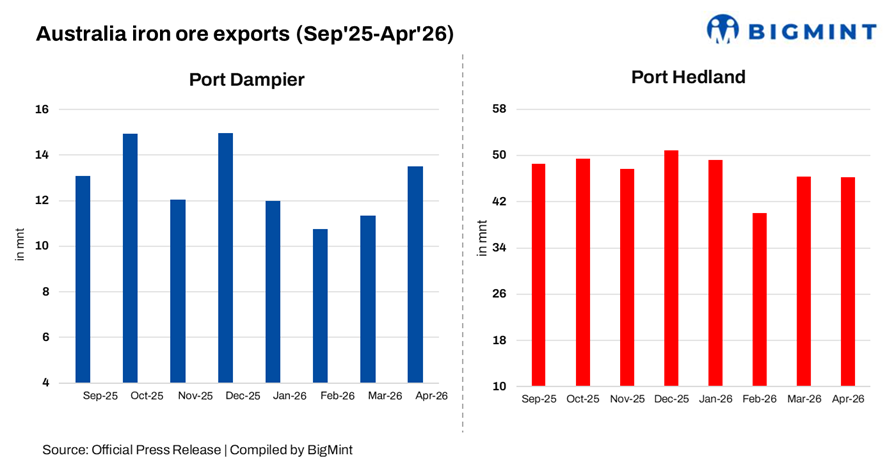
- Port Dampier shipments rise on stronger Rio Tinto cargo movement
- Port Hedland upgrades to boost long-term export efficiency
Australian iron ore shipments through major export ports totalled 59.77 million tonnes (mnt) in April 2026, up 3.6% m-o-m from 57.7 mnt in March, supported by steady mining output and improving port operations, according to port export data.
Port-wise iron ore shipment:
- Port Hedland: Iron ore shipments from Port Hedland – the world’s largest bulk export hub – edged down marginally by 0.17% m-o-m to 46.27 mnt in April 2026 against 46.35 mnt in March 2026. Despite the slight decline, recent developments at the port indicate a strong long-term focus on improving export efficiency and operational resilience. Authorities, along with major miners are advancing plans for a bypass navigation channel aimed at enhancing operational flexibility and mitigating congestion or disruption risks following recent vessel navigation incidents in the main channel.
- Port Dampier: Port Dampier iron ore shipments rose sharply by 19% m-o-m to 13.5 mnt in the month under review against 11.35 mnt in March 2026, reflecting stronger cargo movement from major miner linked operations and improved vessel turnaround efficiency. The increase highlights the continued resilience of Australia’s iron ore supply chain despite periodic weather-related disruptions and maintenance activities across the Pilbara region. Ongoing infrastructure initiatives and steady export activity also reflect expectations of sustained iron ore demand from Asian steelmakers.
Outlook
We expect Australian iron ore exports to remain strong, supported by ongoing infrastructure upgrades and steady mining activity. However, operations at Port of Dampier will be temporarily suspended at the DCW East and West berths from 18-24 May 2026 for maintenance and deck repair works. This may disrupt vessel scheduling and cargo movement from the Pilbara region, leading to short-term shipment volatility.
Despite these near-term challenges, resilient Asian steel demand, improving port efficiency, and currently stronger export activity are expected to support stable shipment volumes in the coming period.

Leave a Reply