- BHP lifts production guidance y-o-y in FY’26
- Operational recovery boosts Q2CY’25 sales
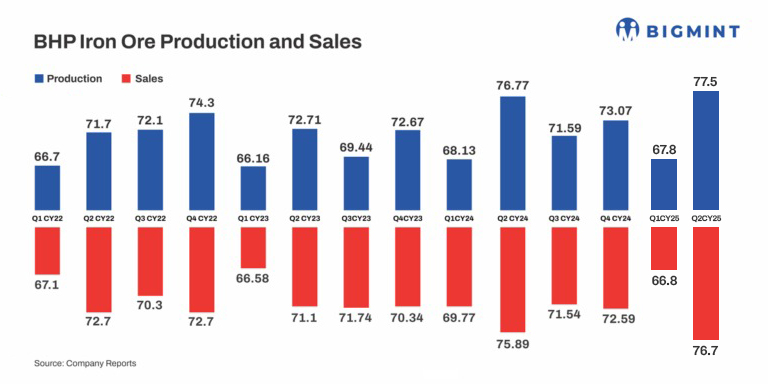
BHP has announced its Q2CY’25 (April-June 2025) results, revealing that iron ore production from all its Western Australia mines totalled 77.5 million tonnes (mnt) on a 100% basis, up by 14% from 67.8 mnt in Q1CY’25. Meanwhile, iron ore sales also increased by 15% q-o-q.
On a y-o-y basis, production remained largely stable (nominally up by 1%). For Samarco, production was reported at 2 mnt, marking a 22% increase from the prior quarter.
The company delivered strong iron ore production, with WAIO producing 290 million tonnes (100% basis) over the past four quarters. This performance was despite early disruptions from Tropical Cyclone Zelia and Tropical Storm Sean. The ahead-of-schedule ramp-up of the second concentrator at Samarco also played a key role in achieving robust output.
Additionally, the planned increase in tie-in activity under the multi-year Rail Technology Programme (RTP1) supported efficient logistics. A robust supply chain performance, marked by record productive movement, further reinforced the company’s operational strength.
Iron ore sales rise
Total iron ore sales from the WAIO region on a 100% basis were recorded at 76.7 mnt in Q2CY’25, representing a 15% increment from 66.8 mnt in Q1CY’25. On a y-o-y basis, sales also inched up 1% compared to 69.8 mnt. Meanwhile, Samarco sales climbed up by 39% q-o-q, standing at 2.01 mnt in Q1CY’25 versus 1.45 mnt in the previous quarter.
The recovery in operations following the cyclone season, improved efficiency, and smoother logistics networks led to higher sales in Q2CY’25.
Other highlights
Production guidance for FY’26 released: BHP’s FY’26 iron ore production guidance from Western Australia has been set at 251-262 mnt (284-296 mnt on a 100% basis), up by a slight 1-2 mnt. Key factors include the planned rebuild of Car Dumper 3 in early FY’26 and continued tie-in work under the Rail Technology Programme (RTP1), both already built into the guidance.
Samarco’s production guidance for FY’26 remains steady at 7-7.5 mnt, higher by about 2 mnt from the previous FY, with expectations leaning toward the upper end of the range.
The Australian financial year (FY) runs from 1 July to 30 June.

Leave a Reply