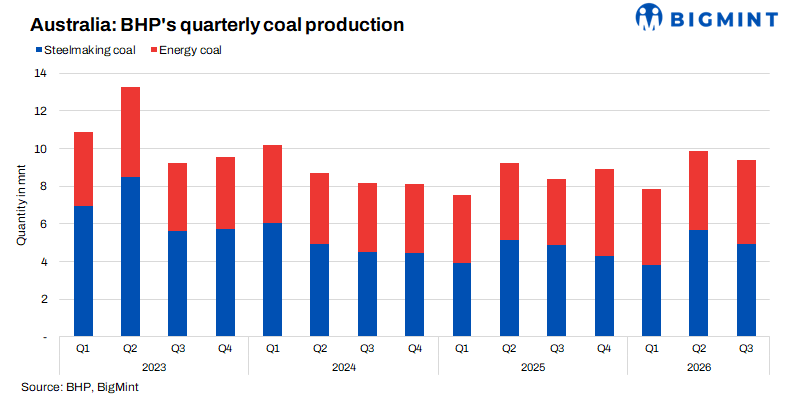
- BMA output remains stable y-o-y at 4.9 mnt despite operational glitches
- NSWEC output rises 26% y-o-y to 4.4 mnt on lower strip ratios, higher wash-plant throughput
BHP’s coal operations delivered a resilient performance in the September 2026 quarter, with production growth across both its steelmaking and energy coal businesses despite operational disruption and a safety-related stoppage at Peak Downs.
The quarter also highlighted an important divergence within the portfolio: while BHP Mitsubishi Alliance (BMA) steelmaking coal production was broadly stable year on year, NSW Energy Coal (NSWEC) recorded a substantial increase as mining moved into lower-strip-ratio areas and wash-plant performance improved.
Resilient start to FY27
BHP reported 4.9 million tonnes (mnt) of BMA steelmaking coal production in Q1 FY27 (Jul-Sep), marginally above the 4.865 mnt produced in the corresponding quarter of FY26. On a 100% basis, BMA produced 9.8 mnt. This result is notable because it was achieved despite a combination of planned operational constraints and an interruption following a fatality at Peak Downs.
The year-on-year stability in BMA production is particularly significant when viewed against the q-o-q decline. Production fell from 5.7 mnt in Q4 FY26 (Apr-Jun) to 4.9 mnt, a 13% sequential decline. BHP attributed the reduction to planned higher strip ratios, scheduled maintenance and the operational impact of the Peak Downs safety incident.
BMA – operational resilience tested by safety and mine sequencing
The most important operational issue for BMA during the quarter was the fatality involving a team member. Following the incident, mining operations were suspended for one week at Peak Downs and for 24 hours across the other BMA operations, with investigations continuing.
The incident places the quarter’s production result in an important context. Maintaining broadly flat y-o-y production despite the suspension demonstrates the flexibility of BMA’s integrated mining system and the benefit of mine sequencing across its portfolio.
At the individual mine level, production performance was mixed. Goonyella produced 1.909 t, up 2% year on year, while Peak Downs produced 1.191 mnt, up 7%. Saraji production declined 4% to 0.846 mnt and Caval Ridge declined 2% to 0.967 mnt.
This mix suggests that BMA was able to offset weaker production at some operations through stronger contributions elsewhere. Such flexibility is strategically important for a large metallurgical coal system where mine sequencing, strip ratios, maintenance cycles and geological conditions can materially influence quarterly output.
BHP’s medium-term objective also remains ambitious. The company retains medium-term BMA production guidance of 43-45 Mtpa on a 100% basis.
The longwall move at Broadmeadow is scheduled to commence towards the end of Q2 FY27, in line with the planned operational sequence and mine development schedule.
NSW Energy Coal emerges as strongest volume performer
The more striking production story came from NSW Energy Coal. NSWEC produced 4.4 mnt in Q1 FY27, an increase of 26% from 3.5 mnt in Q1 FY26.
BHP identified two principal drivers: higher bypass coal as mining progressed into lower-strip-ratio areas, and improved wash-plant throughput.
The q-o-q trend was also positive. NSWEC production increased from 4.2 mnt in Q4 FY26 to 4.4 mnt, a 6% sequential improvement. BHP linked this increase to higher bypass coal and the completion of annual wash-plant maintenance ahead of schedule.
Guidance stability most important signal
Despite the operational disruptions during the quarter, BHP left its FY27 coal production guidance unchanged.
BMA guidance remains 18.5-20.5 mnt, with volumes weighted towards the second half of the financial year. On a 100% basis, the corresponding guidance is 37-41 mnt. NSWEC guidance remains 14-16 mnt, with production weighted towards the first half.
For BMA, the first-quarter production of 4.9 mt represents only the beginning of a year in which management expects volumes to build into the second half. Consequently, the quarter should not be extrapolated mechanically across the full year. The company is effectively signalling that operational sequencing and planned mine activities will produce a different volume profile as FY27 progresses.
For NSWEC, by contrast, first-half weighting means the strong Q1 performance carries greater significance for the annual delivery profile. The 4.4 mnt achieved in the quarter provides a solid foundation against the 14-16 mnt full-year target.
Safety remains critical operational consideration
The production numbers must ultimately be viewed against BHP’s stated safety priorities.
The company’s September-quarter review opened with acknowledgement of fatalities at both Escondida and Peak Downs, emphasising that investigations were underway and that strengthening operational controls remains central to the pursuit of a fatality-free business.
For BMA, the Peak Downs fatality had a direct operational consequence through the temporary suspension of mining. This reinforces a broader principle in mining: production continuity cannot be evaluated independently of safety performance. Temporary production interruptions may be necessary consequences of safety investigations and control reviews, and management’s decision to maintain or adjust production targets must be understood within that framework.
The fact that BHP maintained FY27 coal guidance following the incident suggests management currently views the operational impact as manageable within the existing mine plan. However, the continuation of investigations means safety performance remains a key variable for the remainder of the year.
Outlook
BHP has retained its FY27 production guidance at 18.5-20.5 mnt for BMA and 14-16 mnt for NSWEC. While BMA volumes are expected to be weighted towards the second half, NSWEC production is weighted towards the first half. Execution against production targets, operational stability and safety will remain key factors shaping performance through FY27.
Leave a Reply