- Operations resume at Moranbah, remain on halt in Grosvenor
- Production guidance remains at 10-12 mnt despite uncertainties
Anglo American’s coking coal production experienced a 51% y-o-y decline in the second quarter of calendar year 2025 (Q2CY’25), primarily driven by operational setbacks and the company’s ongoing strategic exit from the steelmaking coal business. While progress was made at select assets, overall output was significantly constrained by site-specific disruptions at key operations.
Production impacted by operational disruptions
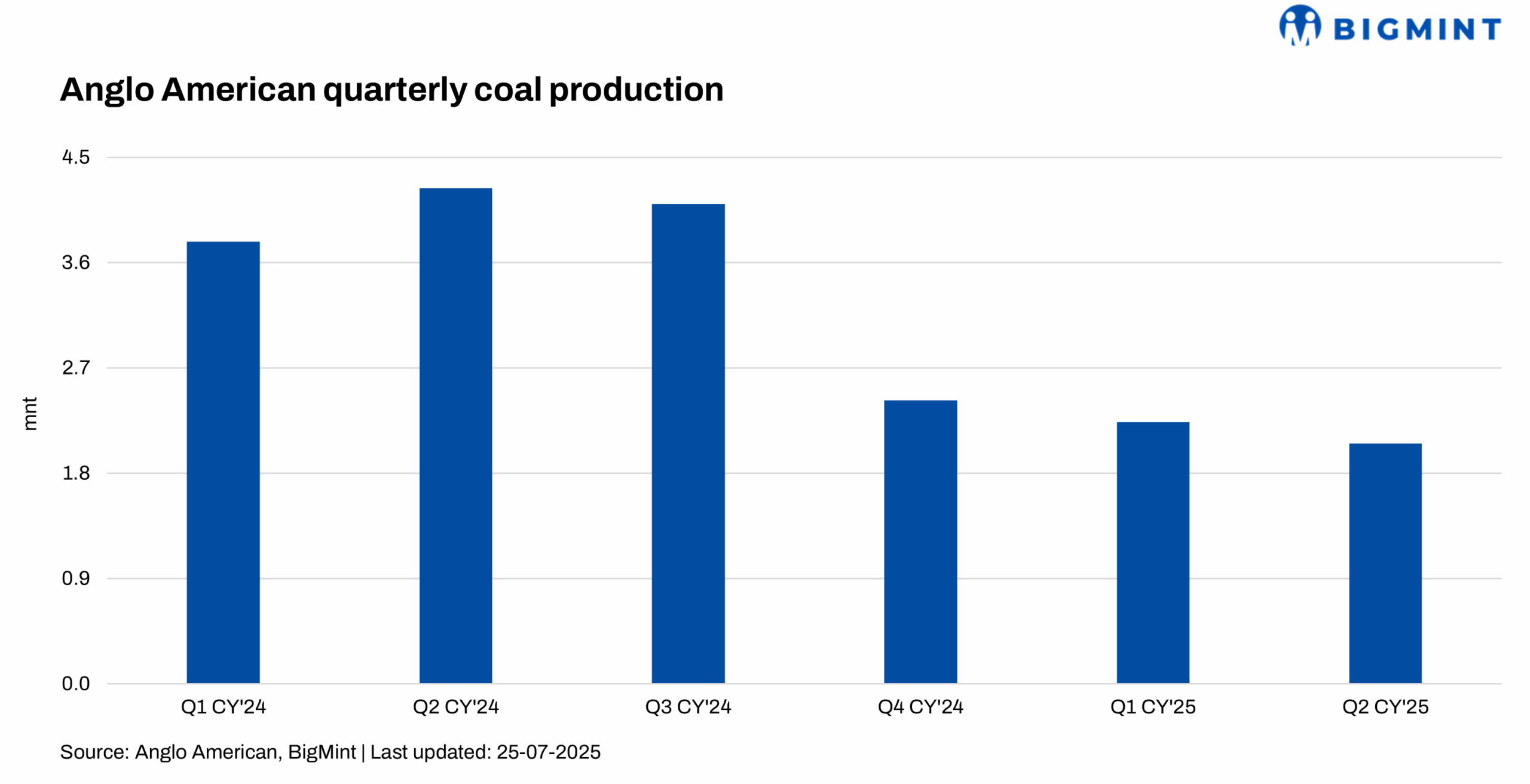
Coking coal production fell by 51% y-o-y to 2.1 million tonnes (mnt) during Q2CY’25. This decline was attributed to the continued suspension of operations at the Grosvenor mine, following a fire incident in June 2024, and a temporary halt at Moranbah North due to an incident in March 2025. Additionally, the company completed the sale of its stake in Jellinbah in January 2025, further reducing reported volumes.
Despite these challenges, production was partly supported by higher output from the Aquila underground mine and improved sequencing at the Capcoal open-cut operation, which collectively contributed to mitigating the extent of the overall production shortfall.
Site-specific production developments
Operations at Moranbah North showed progress during the quarter. Following safe underground re-entry in April, development activities resumed in June. Preparations are underway for a staged restart of longwall production, initially to be conducted via remote operations, pending final regulatory approvals and the implementation of enhanced safety protocols. In contrast, the Grosvenor mine remains fully suspended, with regulatory re-entry yet to be granted.
Meanwhile, Aquila (including Capcoal) recorded a significant y-o-y production increase of 106% to 1.29 mnt in Q2CY’25. This improvement was supported by favourable ground conditions and successful longwall operations.
The Dawson mine contributed 0.62 mnt, maintaining a stable output profile. No production was reported from Grosvenor, and Jellinbah’s volumes were excluded following the sale.
H1CY’25 production plunges y-o-y
For the six-month period ending June 2025 (H1CY’25), Anglo American’s total coking coal output stood at 4.3 mnt, representing a 46% decline from 8 mnt in H1CY’24. The production mix also shifted notably, with hard coking coal accounting for 85% of Q2CY’25 output, up from 78% in the corresponding quarter of 2024. This change reflects the exclusion of lower-grade PCI and semi-soft coal volumes following the Jellinbah divestment.
Strategic exit progresses with asset sale to Peabody
Anglo American is advancing its planned exit from the steelmaking coal business. The company has entered into definitive agreements with Peabody Energy for the sale of its remaining Australian coal assets. Notably, Anglo American has confirmed that the recent incidents at Grosvenor and Moranbah do not constitute a “material adverse change” under the terms of the agreement, and the transaction remains on track.
Guidance maintained
The company has maintained its full-year production guidance for steelmaking coal at 10-12 mnt. This projection excludes contributions from Grosvenor, which remains non-operational. However, the guidance is under close review, given the uncertainties surrounding the timeline for full operational recovery at Moranbah. Additionally, a scheduled longwall move at Aquila in Q3CY’25 is expected to have minimal impact on output.
In view of the constrained output and ongoing price pressures in the seaborne coal market, Anglo American expects to report a negative EBITDA from its steelmaking coal business for the first half of 2025.
Outlook
Anglo American is prioritising the safe restart of Moranbah North, working with regulators through a tripartite forum to enhance safety standards. While Aquila and Dawson are expected to support near-term output, full recovery depends on resuming suspended operations. Meanwhile, the company continues to advance its coal divestment strategy to focus on a higher-margin portfolio.

Leave a Reply