- Indonesian logistics constrain supply despite subdued buying
- Falling Indian stocks cap downside from weak industrial demand
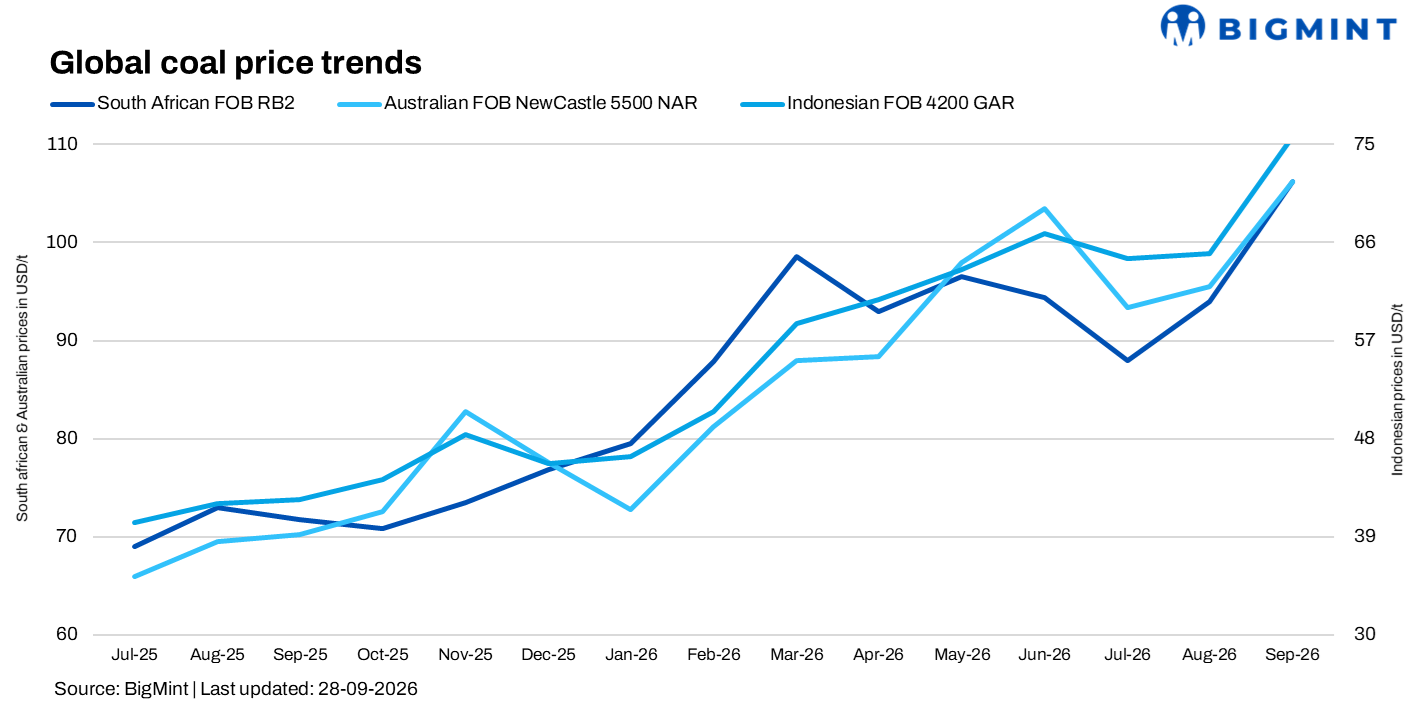
Asian thermal coal markets diverged in the week ending 25 September 2026. Chinese domestic prices returned to their September highs, while seaborne buyers remained selective. Australian 6,000 NAR buyers lowered bids, but 5,500 NAR attracted fresh transactions. Indonesian 4,200 GAR held broadly stable, while Indian portside prices softened marginally amid weak industrial demand.
Supply constraints in Indonesia, limited South African cargo availability, rising India-bound freights, and declining Indian power-plant stocks prevented a broader price correction.
Key thermal coal prices

The previous South African 5500 observation is dated 17 September. GAR and NAR values have not been treated as interchangeable. Bids, offers, assessments and transactions are identified separately.
Indonesian supply remains constrained
Indonesia remained the principal source of supply-side support. Low river levels continued to impede barging in central and eastern Kalimantan, restricting coal movement from mines to loading terminals. Forest fires and associated transport disruptions added to logistics uncertainty.
Additional production quotas were approved for selected mining operations, including a sizeable increase for three units belonging to a major producer. However, the extra quotas had not translated into a visible increase in prompt cargo availability during the assessment week. Market participants also remained uncertain whether revised allocations would provide sufficient export supply through the remainder of 2026 after accounting for domestic obligations.
These constraints enabled miners to maintain October 4,200 GAR offers at $78-80/t FOB despite weaker Chinese participation and cautious Indian buying.
The lower 3,800 GAR segment showed softer indications, including a $64/t bid and an unconfirmed $66/t trade. These prices should not be compared directly with 4,200 GAR values, which remained broadly stable.
Demand for Indonesian mid-CV coal also continued from Bangladesh, Vietnam, and the Philippines, although elevated offers restricted transactions.
China’s domestic market regains strength
Chinese domestic prices reversed the previous week’s correction. Qinhuangdao 5,500 NAR rose RMB 13/t to RMB 996/t, while 6,000 NAR gained RMB 12/t to RMB 1,091/t, marginally exceeding its earlier September high.
Imported-coal tender activity remained visible but inconclusive. Offers for Indonesian 3,800 NAR ranged from RMB 657-705/t DDP, compared with a confirmed award at RMB 638/t in the preceding week. No subsequent award was disclosed, preventing confirmation that buyers had accepted the higher offer range.
Demand slowed ahead of the holiday period, with Chinese utilities reducing their participation in the seaborne market. Stable inventories at major northern ports also limited immediate procurement urgency. Nevertheless, elevated domestic prices preserved the commercial relevance of lower-CV Indonesian imports.
Australian markets split by grade
Australian 6,000 NAR remained in a bid-offer standoff. December bids were heard at $138.50-141.50/t FOB against offers of $146-151/t. No fixed-price transaction was confirmed, following a November trade at $139/t in the previous week.
The 5,500 NAR segment showed greater liquidity. Confirmed October and November Panamax trades were reported at $108/t and $109/t FOB, respectively. These values remained below the $113/t transaction recorded in early September but improved upon some intervening bids.
Australian demand was restrained by limited Chinese engagement. Buyers in Northeast Asia did not show evidence of aggressive restocking, leaving sellers and consumers apart in the high-CV market.
Indian industrial demand weakens
Indian portside Indonesian prices declined INR 50-100/t w-o-w as sponge iron and other industrial consumers restricted purchases to immediate requirements. Sellers were unable to pass higher replacement costs fully into the spot market.
However, India’s inventory position continued to tighten. Coal stocks at major ports declined 2.05% w-o-w to 18.72 mnt during 13-19 September. Non-coking coal stocks fell 3.05% to 12.68 mnt, indicating continued evacuation despite subdued fresh trading.
Power-plant inventories fell to 22.31 mnt by 24 September, equivalent to 38% of normative requirements, with 80 plants carrying critical stocks. Domestic coal receipts remained below consumption, while monsoon-related mining and railway constraints limited inventory rebuilding.
The power sector therefore provided underlying support to imported coal, even as industrial demand weakened. Discussion of renewed imported-coal blending further highlighted the widening gap between power-sector consumption and domestic deliveries.
South African cargoes find alternative demand
South African 5,500 NAR offers stood at $106-110/t FOB Richards Bay against bids of $102-104/t. CFR India offers were around $129-130/t, above buyer targets near $126/t.
Indian sponge iron producers resisted these replacement costs, but Bangladesh remained active for 4,800 NAR cargoes. November transactions at $91-93/t FOB demonstrated continued demand outside India. Limited prompt availability and higher Richards Bay-India freight kept Indian portside RB2 supported despite cautious buying.
Outlook
Asian thermal coal remains divided between constrained supply and selective demand. Indonesian logistics, firm South African availability and rising freights support replacement costs, while weak Indian industrial activity and cautious Chinese procurement limit transactions.
Post-holiday Chinese buying, Indonesian barge movements and India’s power-plant inventory position will determine the next direction. Australian 6,000 NAR requires a narrower bid-offer spread to establish a clear traded level, while 5,500 NAR Australian and lower-CV Indonesian coal remain the more active segments.
Leave a Reply