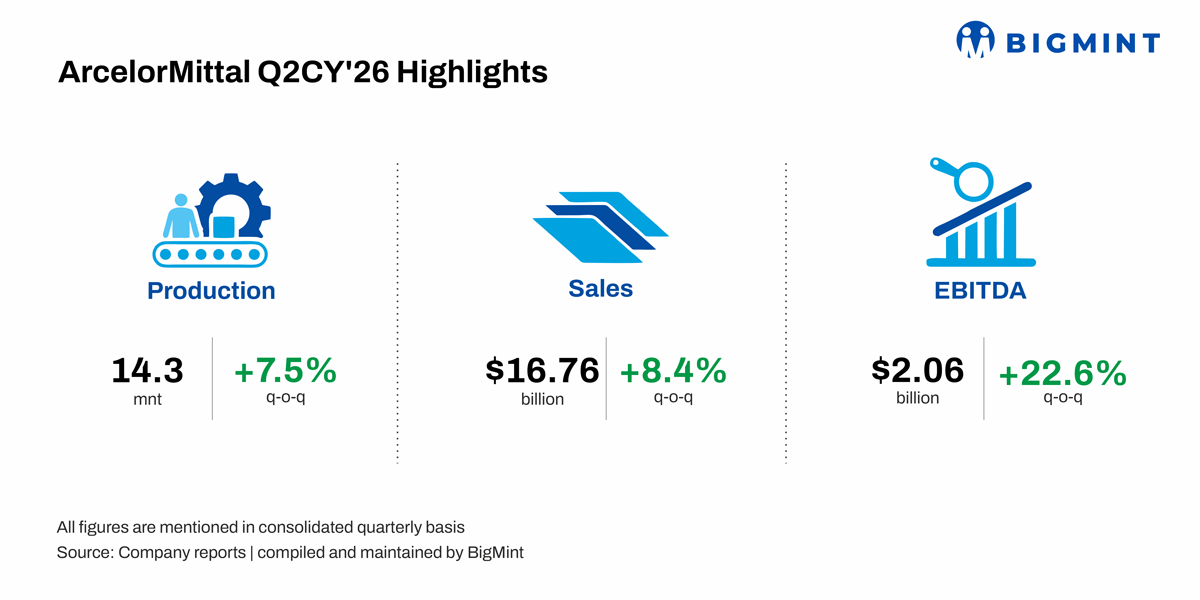
- Crude steel production rises 7.5% q-o-q to 14.3 mnt in Q2 CY’26
- Revenue climbs 8.4% q-o-q to $16.76 bn; EBITDA increases 23% to $2.06 bn
ArcelorMittal has reported stronger financial and operational performance in the second quarter of CY’26, supported by higher steel prices, improved shipments across all steel businesses and a recovery in its European operations following the implementation of the revised EU steel regulation. The company recorded sequential growth in revenue, profitability, crude steel production and shipments, while maintaining its strategic investment outlook and expecting stronger volumes in the second half of 2026.
Revenue rises on stronger prices and shipments
ArcelorMittal’s revenue rose to $16.76 billion in Q2 CY’26, up by 8.4% q-o-q from $15.46 billion in Q1 CY’26 and 5.2% higher than $15.93 billion reported in Q2 CY’25. The growth was primarily driven by a 4.4% increase in average steel selling prices and a 4.1% rise in steel shipments. The company said both steel prices and shipment volumes improved across all steel businesses during the quarter, reflecting stronger demand and healthier market conditions.
Profitability strengthens across steel businesses
Operating performance improved across all steel businesses during the quarter. EBITDA increased by 22.6% q-o-q and 10.8% y-o-y to $2.06 billion, while EBITDA per tonne rose to $155/t from $131/t in Q1 CY’26 and $135/t in Q2 CY’25, reflecting stronger steel margins.

Operating income climbed by 40% q-o-q but declined by 45.6% y-o-y to $1.05 billion, while net income increased by 18.8% q-o-q to $683 million but fell by 61.9% y-o-y from $1,793 million Q2 CY’25.
The improvement from the previous quarter was primarily driven by stronger performance across all steel businesses, although higher foreign exchange losses partially offset the gains. On a year-on-year basis, profitability remained lower due to exceptional gains recorded in the corresponding quarter last year.
Crude steel output and shipments improve
Crude steel production increased by 7.5% q-o-q to 14.3 million tonnes (mnt) in Q2 CY’26 from 13.3 mnt in Q1 CY’26 but was marginally 0.7% lower y-o-y than 14.4 mnt in Q2 CY’25. Steel shipments rose by 4.7% q-o-q to 13.4 mnt from 12.8 mnt, although they remained 2.9% lower y-o-y compared with 13.8 mnt in the corresponding period last year.
Key regional markets deliver stronger quarterly results
North America reported EBITDA of $488 million, up by 27.4% q-o-q and 89.1% y-o-y, driven by stronger steel prices, higher shipments and the resumption of Mexican long-product operations.
Europe delivered the strongest sequential improvement among the steel segments, with EBITDA climbing by 39.1% q-o-q to $697 million, while the y-o-y increase remained marginal at 0.27%, supported by a favourable price-cost effect during the quarter. Crude steel production increased by 10.5% q-o-q to $7.55 billion following the restart of production facilities in Spain and Poland, while improving order books after the implementation of the revised TRQ measures are expected to support stable-to-higher shipments in Q3.
Brazil’s EBITDA increased by 20% q-o-q to $401 million, broadly in line with $407 million reported a year earlier, supported by improved domestic demand, higher steel prices and favourable price-cost spreads.
Meanwhile, AMNS India continued to deliver strong performance. EBITDA rose by 31.8% q-o-q and 28.5% y-o-y to $257 million, while sales increased to $1.66 billion, supported by stronger steel selling prices.
Strategic developments and outlook
ArcelorMittal maintained its 2026 capital expenditure guidance of $4.5-5.0 billion, including $1.7-1.9 billion earmarked for strategic projects. The company expects its portfolio of expansion projects, including investments in India, Brazil, Liberia, electrical steel and renewable energy, to contribute around $1.8 billion in additional annual EBITDA once fully operational.
Looking ahead, management expects shipments during the second half of 2026 to exceed first-half volumes across all business segments, supported by improving demand in Europe following the implementation of the revised TRQ framework and continued contributions from strategic growth investments.
Leave a Reply