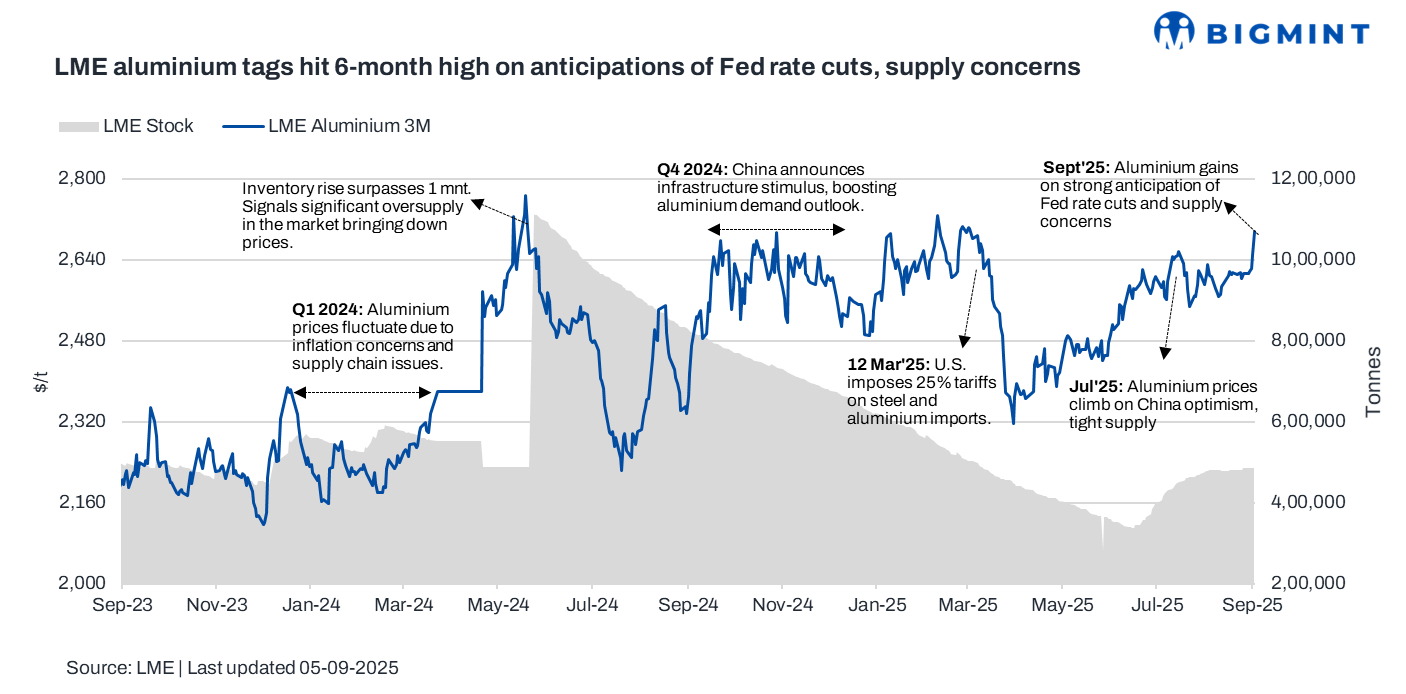
- US regional premiums surge to nearly decade high
- China’s production caps shift market into deficit
Aluminium prices worldwide are surging due to a rare global supply squeeze, rising demand, and US import tariffs under President Donald Trump.
In the US, regional premiums have soared, which reflects the cost above the LME benchmark for local delivery rising by 177% to over $0.70 per pound, almost a decade-high. Base London Metal Exchange (LME) prices have also climbed up by 17% since April, fuelled by Trump’s “Liberation Day” tariffs that impose a 50% levy on aluminium imports.
The price rally is attributed to a combination of constrained global supply and robust demand. China’s long-standing production cap of 45 million tonnes (mnt), originally introduced in 2017 to combat industrial overcapacity, has now significantly altered the global supply balance. As China nears its cap, it is on track to become a net importer of aluminium, which is a dramatic shift for a historically oversupplied industry.
Stockpiles at both the LME’s global warehouse network and the Shanghai Futures Exchange have dropped sharply, with European and North American inventories near all-time lows, and Chinese inventories halving since April. It is expected that the demand from China’s stimulus efforts, combined with limited supply, is expected to drive prices higher through the year-end.
Additionally, as per market participants’ projections, the aluminium market will swing from surplus in 2025 to deficit in 2026, potentially pushing prices to $3,000/t, significantly up from just over $2,700/t now on LME.
Currently, LME aluminium prices are trading at $2,705/t, an almost 6-month high, with stock levels of 485,275 t.

While the US domestic premium has surged primarily due to tariffs, Europe’s premium has risen due to shifts in global trade flows and localised shortages. Market tightness has also been worsened by elevated energy costs in Europe (post-Ukraine invasion), which forced several smelter shutdowns and sluggish capacity expansion in countries such as Indonesia and India.
Adding to the strain, a single trader is reported to control over 90% of LME-available aluminium, squeezing liquidity even further. As of late August, LME warehouse levels were half what they were a year ago, with about 50% of stored aluminium originating from Russia. While many Western buyers have avoided Russian-origin metal post-invasion, it continues flowing into China to meet demand.
Market expectations suggest that the US regional premium could rise further after the seasonal slowdown due to limited US inventory. Meanwhile, imports from Canada — the top US aluminium supplier — are increasingly being diverted elsewhere due to US tariffs. To bypass levies, more scrap aluminium is entering the US market, remelted domestically after being sourced globally.
Leave a Reply