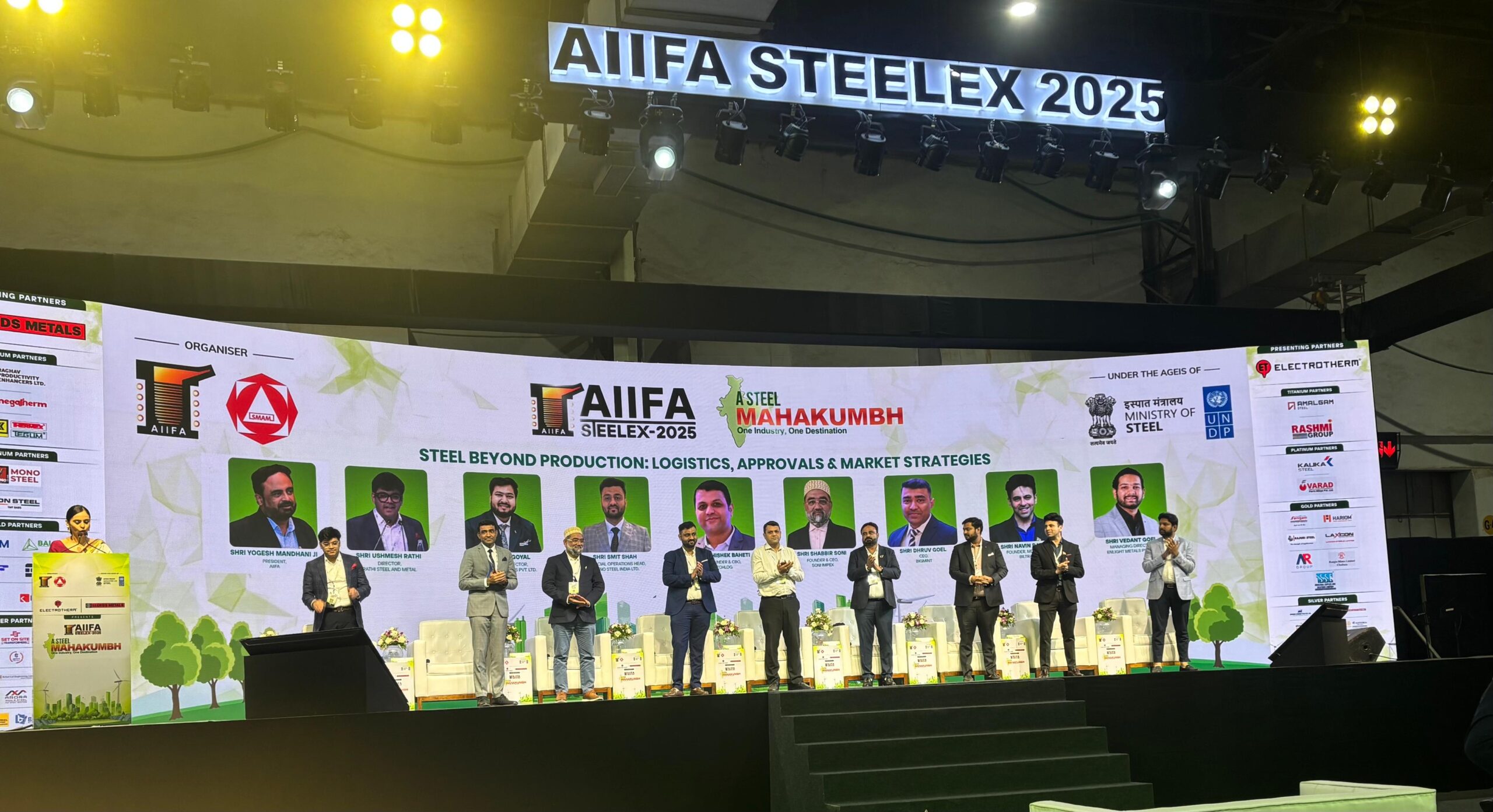
- MOUs for over INR 81,000 crore signed, to create 100,000+ jobs
- Experts stress need for accessible financing, streamlined logistics
The inaugural day of the AIIFA Steelex 2025, held in the Bombay Exhibition Centre, NESCO, on 19 September 2025, delved deep into the evolving dynamics of India’s steel industry by addressing regulatory challenges, sustainability ambitions, and global competitiveness. The event brought together policymakers, industry veterans, technology experts, and academics to lay a robust foundation for the country’s steel future. Highlights included the signing of multiple high-value MOUs in the inaugural session, expert-led panels on green growth and export competitiveness, and discussions on finance, logistics, R&D, and regulatory reforms.
Inaugural session and MOUs
The inaugural session stood out for the signing of MOUs by both prominent steel companies and government representatives, locking in investments crossing INR 81,000 crore and direct job commitments exceeding 100,000 positions. Projects covered new plants, expansions, and advanced material labs, spread across Maharashtra and other states. The MOUs not only signal robust capacity expansion but also reflect strong government-industry synergy aimed at sustainable, high-employment steel manufacturing. Major government subsidies, ease-of-doing-business reforms, and energy transition incentives were announced, making Maharashtra a nucleus of the steel renaissance.

Breaking barriers
This session set the tone for overcoming long-standing obstacles in the steel value chain. Discussions revolved around the urgent need for reforms in GI standards, GST on scrap, and tailored policies reflecting India’s unique ecosystem — rather than blindly adopting global benchmarks. Industry leaders stressed self-sufficiency in raw materials, investment in innovation, and localising standards to avoid stalling small and medium producers. Collaboration between government, academia, and industry to bolster R&D and standards formation emerged as a recurring theme.
Green steel, secondary sector transformation
Focusing on the secondary steel segment and its pivotal role in India’s “green steel” ambitions, this panel analysed the government’s INR 5,000 crore incentive, technological upgrades, and evolving BIS standards. There was a strong call for the sector to build R&D partnerships, especially with leading institutes such as IIT Bombay. Panellists discussed practical pathways to meet ambitious energy efficiency and emissions targets, underlining that workable, localised standards were vital for a level playing field and for harnessing India’s unique resource mix.
Financing growth, exports
Finance was repeatedly described as the “oxygen” for industry growth and competitiveness. Experts from financial institutions and companies discussed the importance of accessible export finance, green bonds, and sustainability-linked loans — critical for scaling up capacity and ensuring Indian steel can meet global environmental standards. Case studies demonstrated how capital market participation unlocks growth, professionalises company management, and enables far-reaching expansions in export markets.
Logistics, market expansion, and outlook
The concluding session spotlighted the logistics challenge. With India’s vast geography and ambitions to increase both per capita consumption and exports, there was a deep dive into upgrading container infrastructure, adopting digital platforms for logistics, and optimising supply chains. Effective logistics and market intelligence were seen as the linchpin of cost competitiveness and export growth — with calls for Indian companies to become more aggressive globally, particularly as competition from countries such as China intensifies.
Conclusion
The event underscored that with robust investments, cohesive government policies, technological innovation, and inclusive forums spanning startups to industry giants, Indian steel stands set for a green, competitive, and globally integrated future. The unprecedented scale of MOUs signed, focusing on both large-scale employment and sustainability, points to a sector ready to set global benchmarks in affordable and responsible production. The consensus: it is time for concrete action, collaborative innovation, and relentless pursuit of both domestic growth and international leadership.
Leave a Reply