- Loss of recoverable iron, handling waste key challenges in ore beneficiation
- Indian mills may need to adopt floatation technology to handle ultra-fine iron ore
- Low-grade iron ore of Fe 52% has been successfully utilised in Hisarna process
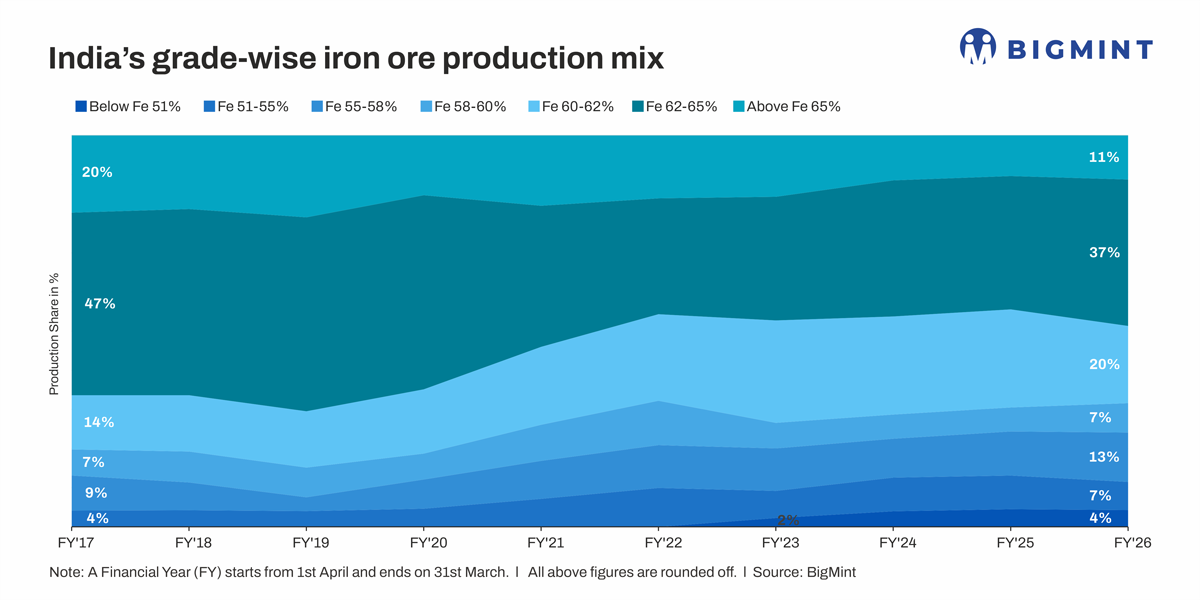
Morning Brief: India’s iron ore production has expanded steadily over the past decade from 194 million tonnes (mnt) in FY’17 to over 313 mnt in FY’26, according to BigMint data. However, the quality mix has deteriorated, posing significant challenges in attaining energy efficiency and emissions standards.
Data for the past 10 fiscal years reveal a stark picture: high-grade Fe 65% ore production, as a share of total production, has declined from 20% in FY’17 to 11% in FY’26, while the share of Fe 62-65% iron ore in total production declined from 47% during the last 10 fiscal years. At the same time, the share of below Fe 55% iron ore has increased from 13% in FY’17 to 24% in FY’26.
The shrinking share of high-grade iron ore poses a direct challenge to DRI-based steel production, and thereby impedes efforts to transition away from higher-emitting blast furnaces. Although the blast furnace as a mature technology is best suited to accept different ore grades, especially low grades, even BF efficiency and emissions are severely compromised by high-gangue Indian ore.
What are the technological options available with Indian steel producers to address this challenge? At BigMint’s India Ferrous Week 2026 (BIFW 2026) held over 19-21 August 2026 in Kolkata, India, Atanu Ranjan Pal, CTO (Process), Tata Steel, explained different aspects of the problem and highlighted technology choices and pathways. Below is an edited version of the key points highlighted:
Problem with beneficiation
People often ask why India is not undertaking beneficiation on a much larger scale. It is not because beneficiation itself is prohibitively expensive. If a steel mill is processing relatively high-grade ore – say around 62% Fe – and the objective is simply to wash the ore, remove kaolinite and other impurities, and improve quality marginally, the cost is roughly INR 1,000/t.
However, the real challenge arises when one is dealing with ore in the Fe 48-56% range and trying to upgrade it to around Fe 60%. In that case, the beneficiation cost itself may increase to around INR 1,400/t. Again, the bigger challenge is yield. A significant quantity of iron is lost as slimes during beneficiation. Disposal of those slimes becomes a major environmental and operational issue.
So, the economics is driven not merely by the cost of beneficiation, but by the loss of recoverable iron and the challenge of handling the waste generated.
Economics of beneficiation
Unless there is a penalty for leaving lower-grade ore unutilised in the ground, very few companies will voluntarily undertake beneficiation. It offers no economic advantage. However, if government policy imposes a cost for leaving Fe 45-58% ore unutilised – for example, through a royalty or penalty mechanism – then the economics begin to change. At present, there is very little incentive. This is particularly true for merchant miners. There is no incentive in spending an additional INR 1,000-2,000/t on beneficiation when miners receive essentially the same selling price in the market. Therefore, policy must carefully consider whether it wants to encourage beneficiation through incentives – the carrot – or enforce it through regulation – the stick.
The real economic issue is the cost of iron ore itself. Today, if NMDC supplies iron ore at around INR 6,000-7,000/t, then an additional beneficiation cost of INR 1,000/t is quite significant. However, many recently auctioned mines carry premiums exceeding 150%. Once production begins, the effective cost of ore could exceed INR 10,000 per tonne. Under those circumstances, spending another INR 1,000-1,500 on beneficiation becomes much easier to justify economically.
Tata Steel’s internal assessments suggest that importing high-grade Fe 65-66% ore from projects such as Simandou could, in some cases, prove more economical than producing expensive domestic ore. If imported ore can reach India in the INR 10,000-12,000/t range, the economics become very interesting. Of course, government policy may ultimately influence these decisions through import regulations. But from a purely economic perspective, beneficiation decisions will increasingly depend on the future cost of iron ore itself, rather than on beneficiation costs alone.
Indian scenario
Most Indian plants are not carrying out true beneficiation. With the exception of a few facilities, including those operated by JSW Steel and Jindal Steel, what is generally being done is washing and scrubbing to remove clay and other impurities. This is quite different from full-scale beneficiation.
According to IBM estimates, India possesses around 20 billion tonnes (bnt) of iron ore resources, beginning with material around Fe 45% and extending to higher grades. If we restrict ourselves to using only Fe 62% ore, the usable resource is actually quite limited. However, if we blend Fe 58-62% ore with higher-grade material to produce an overall feed of around Fe 60%, the usable reserve increases dramatically – from roughly 4 bnt to more than 11 bnt. The remaining 10-11 bnt would eventually require beneficiation if India wishes to fully utilise its resource base.
Mineralogical characterisation
The obvious question is: why has beneficiation been more successful in countries like Brazil and China? The answer lies in mineralogy. Much of Odisha’s ore is goethitic. In these ores, alumina is closely associated with the iron-bearing minerals at the lattice level, making liberation extremely difficult. If the minerals cannot be liberated effectively, recovery declines significantly.
Brazilian ores, by contrast, are much more siliceous. Silica can be separated from iron much more easily, resulting in substantially higher recoveries.
Today, Indian beneficiation plants rely predominantly on magnetic separation. Very few employ flotation. Flotation generally provides better recovery for ultra-fine particles, but it requires greater investment and operational complexity. As high-grade iron ore becomes scarcer in the future, more Indian producers to adopt flotation technology.
Every ore body behaves differently. Some ores are relatively easy to beneficiate. For example, banded hematite quartzite (BHQ) responds quite well to beneficiation because the iron-bearing minerals can be liberated more easily. However, many of the goethitic ores found in Odisha are far more challenging. The iron and alumina are closely associated, making liberation difficult. As a result, recoveries decline significantly.
Therefore, beneficiation cannot be approached as a single technology applicable to every deposit.
Electric smelting furnace
Globally, one of the preferred decarbonisation routes involves producing DRI using either hydrogen or natural gas. However, DRI contains not only metallic iron but also gangue minerals. If DRI is charged directly into an electric arc furnace, those gangue minerals must also be melted. To achieve proper slag fluidity, additional FeO must be generated within the slag, resulting in iron losses and reduced overall yield.
An electric smelting furnace addresses this problem. Instead of melting under oxidising conditions, it operates under reducing conditions. Because the iron is not oxidised to FeO, overall iron recovery improves. The slag can be separated while preserving a much higher proportion of metallic iron.
Consequently, if DRI is to become the dominant ironmaking route, electric smelting furnaces offer a much more efficient way of converting it into hot metal before steelmaking. Of course, introducing another processing step always adds capital cost, so the economics must also be considered.
At present, most operating units worldwide are relatively small. Typical installations are around 80 t. A company such as Tata Steel, however, would require vessels capable of handling approximately 360 t. Scaling the technology from current demonstration plants to that level remains a significant engineering challenge.

Experience with Hisarna
Hisarna has been under development in Europe for almost two decades. It began as a European Union collaborative project. Over time, several partners withdrew, but Tata Steel Europe continued its development.
During the past two years Tata Steel has achieved encouraging progress. The pilot plant now operates continuously at approximately 12/t per hour, equivalent to around 60,000-70,000 t/year. The next step is commercial scale-up. In Jamshedpur, a demonstration facility approximately ten times larger, with annual production of around 600,000 t, is coming up. This project is being developed in collaboration with international partners, including engineering specialists, and represents a major investment – roughly INR 4,000-5,000 crore.
At first glance, that investment appears expensive because the same amount of money could build a conventional 5 mnt BF. However, the real advantage of Hisarna lies elsewhere. Unlike a BF, Hisarna can process much lower-grade iron ore directly, without requiring extensive beneficiation. Virtually the entire mine output can be utilised. Issues such as burden permeability – which constrain BF operation – are far less significant in the Hisarna process. That ability to utilise lower-grade resources is one of its greatest strengths.
Another major advantage is carbon capture. The off-gas contains CO2 at much higher concentrations than conventional blast furnace gas, making carbon capture and storage considerably easier. Tata Steel’s European partners are particularly interested in that aspect because carbon sequestration receives significant policy support in Europe. In India, however, carbon capture currently receives very limited policy incentives.
For Tata Steel, therefore, the principal motivation behind Hisarna is not only decarbonisation but also the ability to utilise lower-grade Indian iron ore.
Tata Steel has successfully injected iron ore with grades down to around Fe 52% into the process. The long-term objective is to develop a process that can efficiently utilise blends containing significantly lower-grade ore.
The Hisarna route offers one of the most promising approaches for directly utilising lower-grade iron ore. There are, of course, hydrogen-based reduction technologies under development. However, very few have yet been demonstrated at full commercial scale.
With hydrogen injection and several of the other blast furnace decarbonisation technologies, many of the individual concepts have only been demonstrated separately and at relatively small scale. For example, Tata Steel is investigating injecting syngas into the upper part of the blast furnace. Several organisations have experimented with this concept, but nobody has yet implemented it successfully on a large industrial blast furnace.
Tata Steel is also examining the conversion of blast furnace gas into syngas and recycling it back into the furnace. Again, elements of this concept have been tested individually, but not as an integrated industrial system. Another area of work involves plasma heating of reducing gases before injection into the furnace.
Leave a Reply